
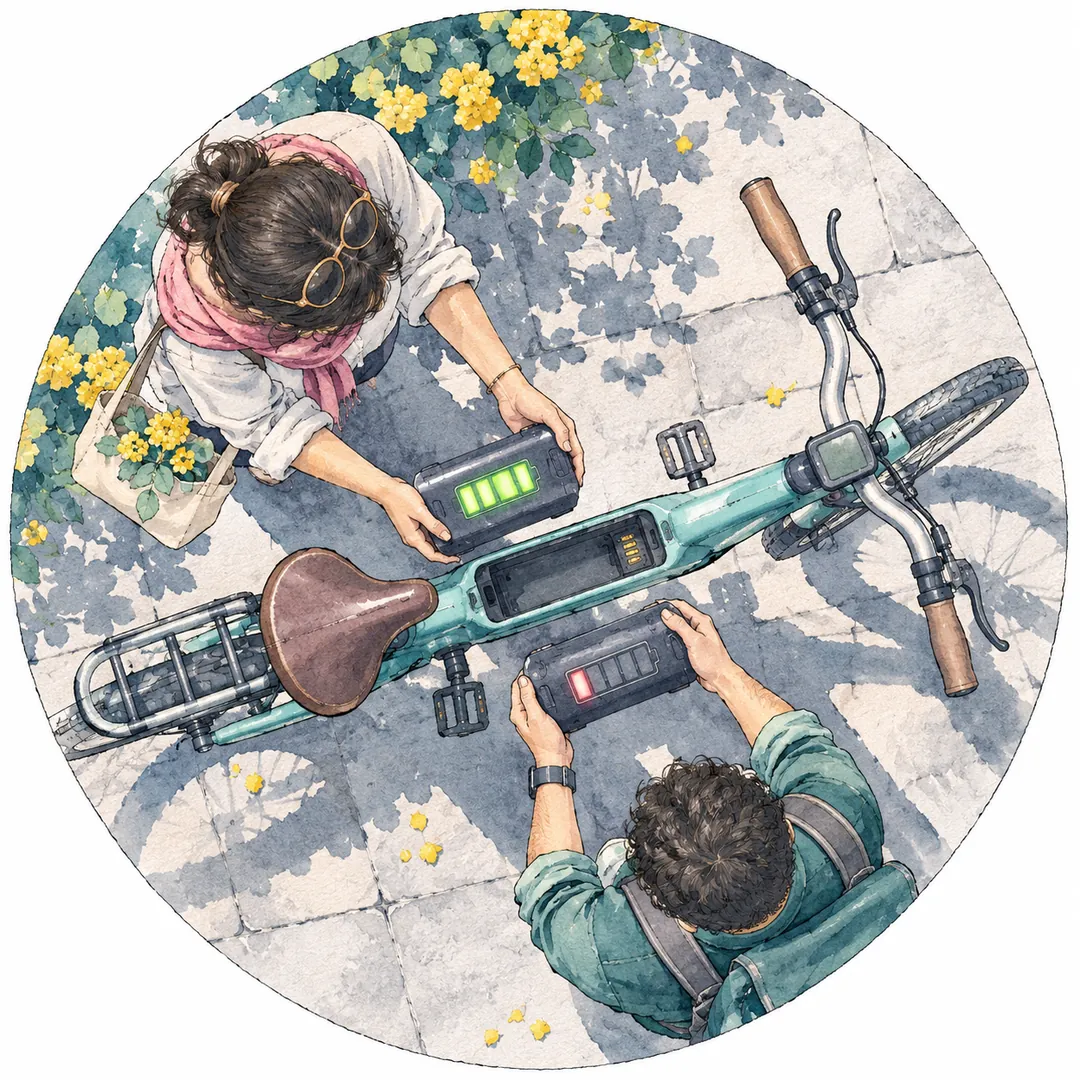
A shared e-bike fleet stays charged in one of two ways: staff swap depleted batteries for charged ones that were charged somewhere else, or each bike charges whenever a rider locks it into a station bay. According to the North American Bike and Scootershare Association’s 2024 operator survey, as summarized by the Great Plains Institute in January 2026, swapping is the current industry standard and in-dock charging looks like the future for station-based systems. For a host, the choice decides whether the site needs power, where loose batteries are charged and stored, how often a service van visits, and which fire-code approvals apply.
This guide compares the two models on the questions hosts, campuses and cities ask, using an operator survey, a city pilot and model code text. It says plainly where Colibrino stands: its own stations use docked charging. That is stated so you can weigh the rest of the page knowing it, not as a reason to skip the comparison.
Two ways to keep a shared e-bike fleet charged
Battery swapping moves energy to the bike by hand; docked charging moves it through a wire in the station. Everything else that differs between the models follows from that.
Battery swapping means replacing a bike’s depleted battery with a charged one. The Great Plains Institute describes the usual form: operations staff bring fully charged batteries to the bikes, sometimes drawing on strategically placed charging cabinets, and swap out the depleted ones (Great Plains Institute, January 14, 2026). The depleted batteries then go back to be charged, usually indoors at a depot or inside a cabinet.
Swap cabinets are a variation in which riders do the swap themselves. A rider opens a locker, leaves a depleted battery to charge and takes a charged one. New York City tested this in 2024 for delivery workers’ own e-bikes, as described below.
Docked charging, also called in-dock charging, means the bike charges through a connection in the dock as soon as it is returned. The Great Plains Institute says this “substantially reduces the operational capacity needed to keep fleets charged,” and that docks can be powered from the grid, from solar panels or from both.
Hybrid systems mix the two. Some stations are electrified and others are not, and staff swap batteries on bikes that end up away from a charging dock. Dockless systems, where bikes are not returned to a station at all, have only one option: the Great Plains Institute notes that for them, battery swapping is the only available strategy.
| Model | Who moves the energy | Where batteries charge | When a bike gets charged |
|---|---|---|---|
| Staff swapping | Operations staff, by vehicle or on foot | A depot or charging cabinets | When staff reach the bike |
| Swap cabinets | Riders, at the cabinet | Inside the cabinet | When a rider makes the swap |
| Docked charging | The station’s wiring | In the bike, in the bay | Whenever the bike is docked |
| Hybrid | Both | Bays at some stations, plus a depot | Docked or swapped, depending on where the bike is |
Terms used in this guide
- Battery management system (BMS): the electronics inside a battery pack that watch its cells and stop charging when something is wrong. NYC DOT’s report describes one pilot provider’s batteries as having a BMS that prevents overcharge, over-discharge, over-temperature and voltage imbalance.
- Fire code official: the local official, often in the fire department or fire marshal’s office, who interprets and enforces the fire code for your building.
- Listed and labeled: tested and certified to a named standard by a testing laboratory, with a mark on the product.
- UL 2849 and UL 2271: the standards e-bike electrical systems and e-bike batteries are certified to; NYC DOT calls UL 2271 “UL’s standard for e-bike batteries,” and the 2027 code text requires e-bikes to be listed to UL 2849. The difference is explained in UL 2849 vs UL 2271.
- UL 4900: the standard for micromobility charging equipment, as New York City’s Department of Buildings describes it.
- UL 1487: the standard for battery containment enclosures, which the same bulletin describes as products that enclose lithium-ion batteries and are intended to mitigate heat, fire and deflagration hazards.
What operators and pilots have found
The evidence is thin but consistent: swapping dominates today, docks are where station-based systems are heading, and a New York City pilot that tested both side by side found its riders preferred quick swaps to two-hour plug-in charging. Each source needs its context, because none of them describes a small community station directly.
The operator survey
The Great Plains Institute reports that, according to NABSA’s 2024 survey of bikeshare operators, battery swapping is the current industry standard for keeping bikes charged. The same article says that while swapping dominates, “the future for station-based bikeshare systems looks to be in-dock charging.” It also reports NABSA’s figure that of nearly 140 million bikeshare trips in North America in 2024, 46 percent were made on e-bikes.
That second figure is why charging has become a central operating question. NACTO’s snapshot of 2023 found a similar share for the United States alone: e-bike trips were 46 percent of all station-based bike share trips, while e-bikes made up a third of the station-based bikes available, and trips on station-based e-bikes grew from 20 million in 2022 to 28 million in 2023 (NACTO, July 2024). More e-bike trips mean more energy to put back every day, by one model or the other.
New York City’s charging pilot
The New York City Department of Transportation ran a public e-bike charging pilot from March 7 to September 7, 2024, with battery swapping extended through February 2025 (NYC DOT). It placed battery-swapping cabinets from two providers and charging docks from a third at five public sites, and enrolled 118 delivery workers who received unlimited free charging.
The headline results, from NYC DOT’s report:
- 12,100 battery swaps over the pilot, against 1,300 charging dock sessions
- a 35 percent reduction in participants charging batteries at home, and no fire incidents during the pilot
- 62 percent of registered dock users had stopped using the docks by the end of the program, while the swap services kept their users
- one site, in a busy restaurant district, accounted for 59 percent of all transactions, and the most remote site for 2 percent
What the pilot does and does not tell a host
Read the pilot for what it tested. Its users were delivery workers riding their own e-bikes, and at the docks they plugged a charging cord into their own battery, so a dock session was a stop of its own rather than the end of a trip. The report says riders saw the docks’ 2-hour charging time as too long compared with quicker swaps, and that many believed the docks delivered less power when more than one bike was plugged in.
A shared bike share dock works differently: the rider’s trip ends at the bay, and the bike charges while it waits for the next rider. The pilot’s lesson for a host is not that docks fail. It is that charging has to fit how riders use the bikes, that power at the site has to be adequate, and that operators who stay in close contact with riders get better care of the equipment, a point NYC DOT made about the swap providers.
Why the pilot matters to building owners
The pilot’s strongest finding was about where batteries are charged, not which hardware won. Before it began, 81 percent of the test users charged their e-bike batteries at home, and 41 percent went home between shifts to recharge. Comparing surveys at the start and midpoint, NYC DOT found a 35 percent reduction in charging at home, and a 50 percent drop in riders carrying spare batteries.
NYC DOT’s first lesson reads: “Public charging infrastructure can reduce fire risks,” because fewer lithium-ion batteries are charged indoors. For an apartment community or a campus, the same logic applies to any program in which the operator, not the rider, charges the battery outside the building. Both swapping and docked charging can do that; what matters is that riders never need to take a battery home. The safety page explains how that rule shapes a station program.
What nobody has measured yet
No source we found compares fire incidents, labor hours or costs between swapping and docked charging across real bike share systems. The operator survey reports what operators do, not how the two models perform against each other. The New York pilot recorded no fires, but it ran for six months with 118 users, which is too small a sample to say anything about fire rates.
So any claim that one model is safer than the other should come with its evidence. The safety differences this guide describes are about where batteries are charged and stored, and what the code asks of each place, not about measured incident rates.
Field labor and van trips: what swapping asks of an operator
Swapping turns charging into fieldwork. Someone has to find the bikes that need a battery, carry charged batteries to them, and bring the depleted ones back to charge, every day the fleet runs.
The Great Plains Institute calls this the biggest downside of swapping: the “enormous amount of time it takes operations staff to identify, locate, and replace depleted batteries,” which it says results in “huge operational costs that did not previously exist with standard bikeshare bikes.” Swap cabinets shift some of that work onto riders, but not all of it. In New York’s pilot, the providers were fully responsible for maintenance, monitored their cabinets remotely and carried out weekly in-person inspections, and riders still reported times when there were not enough fully charged batteries and they had to take partly charged ones.
The amount of fieldwork follows directly from how much energy riders use. That can be estimated before any bikes arrive.
Example (fictional). Larkspur Commons, a fictional 240-home apartment community, plans for 135 rides a week with a typical trip of 1.8 miles: 243 miles a week. At 15 Wh per mile, the planning assumption the site’s charging cost calculator uses, that is about 3,645 Wh, or 3.6 kWh, put back into batteries each week. Suppose each battery holds 400 Wh, the range estimator default, and staff swap it when about a quarter is left, so each swap delivers about 300 Wh: that is about 12 swaps a week, or about 6 a visit if staff come twice a week. Under docked charging, the same 3.6 kWh flows through the bays as riders dock, and service visits are for inspections and repairs rather than for charging. All of these numbers are invented for the example.
The example shows something a host should ask any operator about: in a small network, the energy to replace each week is modest, but under swapping it has to be carried. A van trip, a staff hour and a charged battery stock are needed whether the week has 12 swaps or 120.
A second stock of batteries
Swapping only works if charged batteries are waiting when depleted ones come off, so a swap fleet owns more batteries than bikes. Those extra batteries are charging, cooling or sitting on a shelf at any given time, and each one has to be tracked, inspected and eventually recycled.
In New York’s pilot, the swap cabinets would charge only their own provider’s batteries, and one provider’s cabinets checked each battery’s serial number before charging it. That kind of control is what makes a shared battery stock manageable, and it is worth asking any swap operator how its batteries are tracked.
What a host sees under each model
Under swapping, a host sees service visits on a schedule set by battery levels, and possibly a charging cabinet on site. The batteries that are not in bikes live somewhere else: in the operator’s depot, or in a cabinet on the host’s property.
Under docked charging, a host sees a station connected to a circuit and service visits on a schedule set by inspections, repairs and rebalancing (moving bikes between stations when one runs empty or full). The maintenance and rebalancing page describes what those visits cover. Batteries stay in the bikes except when one is pulled for service.
Power at the site: what docked charging asks of a host
Docked charging needs electricity where the bikes park, and swapping mostly does not. That is the docked model’s main cost to a host, and for a compact station it can be checked against a single ordinary circuit.
A station’s load is the number of bikes charging at once times the power each charger draws. The station power calculator works through it with its default example: 8 bikes on a 20-amp, 120-volt circuit, each charger drawing 100 W, gives an 800 W peak, which is 41.7 percent of a 1,920 W planning limit (80 percent of the breaker rating). On a deliberately heavy day, with each bike using 40 percent of a 400 Wh battery, the station draws about 1.51 kWh, and one bike replaces a day of riding in about 1.9 hours. Those are fictional default figures, not the specification of any bike; a licensed electrician confirms the real circuit.
What the electricity costs
The electricity itself is a small line in either model. The charging cost calculator default, a fictional 14-bike fleet riding 1.8-mile trips at 15 Wh per mile, two rides per bike per day and an example rate of $0.13 per kWh, comes to about $3.47 per 30 days for the whole fleet. The calculator’s own note says repairs, parts, batteries, labor and insurance cost far more.
That matters for the comparison. Under docked charging, the host’s circuit carries a load that costs little to run. Under swapping, the same energy is bought at the depot, and what the operator pays for is the labor of moving it.
Where power goes wrong
New York’s pilot is a warning about assuming existing power is enough. NYC DOT chose sites with existing electrical service and created no new power service for the program. Its report says the most significant disruption came from insufficient electrical load at the heavily used site, that cabinet downtime was mostly caused by minor electrical issues such as tripped breakers, and that the docks’ perceived power problems may have had the same cause. Its lessons list says plainly: “Sufficient power connections must be established to meet operational needs.”
The Great Plains Institute describes the same trade-off for bike share. A direct grid connection is the most common and most reliable way to power charging docks, but it can require expensive underground connections, coordination with the local utility and limits on where a station can go. Solar lets a station sit far from a power source, but it says solar power can be unreliable, depends on battery storage capacity, and can be expensive to install.
The host’s side of the power question
For a host, docked charging comes down to four questions an electrician can answer on a site walk:
- Is there a circuit near the spot where the station would go?
- What else already shares that circuit?
- Does the station’s peak load, from the charger labels, fit under the circuit’s planning limit with margin?
- If not, is a second circuit or a dedicated circuit practical, and who pays for it?
Swapping removes those questions from the host’s site and moves them to the operator’s depot, where the same energy has to be put back indoors.
Where batteries live, and how fire codes treat each model
The two models put lithium-ion batteries in different places, and fire codes treat those places differently. Under docked charging, batteries stay installed in listed bikes at the station. Under swapping, a stock of loose batteries is charged and stored in a depot or cabinet, which brings battery exchange, charging room and storage rules into play.
The most direct model code text is Chapter 43 of the forthcoming 2027 International Fire Code, which the International Code Council released early in 2026 so jurisdictions can adopt it by amendment or ordinance (ICC early release). Wyoming’s State Fire Marshal lists the 2024 International Fire Code among the codes the state adopted on June 28, 2024 (Wyoming State Fire Marshal), and the ICC describes the 2024 code’s micromobility section as the predecessor of the 2027 text. Which edition and which sections apply to your site is for your local fire code official to say.
Battery swapping in the code
As printed in the early release:
- Section 4304.8, battery exchange: equipment or facilities providing battery exchange operations must be approved by the fire code official, and under Section 4304.8.1 their charging equipment must be listed and labeled to UL 4900, the standard for micromobility charging equipment.
- Operational permit: the ICC’s model ordinance includes a permit (Section 105.5.5) for facilities providing battery exchange programs or equipment for exchanging lithium-ion batteries. The guide notes this permit category existed in earlier editions.
- Containment enclosures: Section 4304.10 says containment enclosures used for storing or charging lithium-ion batteries must be listed to UL 1487 or specially designed and approved.
- The depot: an indoor room where removed batteries charge is an indoor charging location under Section 4304.2.2, which calls for an automatic sprinkler system, fire detection, enough receptacles for every charger to plug in directly with no extension cords, no combustible storage, no charging in an exit, and 18 inches between charging batteries unless an approved barrier, rack or cabinet isolates them.
- Spare stock: loose batteries on shelves can fall under Section 4303, battery storage, which allows up to 15 cubic feet per fire area in approved containers, cabinets or other approved methods; more than that needs a dedicated indoor storage area with stricter construction rules.
New York City already regulates swap cabinets in detail. Its Department of Buildings’ Bulletin 2025-009, issued August 13, 2025, sets filing procedures for battery containment enclosures, also called e-micromobility battery charging cabinets (NYC DOB). On a public sidewalk, an enclosure needs an electrical permit filed by a licensed electrical contractor, a revocable consent from the city’s Department of Transportation and a letter of no objection from FDNY for the site. On private property it needs a general construction permit filed by a registered design professional as well as an electrical permit. Every enclosure make and model needs FDNY approval, and apart from a transition path for some earlier approvals, the bulletin says each must be listed and labeled to UL 1487. Those are New York City rules, but they show how seriously a fire department may treat a cabinet full of charging batteries.
In New York’s pilot, FDNY also required every provider to cap charging at 95 percent to reduce the risk of thermal runaway, the uncontrolled overheating behind battery fires. The report notes that the cap at first confused users, who thought the equipment was malfunctioning.
Docked charging in the code
Under docked charging, the battery stays in the bike, and the bike itself is the listed product. Section 4304.6.1 requires battery-powered micromobility devices to be listed and labeled to UL 2272 or UL 2849, as applicable, and Section 4304.11.1.1 expects batteries and chargers to be provided as part of the listed device. Section 4304.12 adds that multiple-unit charging equipment that does not meet those rules must be listed to UL 4900, and that its installation location must be approved by the fire code official.
An outdoor station is not an indoor charging location, so the indoor charging room rules do not attach to it, which is one reason to charge outdoors where a site allows. An indoor station in a garage or bike room is an indoor charging location and brings the Section 4304.2.2 list above with it. One more line deserves a question to the fire code official: Section 4304.1.4.1, as printed, says repair or charging operations for business purposes shall not be permitted in R-2 occupancies, which include apartment buildings. It sits under a subsection whose list names industrial equipment, trucks, robots and appliances, so how it applies to a shared e-bike station inside an apartment building is a question to settle before planning one there.
The full treatment of indoor charging rooms, cabinets and the personal-use exception is in Charging e-bikes inside a building: what fire codes now require.
What riders notice under each model
Riders feel the difference mostly in one number: how much charge is in the bike when they take it. Docked charging ties that number to how long the bike has been docked; swapping ties it to how recently staff came by.
Under docked charging
- Returning a bike and charging it are the same step. Nobody has to remember to plug in, and no rider handles a battery.
- The fullest bike is usually the one that has been docked longest. After a busy morning, a station may hold bikes at different levels, and riders learn to pick the one with the most bars.
- Power matters to riders as well as to hosts. In New York’s pilot, users who believed the docks charged slowly stopped using them, even though the provider attributed the complaints to a misunderstanding of how the docks shared power.
Under swapping
- Charge levels vary between visits. A bike that has made several trips since the last swap may be low until staff reach it.
- Cabinets can run short. New York’s swap users reported times when there were not enough fully charged batteries and they had to take partly charged ones, and they asked for more stations and more capacity.
- Battery choice changes the swap rate. NYC DOT found that one provider’s batteries had a shorter range than the users’ own, and said that likely explained that provider’s higher swap count.
- The battery is a removable, valuable object. The pilot recorded thefts of e-bikes with a provider’s battery still attached, and one bike stolen from a dock while charging.
In a shared station program, riders also never see the charging at all, which is part of the point. When the bays do the work, the rider’s only battery task is a glance at the gauge before leaving.
Winter on the High Plains: which model copes with cold
Cold favors charging indoors, which is where swapped batteries charge. An outdoor dock has to respect the battery’s charging temperature limits on every cold night, so a docked program in Cheyenne needs a written cold-weather plan.
Published charging limits generally start at freezing. Bosch gives a charging range of 32 to 104°F for its batteries (Bosch battery safety, US), and the U.S. Fire Administration says not to charge lithium-ion batteries below 32°F or above 105°F (USFA). Each battery maker sets its own limits, and those limits take precedence over any general figure.
The National Weather Service’s 2025 climate summary for the Cheyenne airport shows how often that matters: under the 1991 to 2020 normals, Cheyenne has 170.4 days a year with a low of 32°F or colder and 32.8 days when the high stays at or below freezing (NWS Cheyenne). An outdoor bay will regularly hold a battery that is too cold to charge, whatever the dock is capable of.
The two models answer that in different ways:
- Swapping charges batteries indoors at a depot, so cold mostly affects range and riding, not charging. The cost is that the depot is an indoor charging location with the code duties above. And because cold reduces range (the London Fire Brigade lists reduced range among the effects of cold on lithium-ion batteries), winter can mean more swaps for the same rides. New York’s swap users also asked for weatherproofing on the cabinets.
- Docked charging needs a cold procedure. Colibrino’s, for example, is part of the written winter plan for every site: a frozen battery is never charged, and when the cold keeps a station’s batteries outside the maker’s charging range, the bikes or batteries come into the operator’s charging area to warm up and charge there. The same plan chooses between a full year with a reduced winter fleet and a riding season with winter storage, as described on seasonal operations.
Example (fictional). On a January morning at a fictional Cheyenne apartment station with 8 bays, the overnight low was 5°F, and the bikes docked overnight are too cold to charge under their battery maker’s limits. Under a docked model with a written winter plan, the service visit that morning brings the lowest bikes, or their batteries, into the operator’s charging area to warm up and charge, and returns them once charged. Under a swap model, staff would bring warm, charged batteries from the depot and take the cold ones back. Either way someone makes a trip; the difference is whether the station’s own bays do the charging on the milder days in between. The station, the temperature and the visit are invented for this example.
For what cold does to stored batteries and when a cold battery can be charged, see Storing and charging e-bike batteries in winter.
Side by side: which model fits which host
For a single community station with power nearby, docked charging asks less of the host and the rider on most of the points below: no swap visits, no spare battery stock and no battery handling by riders. For dockless systems, sites without power, or programs whose operator already runs a large depot, swapping is often the practical choice. The table compares the two on the points a host has to sign off on.
| Question for the host | Battery swapping | Docked charging |
|---|---|---|
| Power at your site | Not needed for charging, unless a swap cabinet is placed there | Needed: a circuit an electrician confirms |
| Where batteries charge | Operator depot or cabinet, indoors or enclosed | In the bike, in the bay |
| Loose batteries | A stock of spares, charged and stored | Only batteries pulled for service or cold |
| Field labor | Regular swap rounds plus inspections | Inspections, repairs and rebalancing |
| Rider experience | Charge level depends on the last swap | Charge level depends on time docked |
| Fire-code path | Battery exchange approval, UL 4900 charging equipment, permits, depot charging and storage rules | Listed bikes (UL 2849); approval of any multiple-unit charging equipment; outdoor stations avoid indoor charging room rules |
| Cold weather | Charges indoors; range still drops | Needs a cold-charging procedure |
| Usually fits | Dockless fleets, sites without power, large networks with a depot | Station-based programs at sites with power |
The Great Plains Institute also reports an industry estimate that electrifying about 20 percent of stations in high-traffic areas can keep a large system charged, which is the logic of hybrid networks. It cites unnamed industry experts rather than a study, and it applies to city-scale systems, not to a one-station program.
| If your situation is... | Lean toward | Because |
|---|---|---|
| Bikes must be returned to a station, and a circuit is near the spot | Docked charging | Returning and charging are one step, and no batteries are carried |
| Bikes are dockless or parked anywhere in a zone | Swapping | There is no dock to charge in |
| No power within reach, and trenching is not practical | Swapping, or a station on another spot | Docks need power; swapping moves charging to a depot |
| You would host a swap cabinet on your property | Ask your fire code official first | Battery exchange approval, UL 4900 and UL 1487 questions apply |
| The station would be indoors in an apartment building | Ask your fire code official first | Indoor charging rules, and the business-charging line in Section 4304.1.4.1 |
| Winters are long and cold | Either, with a written cold plan | Docks need a cold-charging procedure; swaps need a depot that meets code |
The neighboring question, whether a program should be docked, dockless or hybrid in the first place, is covered in Docked, dockless or hybrid bike share: which fits a neighborhood?
How Colibrino’s stations charge
Colibrino’s stations use docked charging. Each bay in a compact station locks a bike and charges its battery, so when a rider docks a bike it is also plugged in, and nobody carries a battery anywhere.
The rules around that are written down on the site and in every network plan:
- Riders never charge Colibrino batteries at home or indoors. Batteries charge only in the station bays or in an operator charging area.
- Only the charger made or approved by the bike’s maker is used, plugged directly into the station’s supply, with no extension cords or power strips.
- The station runs from an existing circuit where a licensed electrician confirms capacity for the charging load, and any electrical work is done by a licensed electrician.
- The operator charging area handles the exceptions: batteries pulled for service, and bikes or batteries brought in when cold keeps them outside the maker’s charging range.
- Every bike Colibrino specifies is certified to UL 2849 and every battery to UL 2271, or tested as part of the UL 2849 system.
Colibrino is a new company with no stations running yet, so this is a description of how its stations work, not a record of results. The how it works page walks through the whole system, the charging stations page covers installation and power, and the example network shows a fictional two-station plan with every number worked out.
Questions to ask any operator before you sign
Whichever model an operator proposes, the answers below should be in writing before an agreement is signed. They turn the comparison above into terms you can check later.
- Which charging model will you use at our site, and why? If it is a hybrid, which bikes or stations are swapped?
- Where will spare and depleted batteries be charged and stored? If any part of that is on our property, what equipment, listings (UL 4900, UL 1487) and fire code approvals does it need, and who obtains them?
- What power does the station need? Ask for the peak load in watts, the circuit it will use and what else shares it, and who confirms it. You can check the arithmetic yourself with the station power calculator.
- How often will staff visit, and for what? Swapping, inspections, repairs and rebalancing are different jobs; ask which ones the schedule covers.
- What standards do the bikes and batteries meet? Ask for the UL 2849 and UL 2271 certifications and the testing laboratory that issued them.
- What happens in cold weather? Ask for the cold-charging procedure, the battery maker’s charging limits it follows, and whether the program runs all winter.
- What will riders see? Ask how charge level is shown and what happens when a bike or cabinet runs low.
- What happens at the end? Ask for written end-of-program terms covering removal of the station or cabinet and restoration of the site.
More on stations, standards and power is collected in Charging and batteries. If you want to see how a docked station would fit your own property, Colibrino starts with a site walk, including a power check.