
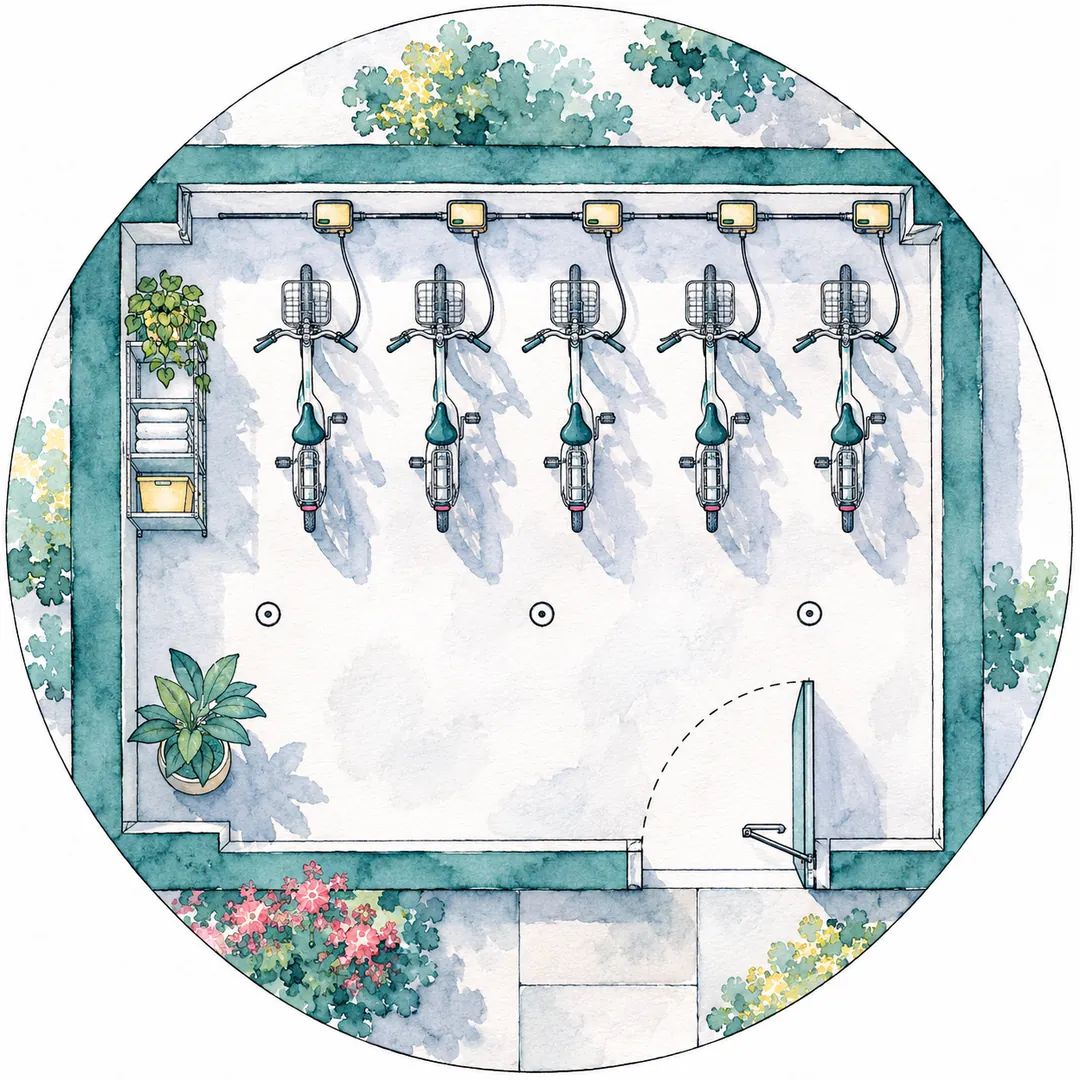
In most apartment buildings, dorms and parking garages, a shared room where several e-bikes charge is regulated by the fire code. The newest model text, Section 4304 of the forthcoming 2027 International Fire Code (IFC), says an indoor lithium-ion charging location needs automatic sprinklers, fire detection, a receptacle for every charger with no extension cords, no combustible storage, nothing in the way out, and 18 inches between batteries, with listed devices and listed cabinets. A resident charging their own e-bike inside their own apartment is exempt from those room rules, as long as the charging spot does not obstruct the way out. Which edition applies depends on what your state or city has adopted, and the local fire code official decides how it applies to your building.
This guide is for property managers, HOA boards, campus housing staff, developers and architects, with Wyoming and Colorado in mind. It quotes code sections only as the loaded source prints them, and it says plainly where the text leaves room for interpretation. It is a reading of public documents, not legal advice, and it does not replace a conversation with your fire marshal.
Which fire code applies to your building
The fire code that applies to a building is the edition its state, county or city has adopted, with any local amendments. The International Code Council (ICC) writes model codes, and its own guide to the 2027 battery chapter is direct about what that means: a model code “has no direct legal effect” and becomes enforceable only when a government adopts it (ICC early release guide). So the first question for any charging room is not what the newest code says. It is which code this building answers to.
Three editions in play
| Edition | What it says about e-bike batteries |
|---|---|
| 2021 IFC and earlier | No sections written for micromobility batteries. The ICC guide notes that the 2021 edition, like 2018, has no Section 320 or Section 322. |
| 2024 IFC | Added Section 320 (storage of lithium-ion and lithium metal batteries) and Section 322 (powered micromobility devices, subsections 322.1 through 322.11). |
| 2027 IFC | Moves battery rules into a new Chapter 43, “Batteries and Battery Powered Equipment and Devices.” Section 4304 “carries forward and expands the 2024 IFC Section 322 micromobility provisions,” in the ICC guide’s words. |
ICC published the early release of Chapter 43 on July 23, 2026, according to its newsroom announcement. The guide warns that “editorial differences may appear in the final document,” and when we checked on November 22, 2026, the ICC store listing for the 2027 IFC named the new Chapter 43 among the edition’s key changes. A trade article in Building Design + Construction, published November 10, 2026, summarizes the same shift: the 2024 edition added micromobility rules in Section 322 “under the general requirements in Chapter 3,” and the 2027 edition widens them (BD+C).
We could not load the 2024 IFC text itself, because ICC’s online code library refused automated requests. This guide therefore describes Section 322 only by its title and place, and it works through the 2027 text line by line. If your building is on the 2024 IFC, ask the fire code official for the Section 322 requirements and compare them with Section 4304, which the ICC calls the refined version of the same framework.
Wyoming
The Wyoming Department of Fire Prevention and Electrical Safety, the State Fire Marshal’s office, states that “the State of Wyoming, on June 28, 2024 adopted the 2024 International Codes,” listing the 2024 International Fire Code, the 2024 International Building Code and the 2026 National Electrical Code among them (Wyoming adopted codes).
Cities and counties can take over enforcement. Under W.S. 35-9-121(a), the state fire marshal delegates authority to a municipality or county that applies, after finding that its locally adopted standards are “equivalent to or more stringent than” the state’s. If a local jurisdiction with that authority fails to adopt, within six months of new state standards, or maintain standards that at least meet the statewide ones, enforcement reverts to the state department. In practice, a Wyoming building answers either to the state’s 2024 codes or to a local code that the statute requires to be at least as strict. The City of Cheyenne’s building safety page refused our automated request, so we have not confirmed the city’s adopted edition or amendments; check them with the city directly.
Colorado
Colorado has no single fire code for every building. The Colorado Division of Fire Prevention and Control lists the 2021 IFC among the codes adopted under 8 CCR 1507-101 for “all property, buildings, and structures subject to the oversight” of the Division. Buildings outside that oversight follow whatever edition their local government has adopted, which may be older or newer than the state’s list. A Front Range apartment building, campus or garage can therefore sit under the 2021, 2024 or a locally amended code, and only the local building and fire offices can tell you which.
Using the 2027 rules before 2027 is adopted
The ICC guide describes how an official can apply Chapter 43 now. Section 102.7 of the IFC lets the fire code official apply nationally recognized standards where the adopted code does not specifically cover a hazard. The alternative materials and methods section (104.8 in the 2024 edition) lets the official approve a design that meets the intent of the code. A design that complies with Chapter 43, the guide says, is an alternative that “in nearly all cases, exceeds the protection the code prescribes.” Jurisdictions can also amend their adopted code or pass an ordinance.
For an owner planning a charging room in 2027, the practical reading is simple: design to Section 4304, then ask the fire code official to confirm what they will require under the code they enforce.
What counts as an indoor charging location
Section 4304 applies to six kinds of battery-powered equipment, including “battery-powered micromobility devices.” The 2027 definition, reproduced in the ICC guide, reads: “Products or equipment that include motorized bicycles, motorized scooters and other personal mobility devices intended for one or more riders powered by a lithium-ion or lithium metal battery.” An e-bike fits that definition. Two exceptions in Section 4304.1 then decide whether a particular charging spot needs the room requirements at all.
Exception 1: batteries under 200 Wh
Section 4304.1 exempts “equipment and devices with batteries with a capacity less than 200 Whs.” Few e-bike batteries are that small. FDNY’s charging guidance gives three common e-bike battery sizes: 48 V and 22 Ah (1.056 kWh), 48 V and 15 Ah (0.72 kWh), and 36 V and 10.4 Ah (0.3744 kWh) (FDNY guidance). To check your own, multiply the volts by the amp-hours on the battery label. The smallest of FDNY’s examples works out to about 374 Wh, nearly twice the threshold.
Exception 2: a resident’s own device at home
The second exception covers “storage, and use of powered micromobility devices, in Group R-2 dwelling units or detached one- and two-family dwellings and townhouses, other than Group R-4, Condition 2 occupancies, provided that such devices are for personal use by its owner. The charging location shall not obstruct the means of egress.”
Three details in that sentence do most of the work:
- It applies inside the dwelling unit. A shared bike room, a garage level or a storage cage is not a dwelling unit, so charging there falls outside the exception.
- It applies to personal use by the owner. A bike owned by a business, a delivery company or a shared fleet is not covered.
- Even exempt charging must keep the way out clear. A bike charging in an apartment’s entry hall, beside the only door, does not meet the last sentence.
How residents should charge inside their own homes, and what warning signs mean they should stop, is covered in our guide to charging an e-bike indoors or overnight. This article stays with shared rooms.
Dorms and other sleeping units
The exception names “R-2 dwelling units.” Building codes describe Group R-2 more broadly. Washington’s version of the building code, for example, defines R-2 as residential occupancies “containing sleeping units or more than two dwelling units,” and lists both apartment houses and dormitories (WAC 51-50-0310). Whether a residence hall room counts as a dwelling unit for this exception is a question for the fire code official, and many campuses set stricter housing rules regardless. Our article on campus e-bike and battery bans looks at those policies, and the student housing page explains how a station keeps shared batteries out of the building.
Charging for a business inside a residential building
Section 4304.1.4.1 says “repair or charging operations for business purposes shall not be permitted” in a detached one- or two-family dwelling or townhouse occupied under the International Residential Code, in R-2, R-3 or R-4 occupancies, or in the sleeping rooms or exit paths of R-1 occupancies. Its parent section, 4304.1.4, names industrial equipment, industrial trucks, robotic equipment and appliances rather than micromobility devices, so how the prohibition applies to a shared e-bike fleet charged inside an apartment building is a question for the fire code official.
Washington’s amendment leaves less doubt. WAC 51-54A-0323 states: “The use of a residential occupancy as a business for the charging of commercially owned powered mobility devices or powered industrial trucks as part of a rental or sales service shall not be permitted.” For an apartment owner weighing a shared e-bike amenity, both texts point the same way: plan the fleet’s charging outside the residential occupancy, and confirm the plan with the official.
The eight requirements for an indoor charging room
Section 4304.2 says indoor charging operations “shall be provided with fire detection, fire suppression and other hazard mitigation measures as required by this section.” Section 4304.2.2 then lists eight requirements that indoor charging areas for lithium-ion and lithium metal batteries must meet, in addition to the general rules in Section 4304.1. Here they are in the code’s order, with what each one tends to mean for a real building.
- Sprinklers (4304.2.2.1). “The fire area containing the indoor charging location shall be protected by an automatic sprinkler system installed in accordance with Section 903.3.” The requirement attaches to the fire area that contains the room, not only the room itself, so ask the official where that fire area’s boundaries are. In a building without sprinklers, this one line often decides whether an indoor room is practical.
- Fire detection (4304.2.2.2). The location “shall be protected by a fire alarm system utilizing a smoke detection system, thermal imaging system or radiant energy-sensing fire detection system.” The code’s term is a fire alarm system, so expect the official to ask how the room connects to the building’s alarm, not just whether a smoke alarm hangs on the ceiling.
- A receptacle for every charger (4304.2.2.3). The room needs “sufficient electrical receptacles to allow the charging equipment for each device to be directly connected to a receptacle installed in accordance with NFPA 70. Extension cords or relocatable power taps shall not be used.” Count chargers, not bikes, and remember that a relocatable power tap is what most people call a power strip. Wyoming’s adopted codes include the 2026 National Electrical Code (NFPA 70), and a licensed electrician does the work.
- No combustible storage (4304.2.2.4). “Combustible materials, combustible waste or hazardous materials shall not be stored in the indoor charging location.” A bike room that also holds boxes, old furniture or cleaning supplies has to choose one job.
- Exits stay clear (4304.2.2.5). “The charging operation shall not be conducted in or obstruct any required means of egress.” Corridors, stair landings and exit passageways are out, and so is a room whose bikes spill into the corridor when it fills up.
- Cabinets (4304.2.2.6). “Removable batteries shall not be stacked or stored in an enclosed cabinet unless the cabinet is listed or is a specially designed battery containment enclosure approved for such purpose.” An ordinary steel locker does not qualify on its own.
- Spacing between removable batteries (4304.2.2.7). At least 18 inches (457 mm) between each removable battery during charging, “unless each battery is isolated from neighboring batteries by an approved fire-resistant material or is within a specially designed rack or cabinet designed and approved for such purpose.”
- Spacing between devices (4304.2.2.8). “Not less than 18 inches (457 mm) shall be maintained between the locations of the batteries on each powered micromobility device” during charging. The distance is measured between batteries, so the layout depends on where each bike carries its pack.
The general rules that come with them
Section 4304.1 and the sections after it add rules that apply wherever covered devices charge:
- Chargers. Charging must follow the device listing and the manufacturer’s instructions, “using only the original equipment manufacturer-supplied charging equipment or charging equipment in accordance with the listing and manufacturer’s instructions” (4304.1.1).
- Ventilation. “Mechanical exhaust ventilation to the exterior shall be provided at the source in the charging location in accordance with Chapter 5 of the International Mechanical Code to prevent the dangerous accumulation of any flammable or other hazardous gases that are produced or discharged by the battery during normal charging operation” (4304.1.2). Ask the official and your mechanical engineer how they read this for a lithium-ion bike room.
- Fire safety plan. A plan under Section 403.10.6 that includes “emergency response actions to be taken upon detection of a fire or possible fire involving lithium-ion or lithium metal battery storage” (4304.5).
- Damaged batteries. “The charging of damaged devices or batteries shall be prohibited” (4304.9).
- Repairs. Repairs happen only “in approved locations outside of buildings or within buildings in areas specifically approved for that purpose” (4304.3).
Example (fictional). Juniper Court is a fictional 60-home apartment building whose residents keep asking where they may charge their own e-bikes. The manager sketches a plan to turn a ground-floor storage room into a charging room for up to 10 personal e-bikes. Walking the eight requirements shows what the plan involves. The building is sprinklered, but the manager asks the fire marshal to confirm that the room’s fire area is covered. Detection means adding the room to the building’s fire alarm system, which needs the alarm contractor. Ten chargers need 10 receptacles; if each charger draws 100 W (an example figure, the same default the station power calculator uses), the room’s peak load is 1,000 W, or 52.1% of a 20-amp, 120-volt circuit’s 1,920 W planning limit, and the electrician still decides the wiring. The stored boxes move out. The layout keeps each battery 18 inches from the next. The manager drafts a fire safety plan and a house rule that damaged batteries are never charged. Before ordering anything, the manager takes the sketch to the fire marshal, because the official decides whether ventilation is needed and how the code applies.
Listed bikes, batteries and chargers
Section 4304.6 says battery-powered equipment “shall be listed and labeled in accordance with this section where applicable.” For e-bikes, Section 4304.6.1 is one sentence: “Battery-powered micromobility devices shall be listed and labeled in accordance with UL 2272 or UL 2849, as applicable.” UL 2849 is the standard for e-bike electrical systems and UL 2272 the standard for other personal e-mobility devices such as e-scooters.
Section 4304.11 then governs the batteries and chargers that go with a listed device:
- Batteries and chargers “shall be provided as part of the listed battery-powered micromobility device. This includes both nonremovable and removable batteries” (4304.11.1.1).
- A replacement battery not provided with the device must be compatible with the listed device “in accordance with the battery-powered micromobility device manufacturer’s instructions” (4304.11.1.2), and the same applies to a single-unit replacement charger (4304.11.1.3).
- “The use of batteries and battery chargers that do not comply with Sections 4304.11.1.2 and 4304.11.1.3 shall be prohibited” (4304.11.1.4).
- Section 4304.4 adds that replacement batteries and chargers “shall be supplied by the equipment manufacturer,” or comply with the manufacturer’s instructions for the certified device.
Listing does not exempt a device from the room requirements. A room full of listed e-bikes still needs sprinklers, detection, receptacles and spacing under Section 4304.2.2. What listing does is narrow the risk that a battery or charger was never evaluated at all. Our article on UL 2849 vs UL 2271 explains what each mark certifies and how to check one. A building that wants these rules in its leases or house rules can read what landlords can require of e-bike batteries.
Charging cabinets, lockers and multi-bike chargers
People shopping for a “fireproof” battery cabinet or an e-bike charging locker will not find either word in the code. The 2027 text names three kinds of equipment, each with its own standard.
Battery containment enclosures (UL 1487)
Section 4304.10 says: “Where provided, containment enclosures for storage or charging of lithium-ion batteries or lithium-ion battery-powered appliances shall be in accordance with one of the following: 1. Listed and labeled in accordance with UL 1487. 2. Specially designed and approved for such purpose.”
New York City’s Department of Buildings explains what these products are in Buildings Bulletin 2025-009, issued August 13, 2025. Citing the UL 1487 definition, it describes a battery containment enclosure, “also known as e-micromobility battery charging cabinet,” as a product that “encloses and stores lithium-ion cells, batteries, battery packs, and battery-powered devices and is intended to mitigate the heat, fire, and deflagration hazards.” The bulletin sets out how New York handles them:
- Every enclosure make and model needs a Letter of No Objection or a Certificate of Approval from FDNY, and under FDNY’s approval guide “every BCE shall be listed and labeled to UL 1487,” with the label readily visible.
- A narrow transition path covered enclosures that received an FDNY letter before March 1, 2025, were amended before September 1, 2025, and had installation applications filed before September 1, 2025.
- Installations inside a tax lot need a general construction permit filed by a registered design professional and an electrical permit filed by a licensed electrical contractor. Installations on a public sidewalk also need a revocable consent from the city’s Department of Transportation.
- The room holding an enclosure is treated as an electrical equipment room and may take the occupancy of the space around it, but where FDNY’s requirements are more restrictive than the construction codes, “the design of the room/space shall follow the more restrictive requirements.”
New York’s process is not Wyoming’s or Colorado’s. It shows the questions an official is likely to ask anywhere: which standard the cabinet is listed to, who certified it, where it sits, and how it is wired.
Multi-bike charging equipment (UL 4900)
Section 4304.12 covers charging equipment that serves several devices: “Battery-powered micromobility device charging equipment that are multiple-unit and do not comply with Section 4304.11.1 shall be listed and labeled in accordance with UL 4900 and installed and operated in accordance with its listing and the manufacturer’s instructions.” It may charge only the devices named in its instructions, and “the installation location shall be approved by the fire code official.” The New York bulletin draws the same line from the other side: it does not apply to equipment whose primary purpose is charging, “as these systems are intended to be covered by UL 4900, the Standard for Safety of Micromobility Charging Equipment.”
Battery exchange
Section 4304.8 says equipment or facilities that provide battery exchange “shall comply with Section 4304.8.1 and be approved by the fire code official,” and Section 4304.8.1 requires their charging equipment to be listed and labeled to UL 4900. How swap programs compare with charging bikes in docks is the subject of our article on battery swapping vs docked charging.
What to ask a cabinet or locker seller
- Which standard is the product listed to (UL 1487 for a containment enclosure, UL 4900 for multi-unit charging equipment), and which certification body listed it?
- Does the listing cover charging inside the enclosure, or storage only?
- Which batteries or devices do the instructions allow, and in what number?
- What electrical supply does it need, and does every charger connect directly to a receptacle?
- Will the seller provide the documents your fire code official will ask for before you buy?
The spacing rules interact with cabinets. Section 4304.2.2.7 allows less than 18 inches between removable batteries only where each is isolated by approved fire-resistant material or sits “within a specially designed rack or cabinet designed and approved for such purpose.” A cabinet sold as fire resistant is not automatically one of those; the official approves it.
How Washington and New York City apply the same ideas
Two jurisdictions already enforce rules close to Section 4304, and comparing them shows which ideas are settled and which still vary.
Washington amended its state fire code with WAC 51-54A-0323, “Powered micromobility devices and powered industrial trucks,” effective March 15, 2024 according to the rule’s history note. It permits charging rooms “where approved,” lists eight conditions much like Section 4304.2.2, requires listing to UL 2272 or UL 2849 (323.3), and requires a fire safety plan (323.5). Its exceptions are wider than the 2027 text: storage, repair and charging of personal devices in residential occupancies, and “charging of a single powered mobility device in any occupancy by its owner.”
New York City works from Section 309.3 of its 2022 Fire Code. FDNY’s public guidance sets a threshold at five devices. For five or fewer, charge away from exits and hallways, plugged directly into a wall outlet, with no extension cords or power strips, no stacked batteries, working smoke and carbon monoxide alarms inside and outside the charging area, and combustible items removed. For more than five devices, use “a dedicated room with ventilation and a self-closing door.” For more than five batteries, FDNY describes “a separate, one-hour, fire-rated and sprinklered room” with a fire-rated, self-closing door. Separation scales with stored energy: 20 kWh “requires at least a 2-foot separation” and 50 kWh “at least a 3-foot separation,” and an approved cabinet or rack can reduce those distances.
| Requirement | 2027 IFC Section 4304 (model code, early release) | Washington WAC 51-54A-0323 (state rule, effective March 15, 2024) | New York City, FDNY guidance on Fire Code 309.3 |
|---|---|---|---|
| Sprinklers | Fire area with the indoor charging location sprinklered (4304.2.2.1) | Not among the section's listed conditions | Separate one-hour fire-rated, sprinklered room for more than five batteries |
| Fire detection | Fire alarm system with smoke, thermal imaging or radiant energy detection | Fire alarm system with air-aspirating smoke detectors or radiant energy detection | Working smoke and CO alarms inside and outside the charging area |
| Power | Receptacle for each charger; no extension cords or power taps | Same | Plug directly into a wall outlet; no extension cords or power strips |
| Combustibles | None stored in the room | Not permitted | Remove all combustible items |
| Exits | Not in or obstructing any required means of egress | Same | Away from exits and hallways |
| Spacing | 18 inches between removable batteries and between battery locations on devices | 18 inches, both cases | 2 feet for 20 kWh, 3 feet for 50 kWh; approved cabinet or rack can reduce |
| Cabinets | Listed to UL 1487 or specially designed and approved (4304.10) | Not used for charging unless specially designed and approved | FDNY approval; UL 1487 listing per Bulletin 2025-009 |
| Device listing | UL 2272 or UL 2849 | UL 2272 or UL 2849 | City law bars sale of batteries not listed by a nationally recognized testing laboratory |
| Personal use at home | Exempt in R-2 dwelling units and houses; exit kept clear | Exempt in residential occupancies; one device by its owner anywhere | Rules start at any number; room required above five devices |
| Business charging in residences | Not permitted in R-2, R-3, R-4 and houses (4304.1.4.1) | Not permitted for rental or sales fleets (323.1.1) | Not addressed in the guidance |
The comparison shows a settled core. Every rule set plugs chargers directly into the wall, bans extension cords, keeps batteries out of exit paths, keeps combustibles out of the room, spaces batteries apart and expects listed equipment. The differences sit at the edges: when sprinklers become necessary, which detectors count, how many devices trigger a dedicated room, and how far a personal-use exception reaches. Those edges are exactly where your local code and your fire code official matter most.
Outdoor charging: what changes when bikes charge outside
The room requirements in Section 4304.2 are written for indoor charging locations. A station outdoors, open to the air and away from the building’s exits, is not one. That takes the biggest retrofit questions, sprinklers and a fire alarm zone, off the table. It does not take the whole code off the table:
- Listing still applies. Devices are listed to UL 2849 or UL 2272 (4304.6.1).
- Chargers still matter. Batteries and chargers come with the listed device or are compatible replacements under the maker’s instructions (4304.11), and charging follows the listing and instructions (4304.1.1).
- Damaged batteries are still never charged (4304.9).
- Multi-unit charging equipment that does not meet Section 4304.11.1 must be listed to UL 4900, and its “installation location shall be approved by the fire code official” (4304.12).
- Electrical work still follows the adopted electrical code, done by a licensed electrician.
- Exits still matter in practice. UL Standards and Engagement advises: “Never charge your device near an exit, as it could block your escape in the event of a fire” (ULSE safety tips). A station belongs beside a door people use, not in front of the exit discharge.
Outdoor charging has its own demands in the Mountain West. Wind, snow and cold shape the hardware, and a battery should not charge while frozen. Colibrino plans its compact charging stations outdoors under a weather hood wherever the site allows, with bays that lock and charge each bike on its maker’s charger, no extension cords or power strips, and a circuit a licensed electrician confirms. Riders never charge Colibrino batteries at home or indoors; the safety page sets out the full rules, including what happens when the cold keeps a station’s batteries outside their charging limits.
Example (fictional). Larkspur Commons is a fictional 240-home apartment community whose network plan puts 2 stations of 8 bays each (16 bays) beside its two lobby doors, with 14 bikes. Its board asked what the same fleet would need indoors. A shared indoor room for 16 bikes would be an indoor charging location: the fire area sprinklered, a detection zone on the fire alarm system, 16 receptacles with no power strips, nothing stored in the room, every battery 18 inches from the next, and a fire safety plan. The fleet would also be charging for a business inside an R-2 building, which raises the Section 4304.1.4.1 question for the fire marshal. Power alone tells part of the story: at an example 100 W per charger, 16 chargers on one 20-amp, 120-volt circuit would draw 1,600 W, 83.3% of the 1,920 W planning limit, while each outdoor station’s 8 bikes draw 800 W, 41.7% of their own circuit’s limit. The board kept the outdoor stations and still sent the plan to the fire marshal for review. The full walkthrough is on the example network page.
Outdoor stations do not settle what residents do with their own e-bikes. Many properties still need an indoor policy, or a compliant room, for privately owned bikes. The apartment communities page explains how a shared station and a personal e-bike policy sit side by side.
Questions to settle with your fire code official
The fire code official, often the fire marshal, is the authority having jurisdiction: the person who interprets the adopted code for your building and approves alternatives. Arrive with a sketch and these questions, and you will save a second meeting.
- Which edition of the IFC, and which local amendments, apply to this building? Will you apply any part of 2027 Chapter 43 through Section 102.7 or alternative methods?
- Is the space we have in mind an “indoor charging location”? Does any exception apply, including the personal-use exception for dwelling units?
- Where are the boundaries of the fire area that contains the room, and is that fire area sprinklered to your satisfaction?
- Which detection technology do you accept (smoke, thermal imaging or radiant energy-sensing), and how must it tie into the fire alarm system?
- How many receptacles do you expect, and does the electrical plan need a separate permit?
- How do you want the 18-inch spacing shown on the plan? Will you approve a specific rack or cabinet to reduce it?
- Does the ventilation requirement in Section 4304.1.2 apply to this room, and what design would satisfy it?
- If the bikes belong to a business or a shared fleet, how do you read Section 4304.1.4.1 for this occupancy?
- What should the fire safety plan include, and who must be trained on it?
- If we choose an outdoor station instead, what location, distance from doors and electrical approvals do you require?
Documents to bring
- A floor plan showing the room, the doors, the exit paths and the proposed charging spots with 18-inch spacing marked.
- A list of the devices and batteries expected, with their certification marks and the battery ratings in watt-hours.
- Charger specifications, including input watts, and the electrical plan from a licensed electrician.
- Product listings and instructions for any cabinet, locker or multi-unit charger.
- A draft fire safety plan with the response steps for a battery fire.
The battery safety checklist turns many of these points into a list you can walk with staff.
What to do next
- Find your code. Ask the local building or fire office which IFC edition and amendments apply, and whether they will apply 2027 Chapter 43 now.
- Decide indoor or outdoor first. Use the decision diagram in this guide. If the only workable indoor room lacks sprinklers or detection, an outdoor station may be the shorter path.
- Walk the room with the eight requirements. The list in this article, plus the battery safety checklist, shows what is missing.
- Check the power. The station power calculator gives a first answer on whether a circuit can carry the chargers. A licensed electrician gives the real one.
- Meet the official with documents. Bring the plan, the device list and the questions above.
- Write the rules down. Put charging rules for residents’ own e-bikes in your house rules, and read the rest of our charging and batteries section for the standards behind them.
If you would rather keep shared batteries out of the building altogether, Colibrino’s engagement starts with a site walk that includes photos and a power check, and its network plan places the station, sizes its circuit and lists anything your fire marshal or insurer requires. You can plan a station when you are ready to look at a site.