
Station power calculator for charging bays
Every bay charges the bike parked in it, so a station is an electrical load. This calculator gives the first answer to whether a circuit can carry it; a licensed electrician gives the real one.
For: Property managers, facilities staff, campus planners and their electricians
Calculator
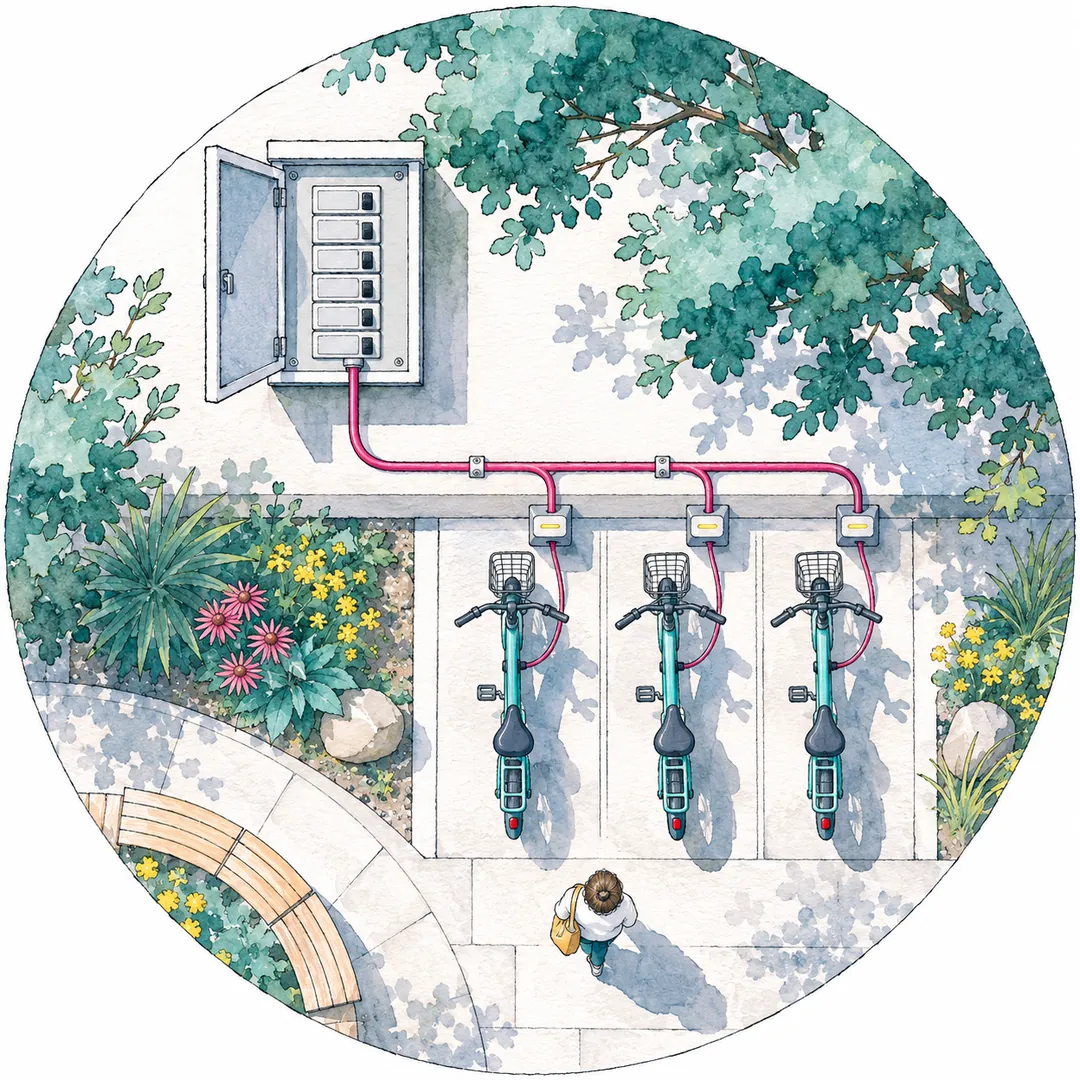
Every bay in a Colibrino station charges the bike parked in it, so a station is an electrical load like any other. Before anything is installed, someone has to answer a plain question: can the circuit carry every charger at once, with margin to spare? This calculator gives a first answer from the charger label and the breaker. A licensed electrician gives the real one.
How to use the calculator
- Bikes charging at the same time: use the number of bays on the circuit. The worst case is every bike docking at once after a busy day.
- Power drawn by one charger from the outlet: on the charger label, input amps times volts, or a measured value. Using the label rating for every charger at once gives a cautious answer.
- Battery size and share of the battery used per bike per day set how much energy has to go back in each day.
- Charger efficiency is the share of energy from the wall that ends up in the battery.
- Circuit breaker rating and circuit voltage come from the panel schedule, confirmed by the electrician.
The method
| Result | Formula |
|---|---|
| Peak load | bikes × charger watts; amps = peak watts ÷ volts |
| Planning limit | breaker amps × volts × 0.8 |
| Share of the planning limit used | peak load ÷ planning limit |
| Bikes that fit under the limit | planning limit ÷ charger watts, rounded down |
| Energy drawn per day | bikes × battery Wh × daily share ÷ efficiency |
| Charging time | battery Wh × daily share ÷ (charger watts × efficiency) |
Why the limit is 80% of the breaker
Planning a circuit at 80% of its breaker rating is a common planning rule for loads that run three hours or more. One bike in the default example recharges in under two hours, but bikes dock one after another through an evening, so a station circuit can stay loaded far longer than any single charge. Planning at 80% is the cautious choice. The licensed electrician decides what the local electrical code requires, what else already shares the circuit and whether the station needs a circuit of its own. Colibrino does not open panels.
The default example, worked through
These are the station power figures from the fictional Larkspur Commons plan: one station’s 8 bays charging on one 20-amp, 120-volt circuit.
- Peak load: 8 × 100 W = 800 W, and 800 W ÷ 120 V = 6.7 A.
- Planning limit: 20 A × 120 V × 0.8 = 1,920 W.
- Share of the planning limit used: 800 ÷ 1,920 = 41.7%.
- Bikes that fit under the limit: 1,920 ÷ 100 = 19.2, rounded down to 19.
- Energy drawn per day: 8 × 400 Wh × 40% ÷ 0.85 = 1,506 Wh, shown as 1.51 kWh; over 30 days, 45.2 kWh.
- Charging time to replace one day of riding: 160 Wh ÷ (100 W × 0.85) = 1.88 hours, shown as 1.9 h.
- Within the planning limit: Yes, with 1,120 W to spare.
The charger watts, battery size and daily use are example figures, not the specification of a Colibrino bike. Use the numbers on the equipment you are checking.
How to read the result
A share under 100% means the chargers alone fit within the planning limit. It does not mean the rest of the circuit is free: lights, a gate opener, a vending machine or a heater on the same breaker count too, and the electrician adds them. If the answer is “No”, the tool tells you how many watts you are over and suggests splitting the bays across two circuits; a dedicated circuit is another option the electrician may propose.
“Bikes that fit under the limit” is a ceiling for power only. The number of bays comes from the fleet size calculator and the space on site.
The daily energy figure assumes each bike uses 40% of its battery every day, a deliberately heavy day for sizing. The charging cost calculator works from rides instead and gives a lower, more typical figure for the electric bill.
Limits and assumptions
This is a planning check, not an electrical design. It does not look at wire size, distance from the panel, protective devices or anything else the local code requires. In a Colibrino station, chargers plug directly into the station’s outlets or a hard-wired supply, never an extension cord or power strip, in line with fire department guidance such as FDNY’s. Batteries are not charged while frozen; the seasonal operations page covers winter.
What to do next
Note the circuit you have in mind on the site assessment checklist, and read how Colibrino installs and powers a station on charging stations. The site walk notes include photos and a power check. To book a walk, plan a station.
Start with one station.
Tell us about the place: how many homes or beds, where people come and go, and where the nearest outlet is. We reply with questions or a time to walk the site with you.