
Compact charging stations for shared e-bikes
The station is where every Colibrino bike locks, charges and waits for the next rider. It is also the only place, apart from an operator facility, where a Colibrino battery is ever charged.
For: Property managers, HOA boards, campus facilities staff and neighborhood groups
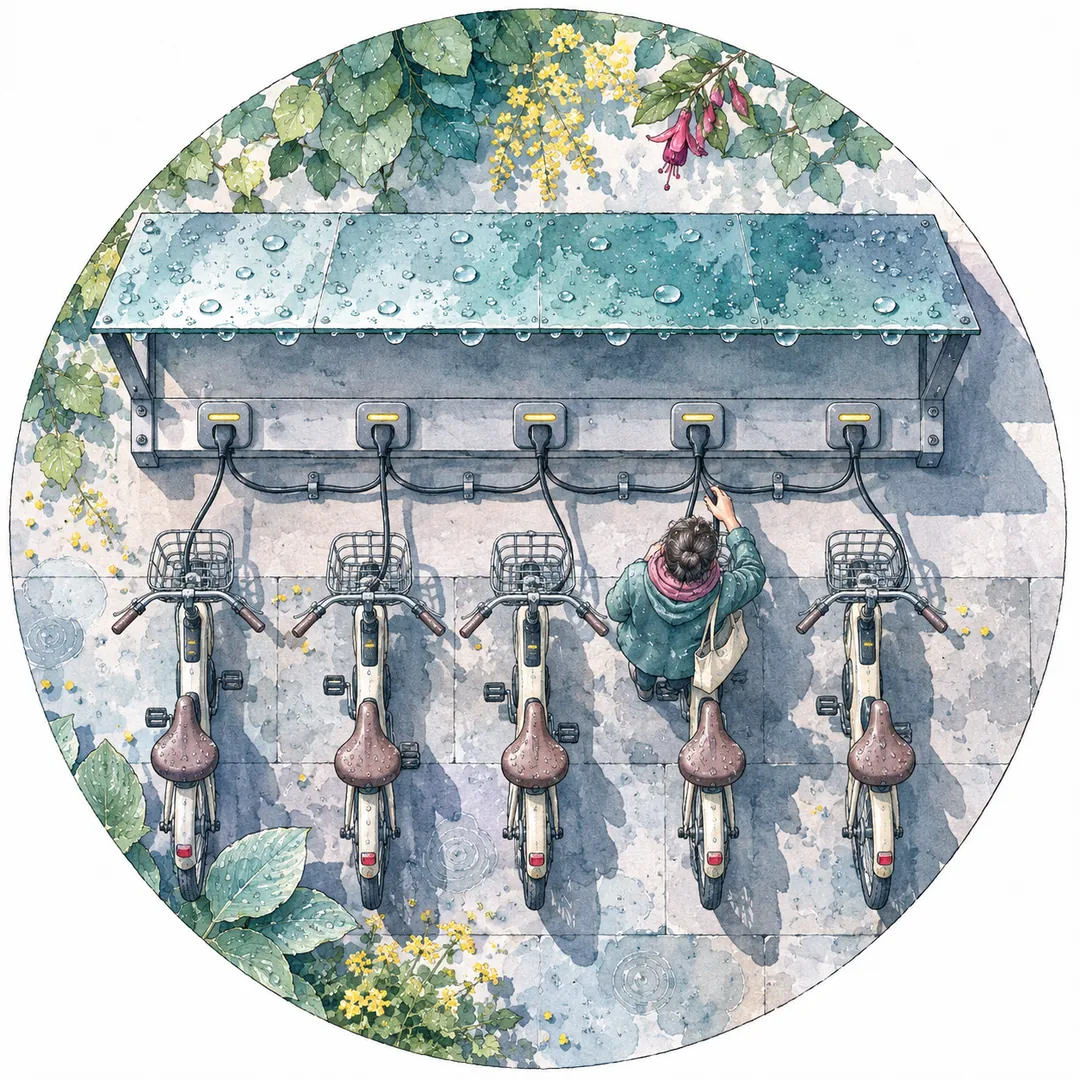
A shared e-bike is only as safe as the place it charges. The U.S. Consumer Product Safety Commission, in its June 2026 proposed rule for e-bike batteries, counted 227 battery incidents from 2019 through 2023, 90 of them associated with 39 deaths and 181 injuries. Fire safety guidance from FDNY and UL Standards and Engagement focuses on where and how batteries charge: away from exits and hallways, plugged directly into a wall outlet, with the charger the maker supplied. A Colibrino station takes that job out of homes and hallways. Every bike charges in its own bay, and riders never take a Colibrino battery home.
What a station is
A Colibrino station is a short row of bays along a wall or beside a path, sized in the network plan for the bikes it holds. It is compact on purpose: it fits beside a lobby door, at the end of a parking row or on a residence hall patio without taking over the space.
Bays that lock and charge
Each bay holds one bike, locks it in place and connects it to the charger made or approved by the bike’s manufacturer. A rider ends a trip by docking the bike in any free bay, so returning a bike and charging it are the same step. Nobody has to remember to plug in, and nobody carries a battery indoors.
A weather hood
A hood covers the charging points and chargers, keeping rain and snow off the connections and shading them in summer sun. A sign on the station shows the rider rules and the support line, (307) 365-7748.
Anchoring for wind
On the High Plains, wind shapes how a station is built. The Wyoming State Climate Office notes that Wyoming has the highest annual average wind speed in the country, 12.9 mph, and that winter brings frequent periods of 30 to 40 mph winds with gusts of 50 or 60 mph. At the Cheyenne airport, the National Weather Service recorded a highest gust of 75 mph in 2025.
Wind pressure grows with the square of wind speed. The Climate Office’s own example: a 4 by 8 foot sheet of plywood facing the wind takes 61 pounds of pressure at 25 mph and 245 pounds at 50 mph, at sea level. Doubling the wind speed roughly quadruples the push. So every station is anchored to pavement or a concrete pad, the hood and signs are kept low and compact, and docked bikes are held by their bay locks so they cannot be blown over. The anchoring is checked against the local building code for the site, and the site walk notes the prevailing wind and the lee side of nearby buildings.
Power from an existing circuit
A station normally runs on a circuit that already exists: an outdoor outlet, a garage circuit or a spare breaker in a nearby panel. Colibrino estimates the charging load in the network plan. A licensed electrician then confirms the circuit, checks what else shares it and does any electrical work the site needs. Colibrino does not open panels.
Chargers plug directly into the station’s wiring. No extension cords and no power strips are used, anywhere. You can test your own numbers with the station power calculator, which plans at 80% of the breaker rating, and see what the electricity costs with the charging cost calculator.
Example (fictional). At Larkspur Commons, a fictional 240-home apartment community, each of the 2 stations charges 8 bikes on one 20-amp, 120-volt circuit. With every bike charging at once the load peaks at 800 W, 41.7% of the circuit’s 1,920 W planning limit, and each station draws about 1.51 kWh a day. Electricity for the 14-bike fleet comes to about $3.47 per 30 days at an example rate of $0.13 per kWh. See the full example network.
Operator-only charging
Colibrino batteries are charged only in the station bays or in a designated charging area at an operator facility. They are never charged in hallways, units or common rooms. Only the manufacturer’s chargers are used, matching the advice from UL Standards and Engagement to use only the charger supplied or recommended by the maker.
Cold-weather charging limits
UL Standards and Engagement also advises against charging batteries in extremely hot or cold temperatures. Every battery has a charging temperature range set by its maker, and that range applies at the station. A frozen battery is not charged. When the cold keeps a station’s batteries outside the maker’s limits, the bikes or batteries come into the operator’s charging area to warm up and charge there. The seasonal operations page explains how winter is planned.
When a host wants charging indoors
Colibrino stations are normally outdoors. If your site calls for an indoor station, in a garage or a dedicated bike room, we use the Fire Department of the City of New York’s lithium-ion guidance as a reference point, because it is detailed and public. For five or fewer devices, FDNY says to charge away from exits and hallways, plugged directly into a wall outlet, with working smoke and carbon monoxide alarms. For more than five, it calls for a dedicated room with ventilation and a self-closing door. That guidance is New York City’s code, not Wyoming’s or Colorado’s: your local fire marshal, building official and insurer decide what applies to your building. The battery safety checklist lists the questions to ask.
What you provide, and what you receive
You provide a spot for the station on land you control, access to an existing circuit (confirmed by a licensed electrician), permission from whoever needs to give it (an owner, an HOA board, campus facilities, a fire marshal), and one contact person.
You receive the installed, anchored station, the installation and inspection record, charging handled entirely by Colibrino, a station check at every service visit, and removal and site restoration under the written end-of-program terms. For more on how we protect riders and buildings, read our safety page, or plan a station for your property.
Start with one station.
Tell us about the place: how many homes or beds, where people come and go, and where the nearest outlet is. We reply with questions or a time to walk the site with you.