
Maintenance, battery care and rebalancing
A shared bike is only useful if it works when a rider walks up to it. This is the everyday work of the Operate stage, and it is all Colibrino's.
For: Property managers, HOA boards, campus offices and neighborhood groups
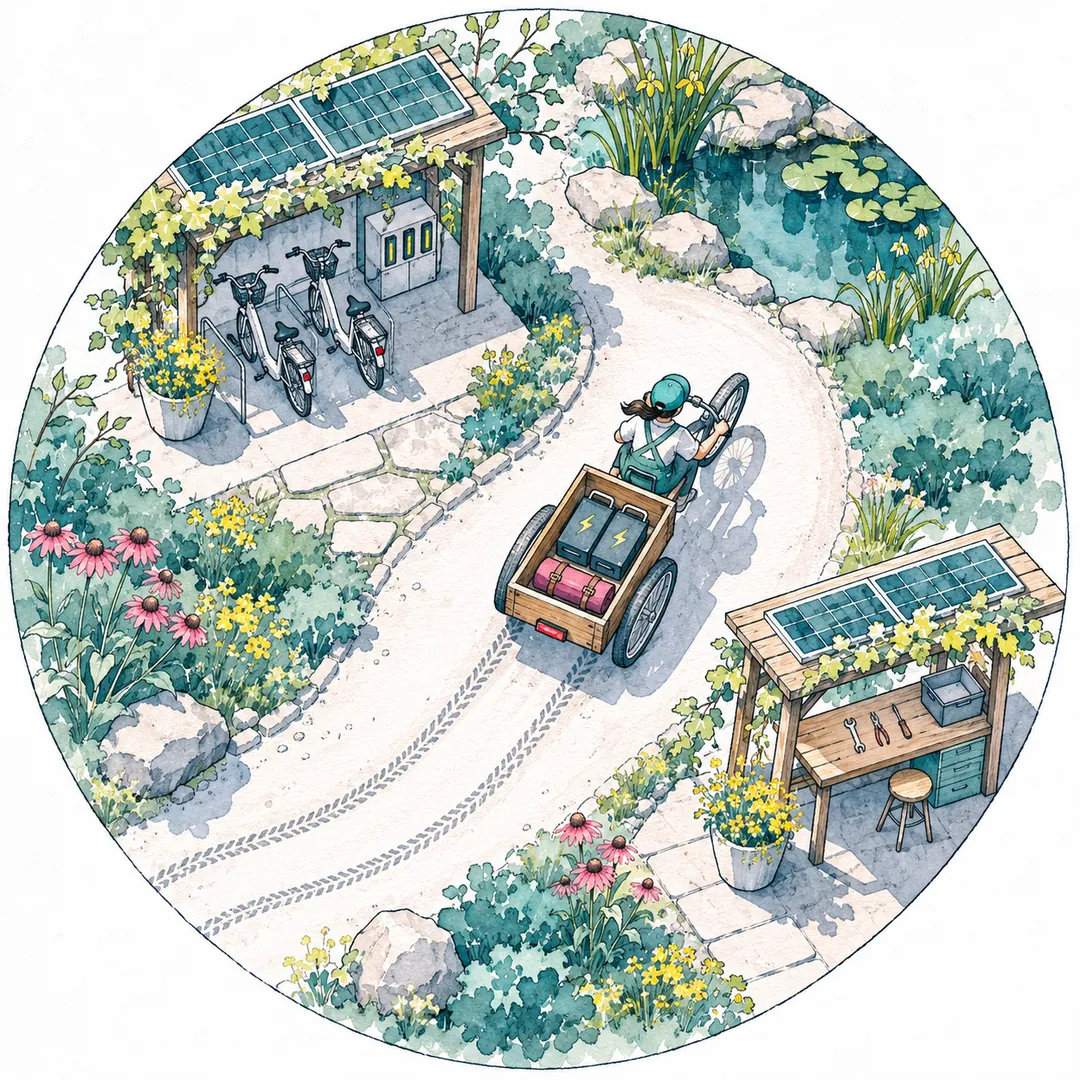
Shared bikes work harder than personal ones. Each is ridden by many people, parked outdoors through wind and snow, and docked and undocked many times a week. Without steady care, small problems turn into a soft brake or a flat tire on a Monday morning, and riders stop trusting the station. Colibrino handles that care for you: inspections, repairs, battery health and, where you have more than one station, moving bikes to where riders need them.
What we check at every station visit
Every station visit includes a check of the same five things on each bike that is docked, plus the station itself. How often a site is visited is set in the network plan from its number of bikes and rides, and changes when the monthly report shows it should.
| Part | What we look at |
|---|---|
| Brakes | Lever feel, pad wear, and that the motor assist cuts out when the brakes are applied |
| Tires | Pressure, tread, cuts, embedded glass or thorns |
| Lights | Front and rear lights switch on and are aimed properly |
| Locks | The bay lock holds the bike and releases it on a valid rider request |
| Battery condition | The case for cracks, dents, swelling or leaks; unusual heat or smell; charge level |
We also look at the chain, the bell, the basket bolts, the seat clamp and the class label on the frame, and at the station’s bays, hood, anchors and charging points. Wyoming law requires an e-bike’s motor assist to stop when the rider stops pedaling or applies the brakes (W.S. 31-5-707(e)), so the brake check includes the motor cut-off, not only the stopping power.
Repairs
Small repairs happen at the station: a tube or tire, a brake adjustment, a loose fender, a light. Larger repairs, such as a wheel, a drivetrain part or anything electrical, happen in the operator’s workshop. Parts come from the bike’s manufacturer or meet its specification. We never modify a motor or speed setting. A repaired bike goes through the same check as above before it returns to a bay.
Taking a bike out of service
A bike with a brake, frame or battery problem comes out of service as soon as it is found and is marked so that no rider can check it out. It stays out until it is repaired and checked again, or it is retired.
Batteries get extra caution. UL Standards and Engagement warns that a damaged e-bike battery can enter thermal runaway hours or even days after the damage happened, and lists the signs to look for: punctures or dents, leaking, swelling, a battery that is very hot to the touch, unusual smells, smoke, or hissing or popping sounds. A battery with any of these signs, or one on a bike that has been in a crash or a hard fall, is removed from the bike, kept apart from other batteries and never charged again until it has been inspected. A damaged battery that cannot be cleared is retired. Our battery safety checklist lists the same signs for any building that stores or charges e-bikes.
Battery health and end of life
Every battery is tracked by its serial number: its age, its condition at each check, and how well it holds a charge through a day of rides. A battery is replaced when it is damaged, when it is recalled, or when it no longer holds enough charge for the station’s daily rides. Batteries are charged only at the station or in a designated charging area, never while frozen; the seasonal operations page explains how cold weather changes the routine.
At the end of its life, a battery is recycled, never thrown away. The U.S. Environmental Protection Agency says lithium-ion batteries should not go in household garbage or recycling bins, recommends taping the terminals or bagging each battery separately to prevent fires, and recommends that businesses consider managing used lithium-ion batteries under the federal universal waste rules, which send them to a permitted facility or a recycler. Colibrino tapes and bags each retired battery and sends it to a battery recycler. No battery ever goes in your dumpster.
Rebalancing between stations
Riders do not return bikes evenly. Once a host has two or more stations, one of them can run empty every morning while another fills up. Rebalancing means moving bikes from the full station to the empty one, usually at quiet hours, so riders find a bike where they start and a free bay where they finish. If the same station needs bikes week after week, the pattern goes into the monthly report, and the season review may recommend moving or adding bays.
Example (fictional). At Larkspur Commons, a fictional 240-home apartment community with 2 stations and 14 bikes, one bike was out of service for 3 days after a flat tire in week 5. In weeks 6 to 8, one station ran empty on weekday mornings, so 2 bikes were moved there each evening. Both events appear in that month’s report as issues and fixes and as rebalancing moves. See the full example network.
The service log you see
Every visit, inspection result, repair, bike taken out of service, battery event and rebalancing move is written into a service log. The monthly ride report summarizes it under issues and fixes and rebalancing moves, and the full log is part of the CSV export you can ask for at any time and at the end of the program.
What you provide, and what you receive
You provide access to the station and, if it is indoors, to the room it is in, and a quick word to us if residents or staff notice a problem. You receive inspections, repairs, battery care, rebalancing and the service log, without hiring a mechanic or storing parts. Riders can help too: the pre-ride checklist shows what to look at before each ride. To discuss a site, plan a station.
Start with one station.
Tell us about the place: how many homes or beds, where people come and go, and where the nearest outlet is. We reply with questions or a time to walk the site with you.