
Seasonal operations for wind, cold and snow
High Plains and Front Range winters bring wind, cold and snow. Colibrino plans for them before launch, in writing, so nobody improvises in the first blizzard.
For: Property managers, HOA boards, campus offices and neighborhood groups
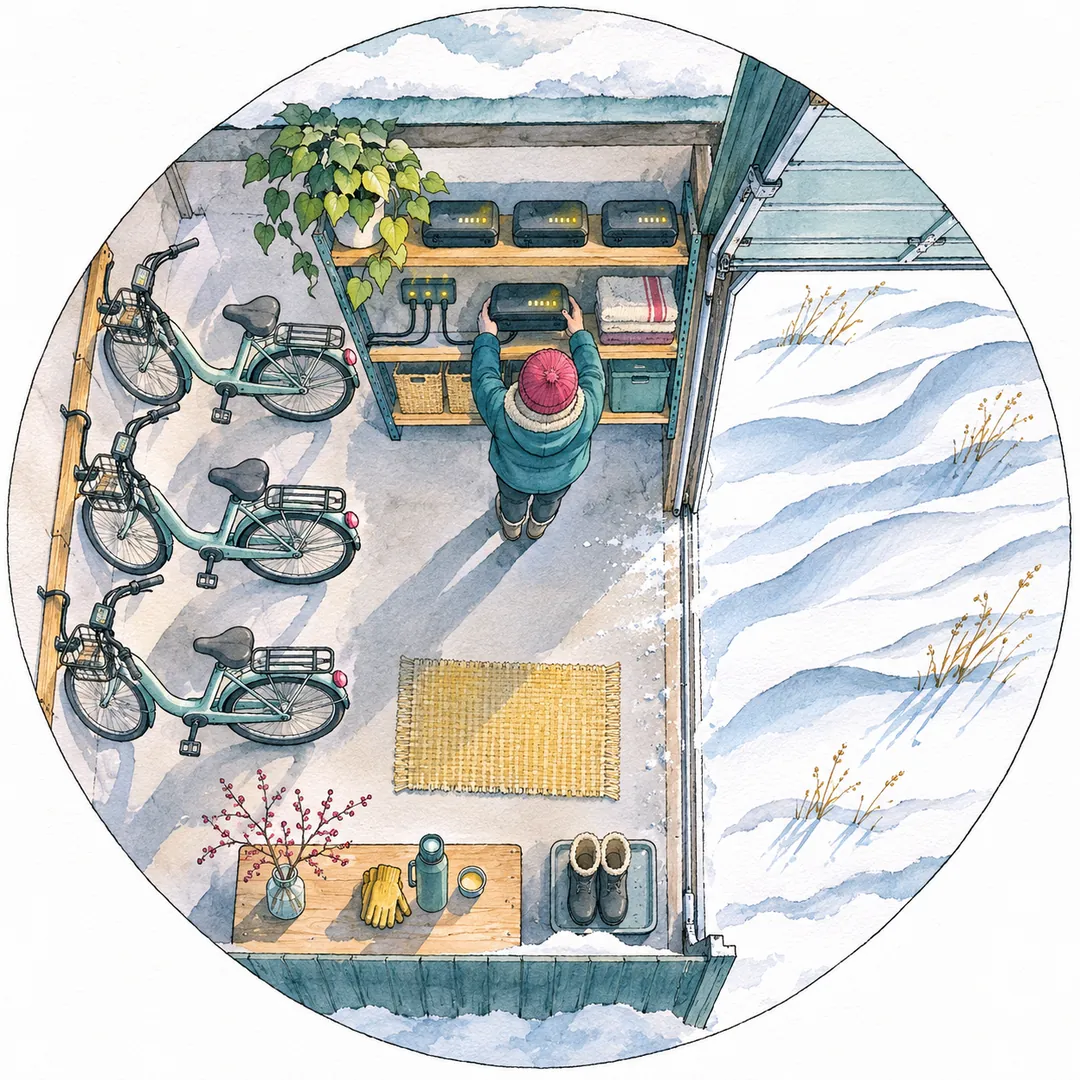
A bike station that works in June and fails in January leaves riders stranded and a host with equipment buried in a drift. Colibrino plans from its Cheyenne office for the weather of the High Plains and the Front Range, and every network plan includes a written winter plan for the site, agreed with the host before launch.
The weather we plan for
The National Weather Service’s 2025 climate summary for the Cheyenne airport shows what a station has to live with:
| Measure (Cheyenne airport) | Value |
|---|---|
| Average wind speed, 2025 | 11.3 mph |
| Highest gust, 2025 | 75 mph, from the west, on December 19 |
| Normal yearly snowfall (1991 to 2020) | 62.9 inches |
| Snowfall in 2025 | 35.1 inches |
| Snowiest year on record | 121.5 inches, in 1980 |
| Normal days a year with a low of 32°F or colder | 170.4 |
| Lowest temperature, 2025 | -12°F, on January 20 |
The Wyoming State Climate Office adds that Wyoming has the highest annual average wind speed in the country, 12.9 mph, and that winter brings frequent periods of 30 to 40 mph winds with gusts of 50 or 60 mph. Prevailing winds come from the west-southwest through west to northwest. Each site’s own exposure is noted on the site walk: where drifts form, where plows pile snow, and which side of the building is sheltered.
Two ways to run a winter
The network plan picks one of two options with the host. Either can change at the season review.
| Full year, reduced winter fleet | Riding season, winter storage | |
|---|---|---|
| Bikes in winter | Fewer bikes stay out; the rest are stored indoors | All bikes and batteries are stored indoors |
| Station in winter | Open, checked after storms | Closed to riders; anchors, hood and bays checked |
| Charging | In the bays when batteries are within the maker’s limits; otherwise in the operator’s charging area | Batteries kept indoors, at the storage charge the maker recommends |
| Riders | Ride on suitable days; notice when the station closes for a storm | Passes and fees for the winter months as set in the network plan; a spring date announced |
| Often fits | Communities and campuses with steady winter trips | Seasonal pilots and exposed sites |
Cold-weather batteries
Lithium-ion batteries behave differently in the cold. The London Fire Brigade explains that cold temperatures reduce battery performance: riders may notice reduced range, slower charging and a battery that loses charge more quickly, because the chemical reactions inside slow down. It says cold usually affects performance rather than safety, but that repeated exposure to freezing temperatures can lead to permanent capacity loss, internal damage and reduced battery life. Its advice is to let a cold battery warm to room temperature before charging and never to charge a frozen battery. UL Standards and Engagement likewise advises against charging batteries in extremely hot or cold temperatures.
We do not publish a single temperature figure, because each battery maker sets its own charging and storage limits. The battery maker’s limits apply. In practice:
- a frozen battery is never charged
- when batteries are outside the maker’s charging range, the bikes or batteries come into the operator’s charging area to warm up and charge there
- batteries are not left out in deep cold when a station is closed for winter
- a battery that has been through extreme cold is inspected before it returns to service
Riders may see shorter range on cold days. The range estimator lets you lower the battery capacity available in the cold and see how range changes.
Snow removal
The winter plan sets out who clears what, for example:
- the path from the station to the street, cleared with the host’s usual snow removal
- a marked area in front of the bays where the plow does not pile snow
- the bays, locks and bikes, cleared by Colibrino at service visits
- what happens when a storm closes the station, and how riders are told
After a storm, we check the station for drifted snow, ice on the bay locks and damage. Placing the station out of the plow’s path and on the sheltered side of a building, decided at the site walk, reduces this work.
Wind
Wind does not stop for winter. Every charging station is anchored and kept low-profile, and docked bikes are held by their bay locks. The Climate Office’s example shows why: a 4 by 8 foot panel facing the wind takes 61 pounds of pressure at 25 mph and 245 pounds at 50 mph, at sea level. The rider guide covers riding in wind and winter weather.
The written winter plan
Every network plan contains a winter plan with:
- The option chosen: full year with a reduced fleet, or a riding season with storage
- The bikes that stay out in winter, if any, and where the rest are stored
- How batteries are charged and stored in the cold, under the maker’s limits
- Who clears snow where, and where the plow must not pile it
- What happens in a storm or high-wind warning
- How riders are told about closures and the spring relaunch
The spring relaunch checklist
Before riding resumes after a winter closure, the station and every bike are checked as if new:
- Bikes: brakes, tires, lights, locks, chain and class label, the same check as every service visit
- Batteries: charge level and condition after storage; any sign of swelling, damage or leaks takes a battery out of service
- Recalls: bikes, batteries and chargers checked again against current recall notices
- Station: anchors, hood, bays, bay locks and charging on every bay
- Site: snow gone from the bays and path, signs readable, lighting working
- Riders: a relaunch notice, a refresher safety session and the pre-ride checklist
The launch readiness checklist covers the same ground for a first launch. To plan a station that works in every season, contact us.
Start with one station.
Tell us about the place: how many homes or beds, where people come and go, and where the nearest outlet is. We reply with questions or a time to walk the site with you.