
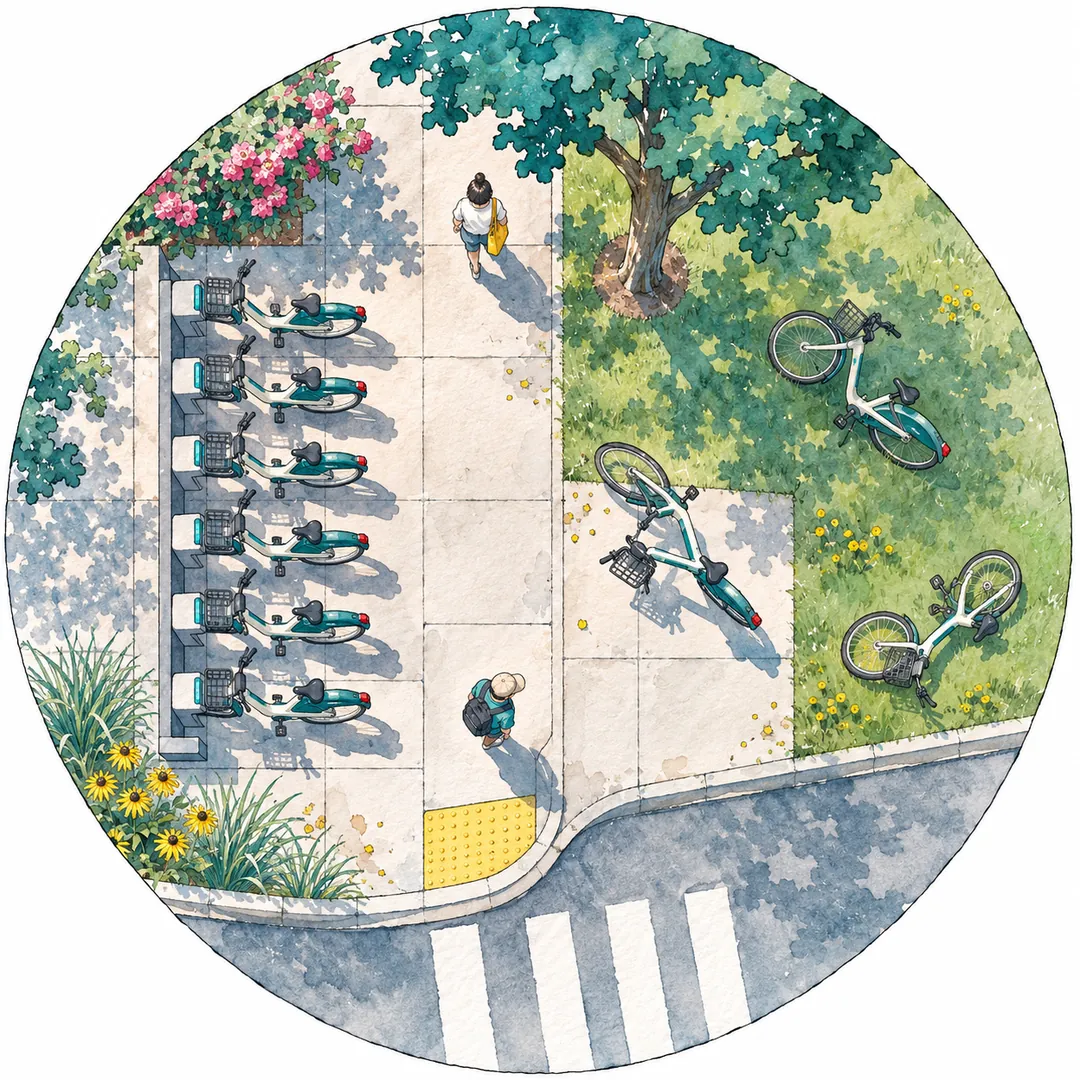
For a neighborhood, campus or downtown planning a few dozen shared bikes or fewer, a docked (station-based) system is usually the better fit: bikes go back to a spot the host controls, e-bikes charge while they are docked, and the footprint stays inside a rectangle everyone agreed to. Dockless bikes reach more doorsteps for less up-front equipment, but they need a city permit, a parking plan someone enforces, and a crew that swaps batteries. Hybrid systems, which add marked parking zones to stations, sit between the two and bring the city’s rules with them.
Most comparisons of the three models were written between 2017 and 2020 for big cities, before e-bikes carried half of all shared bike trips. This one compares them on what a small host actually controls: sidewalk order, charging, cost, station spacing, winter and data. In the interest of plain dealing: Colibrino, which wrote this, runs station-based e-bike networks with charging bays and does not leave dockless bikes on public sidewalks. The comparison below gives each model its due.
Docked, dockless and hybrid: what each term means
A docked system ends every trip at a station, a dockless system lets a trip end wherever the rules allow, and a hybrid system offers both. The details matter, because “station” and “dockless” are used loosely by vendors and counted differently by the associations that publish national data.
ITDP’s Bikeshare Planning Guide defines the three types this way:
- Station-based (docked): systems “that require bikes to be picked up from and returned to designated docking points or smart docks.”
- Dockless: systems with no docking points or physical stations, where riders find and unlock a bike through an app and end the trip by closing the bike’s own lock. ITDP splits them into wheel lock bikes, which lock their rear wheel and need not be attached to anything, and lock-to bikes, which carry a U-lock or cable that must be locked to a fixed object such as a rack or sign post. Virtual parking zones can encourage riders, but “users are not forced to end their trips in these zones.”
- Hybrid: systems with docking points at physical stations and geofenced hubs, where a rider can start or end at either. Ending at a station “is typically incentivized by reduced user fees.”
ITDP’s 2018 dockless policy brief puts the difference more bluntly: dockless bikes can be locked and unlocked “anywhere the user wants to start or end a trip, from a public bike rack to the middle of a sidewalk.”
National counts draw the lines in slightly different places. NACTO, the National Association of City Transportation Officials, counts “smart bike systems”, where the electronics are in the bike and “use of a dock is optional”, as station-based in its report on 2023, and counts as dockless only systems “designed to be free-floating” that never require a dock. NABSA, the North American Bikeshare & Scootershare Association, groups “docked/hybrid bikes” together in its 2025 State of the Industry charts. So in the national numbers, hybrid systems sit on the docked side.
| Model | Where a trip starts | Where a trip ends | How the bike is secured between trips |
|---|---|---|---|
| Docked (station-based) | A station dock or bay | Any station dock or bay | Locked into the dock |
| Dockless, wheel lock | Wherever a bike was left | Anywhere the rules allow | The bike’s own rear-wheel lock |
| Dockless, lock-to | Wherever a bike was left | At a rack or other fixed object | An onboard U-lock or cable |
| Hybrid | A station or a marked hub | A station or a marked hub, often with a fee difference | A dock at stations; the bike’s own lock in hubs |
Terms you will hear in the conversation
- Dock or bay: the slot at a station that holds and locks one bike. On an e-bike station, the bay can also charge the battery.
- Smart bike: a bike that carries its own lock and electronics, so it can be left at a station or, where allowed, elsewhere. NACTO counts these systems as station-based.
- Geofence: a boundary drawn on the map in the operator’s software. The app can block a trip from ending outside it or slow bikes inside it, but only as accurately as the bike’s GPS allows.
- Corral or hub: a marked parking area without docks, on a sidewalk or in the parking lane.
- Furniture zone: the strip of sidewalk next to the curb that holds trees, poles, benches and racks, outside the walking path.
- Rebalancing: moving bikes from stations or areas with too many to those with too few.
- Fleet cap: the maximum number of vehicles a city permit allows an operator to place on its streets.
What the national numbers say about each model
Docked and hybrid bikes carry most shared bike trips in North America, and each docked bike is used far more often than each dockless bike, on average. Those averages come mostly from big-city systems, so they describe the industry rather than predict a small network.
NABSA’s 2025 charts count 132.2 million trips on docked and hybrid bikes, 56% of all shared micromobility trips in North America that year, against 13.6 million (6%) on dockless bikes and 91.4 million (38%) on e-scooters. On an average day in 2025, NABSA counts about 114,000 docked and hybrid bikes deployed, 46,000 dockless bikes and 190,000 e-scooters.
Dividing each mode’s annual trips by its average daily fleet and by 365 days gives a rough use rate. This is our arithmetic, not a figure NABSA publishes: about 3.2 trips per deployed docked or hybrid bike per day, about 0.8 per dockless bike, and about 1.3 per e-scooter. It averages seasonal systems across the full calendar year and lets the biggest systems dominate; NACTO found that 90% of station-based trips in 2023 took place on just 10 systems.
NACTO’s report on 2023, which counts only systems with more than 150 vehicles, tells a similar story. People took 81 million trips on station-based systems in the U.S. and Canada that year. Dockless e-bikes made up 10% of shared micromobility devices but carried 4% of trips, and NACTO’s chart of trips per dockless e-bike per day in September 2022 and 2023, as reported by each city, shows values between about 0.3 and 2 across eleven cities.
What the national numbers leave out
The national figures are useful context and poor predictors, for four reasons:
- They are dominated by a few dense systems. In NACTO’s data for September 2023, the busiest station-based systems, in Montreal, Toronto and New York City, had each bike taken out 6 to 8 times a day on average.
- They leave out small systems. NACTO’s count starts at 150 vehicles, and NABSA’s totals are summed across hundreds of cities of every size.
- They count trips, not riders or purposes. A trip by a visitor on a day pass and a trip by a resident going to work count the same.
- They say nothing about cost per trip or reliability. A model with more trips per bike can still be the wrong one for a site where nobody can keep sidewalks clear or batteries charged.
None of this tells a small host what its own bikes will do. It does show that a bike locked in a known place near riders tends to be used more than one that might be anywhere. Trips per bike per day explains how these averages are calculated and why they mislead small networks.
Sidewalk order and parking
Parking is the first thing neighbors notice, and the models differ most here. A docked bike ends its trip locked in a bay, so the only parking question is where the station goes. A dockless bike ends its trip wherever the rider stops, so parking becomes a set of rules that the city writes and someone enforces every day.
NACTO’s Guidelines for Regulating Shared Micromobility (version 2, September 2019) describe the rules most cities use for dockless parking:
- Vehicles should not be parked within 5 to 15 feet of a crosswalk or curb ramp.
- Vehicles parked on sidewalks may only be parked in the street furniture zone, unless the city permits otherwise.
- A minimum 6-foot clear path is required at sidewalk corrals.
- Operators should share a parking management plan covering geofencing, rider communication, moving badly parked vehicles and staffing.
The same guidelines explain why. “Large numbers of shared micromobility vehicles on the sidewalk can block accessible travel paths,” affecting people with visual disabilities, people using wheelchairs and people pushing strollers. NACTO also notes that the GPS in most shared devices is “accurate to within 5-10 feet,” so geofencing “is not sufficient to be solely used to enforce or verify proper parking.” Cities, it reports, “have increasingly shifted toward corral-based systems,” which in practice means designated spots that behave like stations without docks.
The worst case is well documented. ITDP’s 2018 brief describes Guangzhou, China, where an estimated 700,000 dockless bikes on city streets by May 2017 “led to massive piles of abandoned dockless bikes and sidewalks blocked with unregulated bike parking,” until the city issued parking guidelines.
A small host rarely faces piles of bikes, but it faces the same question at smaller scale: who moves a bike left across a curb ramp at nine on a Saturday night? Under a dockless permit, the operator answers to the city. With a docked station on private land, the bike cannot be left anywhere else, because the trip only ends when the bike is locked in a bay. Cheyenne’s own experience with unlocked shared bikes, described in the small-city bike share record, shows what happens when a bike is not tied to a place or an account.
What a small host should check about the footprint
A docked station still needs a careful footprint, and NACTO’s dockless parking rules make a sensible starting checklist for it. Before a station goes in, a host can check:
- The walking path. The station and the bikes in it leave a clear path past them. NACTO’s figure for sidewalk corrals is a minimum of 6 feet.
- Curb ramps and crossings. Nothing sits in front of a curb ramp or at the edge of a crosswalk; NACTO’s guideline for dockless parking is 5 to 15 feet away.
- Doors, ramps and fire lanes. Building entrances, accessible ramps and fire lanes stay open, including when every bay is full and a rider is waiting.
- Snow. The station is not where the plow piles snow, and riders can reach it after a storm.
- Light and sight lines. The station is lit at night and visible from a lobby, office or street.
Colibrino’s rule follows from this: trips end at a station bay, never on the sidewalk. The urban neighborhoods page explains how that works for a downtown or neighborhood host, and why any station on a public street or sidewalk needs a city agreement first.
Charging e-bikes: in the dock or by battery swap
Charging is the trade-off older comparisons leave out. A docked e-bike can charge whenever it is in its bay; a dockless e-bike can only be recharged by a crew that swaps its battery or collects the bike. For a small host, that decides where batteries live and how much labor the program needs.
E-bikes now carry most of the work. NABSA’s 2025 charts count 74.2 million shared e-bike trips and 71.6 million shared pedal bike trips, so e-bikes carried 51% of shared bike trips while making up 45% of shared bikes deployed on an average day. NACTO reports that e-bikes carried 46% of U.S. station-based trips in 2023 while making up about a third of station-based bikes.
The Great Plains Institute, summarizing NABSA’s 2024 survey of bike share operators in January 2026, reports three points that matter for this choice:
- Battery swapping is “the current industry standard.” Staff bring charged batteries to the bikes, sometimes from charging cabinets placed around the system, and replace the depleted ones. The biggest downside, GPI writes, is the time it takes to “identify, locate, and replace depleted batteries,” which creates large operating costs.
- For dockless systems, swapping “is the only available strategy.” A free-floating bike has no plug.
- In-dock charging looks like the future for station-based systems. A returned bike starts charging through the dock. Connecting docks to the grid is the most common approach, though it can require expensive underground connections and work with the local utility.
For a small network, a docked charging station removes the battery route entirely and keeps batteries out of vans, storerooms and riders’ homes. The cost moves to the site: a circuit that a licensed electrician confirms can carry the load, and a station built for the weather. The charging stations page describes that installation, and battery swapping versus docked charging compares the two charging models in depth, including fire code treatment.
Example (fictional). Larkspur Commons is the fictional 240-home apartment community used across this site. Each of its 2 stations has 8 bays, and each station’s 8 bikes charge on one 20-amp, 120-volt circuit: 800 W at peak with every bike charging, 41.7% of the circuit’s 1,920 W planning limit, and about 1.51 kWh per station per day. No battery leaves a bay for charging, and no resident ever carries one indoors. Under a dockless model, the same 14 bikes would need someone to find each low battery, swap it, and charge the spares somewhere off site.
Colibrino’s stations work the docked way: each bay locks and charges a bike, chargers are the manufacturer’s, and riders never charge Colibrino batteries at home or indoors.
Questions to ask any operator about charging
Whichever model you consider, ask the operator to answer these in writing:
- Where are batteries charged, and in what kind of space: a station bay, a cabinet, a warehouse, a van?
- Who handles batteries, and how are damaged ones identified and taken out of service?
- Are the bikes and batteries certified to recognized safety standards, and are serial numbers checked against recall notices?
- What circuit does a charging station need, and who confirms it? Any electrical work should be done by a licensed electrician.
- Will any battery ever be charged inside a building the host owns, and if so, where and under what rules?
- What happens to charging in cold weather, when batteries should not be charged frozen?
An operator with good answers will have them ready. Vague answers about where batteries spend the night are a reason to keep asking.
Cost: equipment, operations and what riders pay
Docked systems cost more to install and less to keep in order; dockless systems cost less to install and more to manage on the street. Which side pays depends on how the program is set up, and riders feel the difference in fares.
ITDP’s planning guide sums up the trade-off: station-based systems “pose high capital and operations costs to the city, but provide a reliable, comfortable service for users,” while dockless systems “are more scalable due to lower capital costs, but raise public space, equity and other operations concerns if not well-regulated by the city.” The two are usually governed differently as well. NACTO notes that traditional procurement is “the management mechanism for most docked bike share programs in North America,” while its guidelines exist to help cities manage permitted services that are not procured that way.
Riders see the cost in fares. NACTO’s report on 2023 gives these averages from the cities that reported prices:
| Trip type, 2023 averages | Typical trip length | Average one-way cost |
|---|---|---|
| Station-based pedal bike, pay as you go | 30 to 35 minutes | $3.85 |
| Station-based e-bike, pay as you go | 30 to 35 minutes | $7.00 or more |
| Dockless e-bike or e-scooter | 11 to 12 minutes | About $6.00 |
Passes lower the per-trip cost for members, and a resident amenity program can remove the fare altogether by having the property pay. As one Front Range reference point, Boulder BCycle, which its operator lists as an all-electric pedal-assist system, listed “Rides start at $7.63” on its home page when checked in November 2026.
Who carries which cost
The same work exists under every model; what changes is who does it and who pays. In general terms:
| Cost | Docked on a host’s land | Dockless under a city permit | Hybrid |
|---|---|---|---|
| Stations, docks and power work | Host or operator, set in the agreement | None | Operator or city, for the stations |
| Bikes and batteries | Operator, or host if it buys equipment | Operator | Operator |
| Charging labor | Small: bikes charge in the bay | Large: battery routes and spare batteries | Mixed |
| Parking enforcement | Little: trips end in bays | City staff time plus operator crews | City and operator, for the hubs |
| Rebalancing | Operator, between stations | Operator, across the service area | Operator, to stations and hubs |
| Fares | Set by the program; an amenity host may pay instead | Set by the operator within permit rules | Set by the operator, often lower for ending at a station |
Docks are part of the equipment bill. ITDP writes that “most medium and large systems have 2-2.5 docking stations for each bike in service,” so a returning rider can find an empty dock during busy periods. A small closed network can start with fewer spare bays only if someone rebalances when a station fills. The fleet size calculator on this site starts from about 10% extra bays, rounded up, which in its fictional Larkspur Commons default gives 16 bays for 14 bikes.
Station spacing and the small-network problem
Big docked systems work because stations sit a few minutes’ walk apart across a whole district. One to three stations cannot do that, so a small docked network works only when riders’ trips begin at the station: at a residential door, a residence hall, an office or a trailhead.
ITDP’s guide gives the big-city yardsticks. A station-based service area is typically a 500-meter radius around each station. Its target density is 10 to 16 stations per square kilometer, and Paris, London and New York used one station about every 300 meters in their first phases. For dockless systems, the service area “is typically the jurisdictional boundary of the city.” NACTO’s report on 2023 adds that “a large number of densely-distributed stations and shared micromobility devices within walking distance of residences, employment hubs, and other popular destinations is critical for supporting trips on shared bikes and scooters.”
What that means at small scale:
- A residential or campus host has a built-in answer. Its riders start at home, so a station by the busiest door is within the walk that matters, and the second station goes where they ride to or by a second entrance.
- A downtown organization wants trips from anywhere to anywhere, which no three-station layout provides. It can start docked on its own land at the busiest anchor and add stations as data shows demand, or work with the city toward a permitted dockless or hybrid service that covers more ground.
- A dockless permit only helps if the fleet is dense enough to put a bike within a short walk most of the time. ITDP’s planning range for large, dense cities is 10 to 30 bikes per 1,000 residents.
A quick calculation shows the gap. A 500-meter radius covers about 0.79 square kilometers, so one station “serves” that area on ITDP’s definition. A downtown of 3 square kilometers would need 30 to 48 stations to reach ITDP’s density target of 10 to 16 per square kilometer. A three-station network covers a few blocks around each station, which is exactly enough when the riders live or work on those blocks, and far too little when they do not.
Example (fictional). A fictional campus residence hall with 600 students sits a 12-minute walk from the main classroom building. One docked station by the hall’s main door and a second by the classroom building cover the trip most students make each day, even though two stations would never meet a citywide density target. A third station at the student union is added in the second semester after the monthly report shows bikes piling up at the classroom building at midday.
The station planning page describes how a site walk tests a location against real doors, paths and power.
Winter, wind and snow
On the High Plains and the Front Range, winter decides as much as the model does. Docked stations are fixed equipment that has to coexist with plows; dockless fleets have no fixed equipment but still need a winter home and a plan for bikes left out in a storm.
The record has examples of each approach:
- Storing stations. Portsmouth, New Hampshire stored its bike share stations for the winter in 2017, to avoid conflicts with snow clearing and give every bike maintenance (City of Portsmouth).
- A seasonal docked system. ITDP’s 2018 brief notes that Montreal’s BIXI runs from April 15 to November 15 and that its stations must be removed while the system is closed, which led to moveable stations later copied elsewhere.
- A smaller winter fleet. The Better Bike Share Partnership reports that Des Moines closes outlying stations and cuts its fleet by 40 to 50% in winter, and that Salt Lake City’s GREENbike keeps all stations open with fewer bikes.
- A winter dockless pilot. Minneapolis let a 300-scooter fleet run until its permit expired on December 31. City staff expected 0.5 to 0.75 trips per vehicle per day and saw about 1.2 to 1.3.
Whatever the model, a written winter plan should answer the same questions: the dates of the riding season, how many bikes stay out in winter and where the rest are stored, where batteries are kept and charged in the cold, which stations or zones close, how riders are told, and who clears snow around each station. A docked network adds one more: what happens to station hardware in the plow’s path. A dockless network adds another: who collects bikes left out before a storm.
Wind is the other local factor. A docked bike held upright by its bay lock is much harder for a gust to knock over than a free-standing bike on a kickstand. The Cheyenne and region page summarizes the wind and snow record for the Cheyenne airport, and seasonal operations describes the two winter options a written plan chooses between: a full year with a reduced fleet, or a riding season with storage and a spring relaunch.
Data and control: what the host and the city can see
Every model produces data, but who holds it and how it is checked differ. A docked station records each bike leaving and returning at a known place; a dockless fleet reports GPS positions and trips through the operator. Either way, the host should get the numbers in writing and be able to take them away.
NACTO’s report on 2023 is frank about the problem: “Cities have found discrepancies between what is reported by companies and what they find during spot checks,” and “there is a growing conversation about data specifications and tools to audit and verify company-reported data.” Its 2019 guidelines ask cities to say exactly which vehicles count toward a permitted fleet, “inoperable, damaged, unsafe, or in maintenance, or only vehicles that are currently available,” and note that many permits raise or lower fleet caps based on “rides per vehicle per day.” ITDP’s guide advises cities to set data-sharing standards that operators agree to “prior to starting service.”
For a small host, the useful questions are the same under any model:
- What is counted: trips by station or zone and by time of day, active riders, bike availability, times a station ran empty or full, and bikes out of service.
- How often: a monthly report in the same format, so one month can be compared with the next.
- In what form: a spreadsheet export at any time, not only charts.
- Who keeps it: whether the data stays with the host if the program or the operator ends.
- What stays private: reports should show counts, not where any one rider went.
Colibrino’s monthly report has four fixed fields (trips, active riders, bike availability, and issues and fixes), and every network plan includes a CSV export of the host’s program data at any time and at the end. Ride data and reporting shows the format.
Hybrid systems: when stations plus parking zones make sense
A hybrid system is worth its extra rules when a city partner wants coverage beyond a few stations and is ready to mark and enforce parking zones. For a single private host, it usually adds rule-writing and enforcement without adding much service.
In ITDP’s definition, hybrid riders may take a bike from a station or a hub and return it to either, and operators usually reward ending at a station with a lower fee. NACTO describes the parking side in its guidelines: corrals and designated “stations” without docks “strike a balance between ease-of-use and predictability.” Riders “often do not have to use the corrals, but operators must rebalance vehicles to those locations,” and cities should “reserve the right to approve all corral or designated parking locations and plans.”
Three conditions make a hybrid reasonable:
- A public partner. Parking hubs on public sidewalks or streets need the city’s approval and its enforcement.
- Enough bikes to fill the hubs. A hub with no bike in it is a painted rectangle.
- A charging plan for bikes outside stations. Following GPI’s reasoning, any e-bike that ends a trip in a hub rather than a charging dock needs a battery swap or a ride back to a dock.
A downtown that starts with one or two docked charging stations on private land can add marked hubs later, once a city agreement exists and the station data shows where riders want to go. A sensible order:
- Run the stations for a season and read where trips end, by station and by time of day.
- List the destinations riders ask for that no station reaches, from support contacts and rider surveys.
- Take that list to the city with a proposal for marked hubs, their size, and who will check them.
- Agree on the hub rules in writing: where hubs go, how riders are told, what happens to a bike left outside one, and how bikes in hubs get charged.
- Report hubs and stations separately, so the next season review can tell which locations earn their keep.
Which model fits your site
The right model follows from who rides, whose land the bikes sit on and who will keep e-bikes charged. The table below sets out the trade-offs for a host planning one to three stations or a fleet of a few dozen bikes.
| Question | Docked (station-based) | Dockless | Hybrid |
|---|---|---|---|
| Where do trips end? | Only in a station bay | Anywhere the rules allow | A station or a marked hub |
| Who keeps sidewalks clear? | Fixed footprint agreed in advance | The operator under city parking rules | The operator, with city-approved hubs |
| How are e-bikes charged? | In the dock, from a confirmed circuit | Battery swaps by field staff | In docks at stations; swaps for bikes in hubs |
| Up-front equipment | Higher: stations, docks, power work | Lower: bikes and software | Between the two |
| Ongoing street work | Rebalancing between stations | Rebalancing, parking enforcement, battery routes | All of the above, at a smaller scale |
| Needs a city permit or agreement? | Only for stations on public streets or sidewalks | Yes, to operate in the public right of way | Yes, for hubs on public space |
| Best fit | Apartment communities, HOAs, campuses, a downtown starting on its own land | A city wanting citywide coverage and able to regulate it | A city or campus adding coverage around existing stations |
| Winter | Store stations or run a smaller fleet; plan around plows | Pull or shrink the fleet; find winter storage | Both sets of tasks |
Four decision rules cover most small hosts:
- If riders start at their own front door (residents, students, employees), choose docked stations by the doors they use.
- If the land is yours and the street is not, start docked on your land and treat anything on the public right of way as a later phase that needs a city agreement.
- If the bikes are electric and nobody is staffed for a daily battery route, choose stations that charge in the dock.
- If a city wants trips from anywhere to anywhere and can enforce parking rules, a permitted dockless or hybrid service may serve it better, and a host’s docked station can still anchor one end.
Example (fictional). Two fictional hosts in the same High Plains town face the same choice. Prairie Gate, an HOA of 300 homes, owns its clubhouse lot and wants bikes for residents only; it picks one docked charging station by the clubhouse and a second by the pool, both on its land, with riders ending every trip in a bay. The Elm Street Business Association wants visitors to ride between the depot, the museum and the river path, none of which it owns. It starts with one docked station on its office lot and asks the city about a permitted service with marked hubs at the depot and the museum, accepting that the city will set the parking and data rules for the hubs.
What to do next
Before choosing a model, write down three things: who should ride, whose land each bike will sit on between trips, and who will keep the batteries charged. Those answers usually make the choice for you.
- Walk the site and mark the door or corner where most trips would start.
- Check who owns that spot and whether a city agreement is needed.
- Ask where batteries will be charged and who will move them, if anyone.
- Agree on the report fields and the data export before launch.
- Decide the winter plan, including where bikes go in a storm.
The how it works page shows how a station, its bikes and its charging loop fit together. For more on neighborhood planning, transit links and data, see the neighborhood mobility section. If you have a spot in mind, a site walk tests it against the doors, the paths, the power and the wind.