
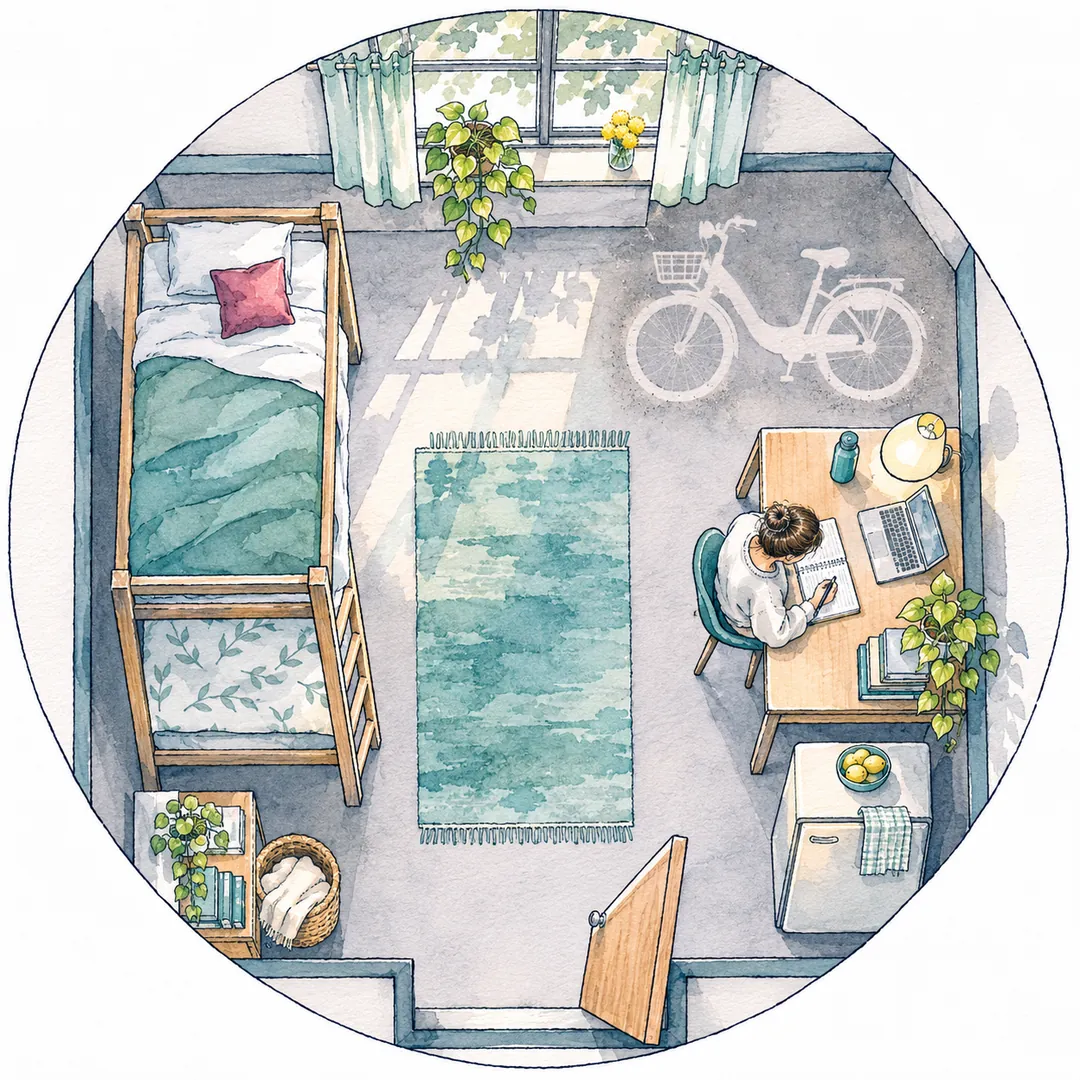
Colleges are banning e-bikes in dorms because lithium-ion batteries can overheat and burn, sometimes without warning, and a residence hall puts hundreds of sleeping students behind shared hallways and exits. The policies differ more than the headlines suggest: some bar storage and charging inside buildings (NJIT since June 5, 2024; the University of Hartford’s interim directive from August 1, 2026), Kenyon College bars the battery even when it is removed from the bike, the University of Pittsburgh bars e-scooters from all university property from August 1, 2026, and William & Mary requires all charging to happen off campus from September 14, 2026. Students can usually still ride: outdoor racks, campus-designated charging spots where they exist, shuttles, and shared bikes that charge outside the building fill the gap.
This article is for housing and residence life staff, fire safety officers, transportation and risk offices, and the operators of student housing near campus. It reads the policy texts themselves, sorts them by what they restrict and who is exempt, and then works through the three ways a campus can replace charging in the room. It is not legal advice: campus rules, local fire codes and state law all apply, and counsel and the fire marshal decide what your campus may require.
Why colleges are drawing the line at e-bikes in dorms
Residence halls combine the three things fire officials worry about most: many devices, charging overnight, and people asleep behind shared exits. Federal data and campus surveys both point to charging in living spaces as the gap policies are trying to close.
The federal evidence
In a proposed rule published June 24, 2026, the U.S. Consumer Product Safety Commission said it is aware of 227 incidents from 2019 through 2023, involving fires, explosions, gas releases, burns, overheating and smoke inhalation, that the rule could potentially have prevented. Ninety of those incidents are associated with 39 deaths and 181 injuries. CPSC proposes to make UL 2849 (e-bike electrical systems), UL 2272 (e-scooters and similar devices) and UL 2271 (replaceable battery packs) mandatory, with added requirements, and proposes that a final rule take effect 180 days after publication. Comments were due August 24, 2026. As of November 2026 it is a proposal, not a final rule.
NJIT’s policy explains the hazard in plain terms. Thermal runaway is “a process in which the lithium-ion cell enters an uncontrollable, self-heating state,” which can produce extremely high temperatures, violent venting, smoke and fire, and the ejection of gas, shards or particles.
What campuses themselves report
In a 2025 study with the League of American Bicyclists’ Bicycle Friendly University program, UL Standards & Engagement (ULSE) found that 39% of participating campuses report e-mobility devices in regular daily use, and only 41% have formal e-bike policies. Nearly two-thirds of respondents (63%) believe riders charge e-bikes in residential buildings, 41% suspect charging in academic buildings and 33% in administrative offices. More than 65% cited convenience and inadequate charging infrastructure as the reason.
That last finding frames the whole problem. Students charge where they sleep because the room has an outlet and the bike is theirs. A policy that removes the outlet without offering another place to charge, or another way to ride, moves the problem rather than solving it.
What staff should do if a battery smokes
A policy also needs a response plan, because a ban will not catch every bike. The warning signs ULSE lists are physical damage such as dents or punctures, leaking, swelling, a battery very hot to the touch, unusual smells, smoke, and hissing or popping sounds. FDNY’s guidance for a battery fire is short: close the door, leave the building immediately, call 911 from outside, and do not try to put out a battery fire. William & Mary’s policy gives its own community the same order: stop using the device, move away if it is safe, call 911 or campus police, and do not try to repair or recharge it.
Build those steps into RA training and the residence hall fire procedures, and make sure the front desk knows that a battery found swelling or hot in a room is an emergency call, not a maintenance ticket.
The policy wave in context
The Hechinger Report wrote in May 2024 that colleges were regulating where e-bikes could be used, stored and charged, in the absence of federal or state legislation. The policies below show how far that went by fall 2026.
Four things a campus policy can restrict
Campus e-bike policies regulate some combination of four things: where a device is stored, where it is charged, where it is ridden and where it is parked outdoors. Reading a policy by those four questions, plus who is exempt, shows what it actually covers.
- Storage. Can the device be kept inside a residence hall, a student room, a hallway, a stairwell or a common room? Some policies cover all university buildings; some only residential ones.
- Charging. Can the battery be charged inside, and if not, is there a designated place to charge on campus? A few policies also address the battery separately from the bike.
- Riding. Where may the device be ridden on campus: roads, paths, pedestrian cores, inside buildings?
- Outdoor parking and presence on campus. Can the device be parked at a rack, and does the campus require registration or certification? At the strictest end, a type of device may be barred from university property altogether.
The fifth question is exemptions: who is outside the rule, usually people using mobility devices because of a disability, and sometimes university-owned vehicles.
Gaps that show up when the texts are read side by side
Comparing the six pages in the table below turns up gaps any campus can check in its own policy:
- Dates. Kenyon’s handbook page and UT Austin’s mobility page give no effective date, and Pitt describes its indoor rule only as long-standing. Students and parents cannot tell which version applies to them.
- The battery alone. Of the six pages, only Kenyon’s says in so many words that a removed battery is still covered. A student could read the other policies as allowing a battery to come inside for charging.
- Where to charge instead. NJIT and Kenyon say where devices may be stored outdoors, and Hartford’s directive addresses only the residence halls; none of the three names a place to charge. Pitt names one garage; William & Mary says charging must happen off campus.
- Scope of buildings. Hartford’s interim directive covers residence halls; NJIT, Pitt, UT Austin and William & Mary cover university buildings generally. A student who cannot charge in the hall may try the library.
- Interim status. Hartford’s directive applies while a permanent policy is drafted, so its terms may change.
| Campus | Effective date as stated | Indoor storage | Indoor charging | Battery on its own | Outdoors on campus | Exemptions named |
|---|---|---|---|---|---|---|
| NJIT | June 5, 2024 | Banned in NJIT buildings, including residence halls | Banned | Not addressed separately | Store outside at a bike rack | Medical devices; NJIT-registered low speed vehicles |
| University of Pittsburgh | E-scooter rule August 1, 2026; indoor rule described as long-standing | E-bikes and e-scooters banned in all buildings except one garage for e-bikes | Banned indoors; e-bike charging offered in the PG Garage | Residence Life enforces a lithium-ion battery rule in residence halls | E-scooters may not be parked or stored on university property; e-bikes at outdoor racks | Contact Disability Resources |
| University of Hartford | August 1, 2026 (interim) | Banned in residence halls | Banned in residence halls | Not addressed separately | Not addressed | People with documented disabilities who require a mobility device |
| Kenyon College | Not stated on the handbook page | Banned in all residential facilities | Banned in residential facilities | Banned indoors even when removed from the device | Outdoor racks or approved outdoor storage | Disability accommodations through the accessibility office |
| William & Mary | September 14, 2026 | Banned indoors unless authorized | All charging must occur off campus, indoors or outdoors | Uncertified or modified battery systems prohibited | Registration and NRTL certification; Class 3 and devices over 20 mph banned | Wheelchairs and powered mobility devices used by people with disabilities |
| UT Austin | No date on the page | Devices with lithium batteries not allowed in campus buildings, including residence halls | Covered by the building rule | Not addressed separately | Dismount zone in central campus; registration required | ADA mobility devices are not counted as personal electric vehicles |
What six campus policies actually say
Read side by side, the 2024 to 2026 policies share a core (no storage or charging in residence halls) and differ on almost everything else: the battery alone, outdoor charging, scooters, registration and certification. Each summary below sticks to what the university’s page says.
NJIT: no storage, charging or use inside any NJIT building
NJIT’s policy, effective June 5, 2024, prohibits “the storage, charging, operation, and maintenance of lithium-ion battery powered personal mobility devices inside NJIT owned or operated buildings, including residence halls.” It names electric skateboards, scooters, kick scooters, unicycles, Segways and e-bikes, and says the devices are to be stored outside in an available bike rack. It applies to students, staff, faculty and guests.
University of Pittsburgh: indoors banned, and e-scooters off campus entirely
Pitt’s regulations page says Student Affairs “has long restricted” lithium battery-powered mobility devices inside residence halls and university buildings. E-bikes are not allowed inside any university building, including residence halls, apartments, academic and administrative buildings, and garages, except the Public Health Building (PG) Garage. Students may charge e-bikes on the garage’s second level, and the page asks them to monitor the bike while it charges and unplug it when charging is complete.
Effective August 1, 2026, Pitt also prohibits e-scooters from being parked or stored on any university property. The page says this extends the indoor restriction to all outdoor university property, and that charging stations previously available for e-scooters, such as the one in the PG Garage, can no longer be used for that purpose. The rule does not apply to e-bikes parked at outdoor racks.
University of Hartford: an interim residence hall ban while a policy is written
The University of Hartford’s interim safety directive, posted August 3, 2026, says that effective August 1, 2026 “the storage and charging of electric scooters, electric bicycles, hoverboards, and other lithium-ion-powered personal mobility devices inside residence halls is prohibited while the University develops a comprehensive campus micromobility policy.” An advisory group of university members will draft a long-term policy.
Kenyon College: the battery counts, even on its own
Kenyon’s student handbook (section 14) bars e-bikes and e-scooters from residence halls, student apartments, college-owned houses and any other residential facility, and lists rooms, hallways, stairwells, lounges, entryways, mechanical rooms and storage rooms. Batteries may not be charged inside any residential facility, and may not be stored there “regardless of whether the battery is attached to the device.” The handbook states that “Removal of a battery from a device does not exempt it from this policy.” Devices must be kept at outdoor bicycle racks or other approved outdoor storage areas. The handbook page we checked does not state an effective date.
William & Mary: registration, certification and charging off campus
William & Mary’s Micromobility and Personal Mobility Device Policy takes effect September 14, 2026. Personal mobility devices may not be brought into or stored in university buildings, residence halls, offices, classrooms or common areas unless expressly authorized. The policy goes further than most on charging: “all charging must occur off campus,” and charging is prohibited inside university buildings and outdoors on university property.
It also sets device rules. Class 1 and Class 2 e-bikes and registered, certified e-scooters are permitted; Class 3 e-bikes and devices capable of more than 20 mph under motor power are prohibited. Electric devices parked at university racks must be registered, and all electric devices operated or stored on university property must display certification from a nationally recognized testing laboratory, with UL 2849, UL 2272 and UL 2271 listed as the applicable standards.
UT Austin: a building rule inside a mobility plan
UT Austin’s mobility page is mostly about riding: personal electric vehicles must be walked through the central Pedestrian Friendly Zone. It also states that “Devices with lithium batteries are not allowed inside campus buildings, including in residence halls,” and that registration with Parking and Transportation Services is required for students, faculty and staff who bike or ride a scooter or other micromobility device to campus. The page does not give an effective date.
Exemptions: disability accommodations and approved storage
Every policy above that names an exemption names people who use mobility devices because of a disability, and federal rules explain why. A housing office should write the exemption process down before the first request arrives.
What the policies say
- Hartford exempts “persons with documented disabilities that require a mobility device.”
- Kenyon says its policy does not apply to mobility devices used as accommodations under disability laws unless the college specifies otherwise, and directs requests to its Office of Student Accessibility and Support Services. Approved accommodations “may require alternative storage or charging arrangements.”
- William & Mary exempts wheelchairs and other powered mobility devices used by people with disabilities.
- NJIT exempts devices used for medical purposes, such as lithium-ion powered wheelchairs, and batteries in NJIT-purchased, approved and registered electric low speed vehicles.
- Pitt asks students whose device is related to a disability to contact Disability Resources.
- UT Austin states that ADA mobility devices, including electric wheelchairs, are not personal electric vehicles under its rules.
The federal framework
ADA.gov explains that under rules in effect since March 15, 2011, covered entities must allow people with disabilities who use other power-driven mobility devices into their facilities unless a particular type of device cannot be accommodated because of legitimate safety requirements. Those requirements “must be based on actual risks, not on speculation or stereotypes.” Five factors apply: the device’s type, size, weight, dimensions and speed; the facility’s volume of pedestrian traffic; its design and operational characteristics; whether safety rules can permit safe operation; and whether the device creates a substantial risk of serious harm to the environment or resources. The guidance encourages written policies on which devices are permitted, where and when.
For a housing office, that means two things. First, a residence hall ban on recreational e-bikes does not settle what happens when a student needs a powered device to get around. Second, the accommodation may itself raise the charging question, which is why Kenyon’s text anticipates “alternative storage or charging arrangements.” Decide in advance who reviews the request, where an approved device may be stored and charged, and how that space meets the fire marshal’s expectations.
How campuses enforce the rules
Enforcement ranges from staff asking a student to move a bike outside, to impound, fines and conduct referrals. The more a policy depends on confiscation, the more it needs a clear, published way to get a device back or appeal.
- NJIT relies on building owners and stewards, such as Residence Life and department heads, to tell owners to move devices outside; Public Safety and Environmental Health and Safety will remove devices on request and relocate them to an appropriate outside location.
- Kenyon reserves the right to remove or relocate improperly stored devices or batteries, and says devices or batteries found in violation may be confiscated pending student conduct review. Violators may face disciplinary action. The college is not responsible for loss, theft or damage at outdoor racks.
- Pitt fines e-scooters found parked, stored or ridden on campus $100 for a first offense and $200 for a second, with impound and possible referral to Student Conduct. Its page says Residence Life separately enforces the lithium-ion battery rule in residence halls, and that impounded e-bikes unclaimed after 90 days become university property. Appeals must be filed within 10 calendar days of a citation.
- William & Mary lists warnings, citations, immobilization or impoundment, conduct referral, employee discipline, loss of registration and restitution. Impounded devices are kept up to 90 days and need proof of ownership for release; devices left on campus over breaks without authorization may be treated as abandoned.
A warning period before penalties
Pitt’s e-scooter rule shows one way to phase enforcement in: its page says violators received warnings during August, and the impound and fine process began in September. A warning period gives students time to move devices home, gives staff time to learn the procedure, and produces a count of how many devices the rule actually touches. Publish the start of penalties as a date, not as “soon,” and say what happens to devices found during the warning period.
The practical question for a housing office is what staff do at 11 p.m. when an RA finds a bike charging in a room. A written procedure helps: who is called, where the bike goes, how the student is told, and how the student gets the bike back once it is stored properly. Confiscation without a place to put the bike just moves it to a different hallway.
Can you bring an e-bike to college? What students should check
Usually you can bring one to campus, but you probably cannot keep it or charge it in your room, and some campuses restrict where you ride or park it. Check five things before move-in, in this order.
- The housing agreement and residence life rules. These decide whether the bike, the battery or both may come inside. Kenyon’s rule covers the battery on its own. UNC Charlotte’s announcement of its 2026 pedestrian zone tells resident students to check their housing agreement for storage rules.
- Where you can charge. If charging is banned in residence halls, find out whether the campus offers a designated spot, as Pitt does in one garage, or whether, as at William & Mary, all charging must happen off campus. If there is nowhere to charge, a removable battery that goes home with a commuter may be the only option, and only if the policy allows the battery itself.
- Registration and certification. UT Austin requires registration for students, faculty and staff who ride a bike, scooter or other micromobility device to campus. William & Mary requires registration for electric devices at its racks and a certification mark from a nationally recognized testing laboratory. Look for UL 2849 on an e-bike and keep the paperwork.
- The class of e-bike. Some campuses ban faster bikes. William & Mary prohibits Class 3 e-bikes and any device capable of more than 20 mph under motor power. Our e-bike classes guide explains the classes.
- Where you can ride and park. Dismount zones and pedestrian cores are spreading. Plan the route from your residence hall’s rack to your classes, and find out whether you will be walking the last stretch.
If you are buying an e-bike before college
Pitt’s battery safety suggestions are a sound buying and charging list for any student: look for devices, batteries and chargers certified to recognized standards such as UL 2849 for e-bikes; use only chargers compatible with the device’s battery; do not use damaged or modified batteries, such as ones that leak or bulge; do not leave a battery charging unattended, and unplug it when it is full; and store and charge batteries at room temperature, out of direct sunlight. Add three questions of your own before you pay: what class the bike is, whether its battery is removable, and whether the campus you are heading to lets that battery inside at all. Our article on UL 2849 and UL 2271 labels explains what the certification marks mean.
If the answer is no
If the rules make a personal e-bike impractical, the options are the same ones a housing office should be building: a conventional bike at an outdoor rack, the campus shuttle (UT Austin’s page, for example, lists free shuttle routes and courtesy carts for its main campus), or a shared bike that someone else charges. Electric bikes for college students do not have to mean a battery in the dorm.
Replacement one: outdoor racks and covered parking
Outdoor parking is what every policy above falls back on, and it is the cheapest replacement. It works best when it is covered, lit, close to the door and planned for theft, weather and battery damage.
What the policies require of outdoor parking
Kenyon requires devices to be secured at outdoor racks or approved outdoor storage. NJIT says devices are to be stored outside in an available bike rack. William & Mary allows devices only at designated racks or approved storage areas, locked with a U-lock or similar, and bars locking them to trees, railings, signs, benches or light poles, or blocking sidewalks, ramps, entrances, exits or accessible routes. Pitt allows e-bikes at outdoor racks, tells students to lock the rear wheel and frame with a good U-lock rather than a cable, and says e-bikes locked to trees, handrails or blocking sidewalks, steps or ramps can be removed immediately.
What outdoor parking does not solve
- Charging. A rack is not a charger. If students cannot charge in the room and the campus offers nowhere else, the rack only helps riders who can charge off campus.
- Battery damage outdoors. ULSE’s battery safety tips warn that a device parked outdoors and unattended “may experience damage without the owner’s knowledge,” and that thermal runaway can occur hours or even days after a battery is damaged or exposed to extreme heat or cold. A battery knocked over at a rack and then carried inside is exactly the case an indoor ban is meant to stop.
- Cold. ULSE also advises against charging batteries in extremely hot or cold temperatures. On a High Plains or northern campus, a battery that spent a January night at an outdoor rack should warm up before charging, which pushes students to bring it inside, the thing the policy forbids.
- Theft and weather. Covered, lit racks within sight of a front desk or a camera reduce both. Bike lockers or a locked cage add cost but answer the concerns students raise first.
A planning note for facilities
Count the racks against the number of residents who bring bikes, not against today’s rack use; once a ban takes effect, every e-bike that used to live in a room needs a space outside. Put the racks near the door, keep them clear of accessible routes and fire department access, and include them in the snow removal plan.
Replacement two: designated charging rooms and what fire codes ask
A designated charging area gives students a legal place to charge, but it brings fire code requirements, supervision questions and liability that a housing office should resolve with the fire marshal before opening one. Some campuses offer one; others, like William & Mary, have decided not to allow charging on campus at all.
What campuses are doing
Pitt designates the second level of the Public Health Building garage for e-bike charging and asks riders to monitor the bike and unplug it when charging is complete. UNC Charlotte says its plans include “dedicated device charging stations” along with larger parking hubs. ULSE’s 2025 study notes that many universities are investing in dedicated e-bike charging stations, secure storage and designated parking to keep devices out of hallways.
What a fire code reference looks like
Local fire codes differ, and your fire marshal decides what applies. As a detailed public reference, the FDNY’s lithium-ion charging guidance, based on the 2022 New York City Fire Code Section 309.3, says:
- For five or fewer personal mobility devices, charge in a safe location away from exits and hallways, plugged directly into a wall outlet, with no extension cords or power strips.
- Keep separation between charging batteries in a single fire area: at least 2 feet for 20 kWh and at least 3 feet for 50 kWh.
- Have working smoke and carbon monoxide alarms inside and outside the charging area, and keep combustible items out of it.
- For more than five devices, charge in a dedicated room with ventilation and a self-closing door.
- For charging more than five batteries, FDNY describes a separate one-hour fire-rated, sprinklered room with a fire-rated, self-closing door, and notes that such rooms need building department filings and approvals.
That is New York City’s code, not a national rule. Our article on what fire codes require for charging e-bikes inside a building covers the model codes and how they are adopted.
Questions to settle before opening a charging room
- Who approves it: the fire marshal, the building official, the insurer and the risk office.
- Whose equipment charges there: only the manufacturer’s charger, as ULSE advises, and only certified batteries?
- Who checks the room, and how often, and who removes a damaged or swollen battery?
- Whether students must stay with a charging battery, as Pitt’s guidance suggests, or may leave it, and what that means for supervision.
- Where the room sits: outside residential buildings, or in a separately rated room if inside.
Replacement three: a shared fleet that charges outside the building
A shared e-bike fleet does not ban anything; it gives students a way to ride without owning a battery. The bikes charge in their own station or in the operator’s facility, so the charging question moves from hundreds of rooms to one place the campus can inspect.
What it changes, and what it does not
A shared fleet takes some students out of the market for a personal e-bike, especially those who mainly ride between their hall and class. It also shows students the charging practice the housing policy asks for. It does not stop students from buying their own bikes, and it does not replace the need for outdoor parking and a clear personal-device policy. Students who commute from off campus, ride long distances or need a bike at odd hours may still want their own.
Sizing a station for a residence hall
A station outside one hall serves trips that start and end at home, so size it from the people it could serve rather than from the number of personal e-bikes the rule displaced. The method is the same one used for apartment communities: how many residents could ride, the share likely to sign up, rides per member per week, how much busier the busiest day is, and how many rides one bike can serve that day. The fleet size calculator runs those five assumptions. Start at the low end, and let a season of trip data show whether the hall needs more bikes or a second station near classrooms.
What to require of any operator
- Charging location: only in station bays or an operator facility, never inside residence halls, academic buildings or student rooms.
- Equipment: e-bike electrical systems certified to UL 2849 and batteries certified to UL 2271 or tested as part of the UL 2849 system, by a nationally recognized testing laboratory; manufacturer chargers only; no extension cords or power strips.
- Recall checks against CPSC notices before each bike enters service, and a record of serial numbers.
- Damaged batteries: how they are identified, stored away from buildings and removed from campus.
- Cold weather: the battery maker’s charging temperature limits and where batteries warm up.
- Reporting: trips, availability and issues, shared with the campus in aggregate.
This is how Colibrino runs its stations: batteries charge only in the station bays or an operator facility, on the manufacturer’s chargers, and never go home with riders. The charging stations page explains the station, its power and its weather hood, and the universities and student housing pages explain how a program fits each host. For a comparison of the ways a campus can structure a bike program, from bike libraries to contracted fleets, see campus bike share models.
Off-campus student housing follows its own rules
Campus policies stop at the campus boundary. A purpose-built student community across the street sets its own rules through its lease, house rules and insurer, and its residents are often the same students who just moved their bikes out of a residence hall. Operators face the same choices as a housing office: where personal devices may be stored and charged, whether to offer outdoor parking or a charging area the fire marshal approves, and whether to give residents a shared option. Our article on the battery rules apartment buildings can set covers the lease side.
Example (fictional). Juniper Hall is a fictional 400-bed residence hall at a fictional state college. After a spring term in which RAs found e-bikes charging in rooms several times, the housing office adopts a rule that bars storage and charging of personal e-bikes and batteries inside the hall from the next fall term, with a disability accommodation process run by the accessibility office. Facilities adds a covered, lit rack for 30 bikes beside the front desk window. The fire marshal reviews, and declines, a proposal for an indoor charging room in the basement. Instead, the transportation office runs a one-season pilot with a shared station of 8 bays outside the hall, where the bikes charge in the bays and never come indoors. At the season review, housing compares RA reports of in-room charging before and after the rule, and transportation reviews the station’s trips and availability.
A checklist for the next housing policy review
The policies that hold up are specific about what they restrict, honest about where students will charge instead, and clear about exemptions and enforcement. Use these steps for a new policy or the next review of an old one.
- Write down the four restrictions. State whether the policy covers storage, charging, riding and outdoor presence, and in which buildings. Say whether a battery on its own is covered, as Kenyon’s handbook does.
- Name the device types. E-bikes by class, e-scooters, hoverboards, e-skateboards, and whether the rule reaches conventional bikes.
- State the effective date and the review date on the policy page. Several pages we read give no date at all, which makes it hard for students and parents to know what applies.
- Write the exemption process. Who reviews disability accommodation requests, where approved devices are stored and charged, and how that space is approved.
- Say where students can charge, or say plainly that they cannot on campus. If you offer a charging area, settle its approvals and supervision first.
- Plan outdoor parking for every device that will move outside, with lighting, cover, theft protection and snow removal.
- Publish the enforcement steps: who acts, what happens to the device, how a student gets it back, and how to appeal.
- Tell students before they buy. Admissions and move-in materials reach families before the holiday gift season; the policy should too.
- Offer a way to ride without a battery in the room: shuttles, bike libraries or a shared fleet that charges outside.
- Review with data: RA reports, fire alarm activations, impound counts and, if a shared fleet runs, its trips and availability.
The campus micromobility checklist puts the policy, parking, agreement and access questions in one list for the offices involved, and the campus mobility section of the journal covers related rules, including dismount zones and campus speed rules. If your campus is considering a shared station outside a residence hall, you can plan a station; it starts with a site walk with your housing and facilities staff.