
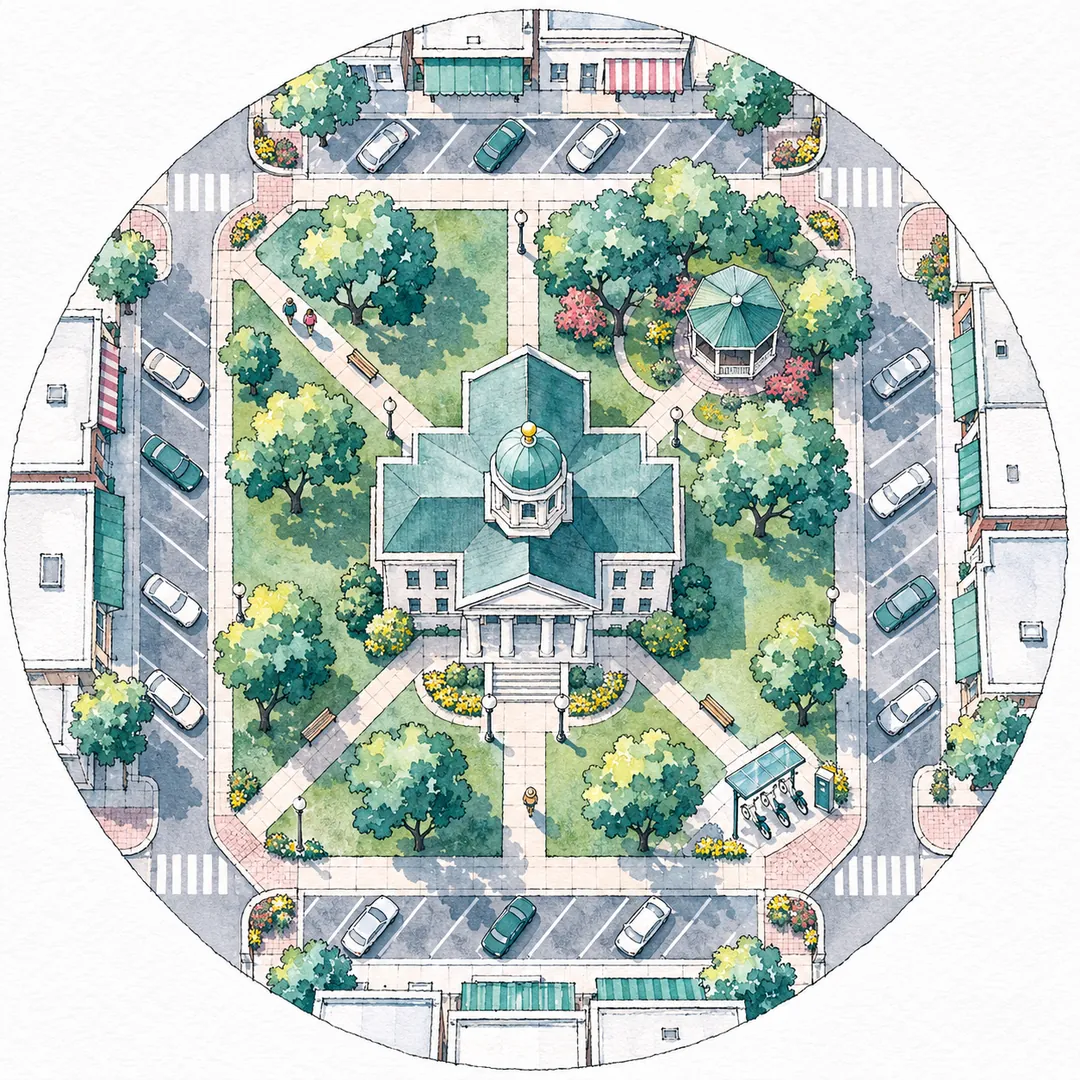
Bike share can work in a small city, and the record shows that small programs rarely end because people dislike the idea. They end when one funder or one operator carries everything, when two or three stations cannot connect the trips people actually make, when nobody local is paid to fix bikes, and when winter arrives without a plan. Programs that last start with a few stations on known trips, a local owner, more than one source of money, and written plans for winter and for the day an operator leaves.
This article walks through four small programs with public records, the five patterns behind the ones that faltered, what the durable ones share, and a start-small sequence for one to three stations. It is written for city staff, downtown and neighborhood organizations, small-city councils and chambers of commerce, including those in Cheyenne and Laramie.
What counts as a small bike share system
A small system, in this article, means one to about a dozen stations and well under 150 bikes, in a town or district of roughly 10,000 to 100,000 people. Systems this size are common, but they barely appear in the national statistics most people quote.
NACTO, the National Association of City Transportation Officials, counts only “bike and scooter share systems with over 150 vehicles” in its annual data snapshot, according to the methodology page of its report on 2023, published in July 2024. Its headline of 157 million shared bike and scooter trips in the U.S. and Canada in 2023 therefore describes large systems. NABSA, the North American Bikeshare & Scootershare Association, casts a wider net: its 2025 State of the Industry summary says at least 237 million trips were taken on about 350,000 shared vehicles across North America in 2025, and its charts count systems in 403 cities that year.
Small systems have long been a big part of the count. A 2015 paper on a Hawaii pilot, citing a national list from 2014, notes that of 68 U.S. bike share systems on the ground that year, 26 (38.2%) had five or fewer stations and 21 (30.9%) had 50 bikes or fewer (Choy and colleagues, Hawaii Journal of Medicine and Public Health).
For scale, here are the places this article mentions, with the U.S. Census Bureau’s Vintage 2025 estimates for July 1, 2025:
| Place | Population, July 1, 2025 | Why it appears here |
|---|---|---|
| Meadville, Pennsylvania | 12,230 | A transit agency’s seasonal bike share |
| Portsmouth, New Hampshire | 23,028 | Sponsor-backed stations from a national operator |
| Laramie, Wyoming | 32,284 | A campus bike library and a likely host city |
| Cheyenne, Wyoming | 66,507 | A free, donation-based program and a likely host city |
| Bismarck, North Dakota | 77,963 | A seasonal station-based system with e-bikes |
Three terms come up throughout. Station-based (docked) bike share means bikes are taken from and returned to fixed stations. Dockless bike share means bikes carry their own locks and can be left anywhere the program allows. A bike library lends bikes for days or a semester rather than for one trip; the University of Wyoming’s Pokes’ Spokes Bike Library rents in-town bikes for the semester at $25 for students and $50 for staff and faculty. The trade-offs between the first two are covered in docked, dockless or hybrid bike share.
Four small programs and what happened to each
Four small programs with public records show the range of outcomes: a two-station pilot in Kailua, Hawaii that taught its state more than it carried riders; a transit-run seasonal system in Meadville, Pennsylvania that grew in its first year; sponsor-backed stations in Portsmouth, New Hampshire whose operator later shut down nationwide; and a free program in Cheyenne whose unlocked bikes mostly went missing within weeks.
Kailua, Hawaii: two stations and 12 bikes, 2011 to 2014
The Hawaii State Department of Health’s Healthy Hawaii Initiative funded the pilot through a competitive request for proposals: $100,000 to install and maintain two stations with 12 bikes, run outreach, and secure sponsors for two to four more stations. The system opened in April 2011 in Kailua’s town core, on sites donated by the main commercial landowner, in a community of about 38,635 people (Choy and colleagues, 2015).
Ridership averaged 41.5 rides a month from 2011 to 2014. Almost every rider bought a 24-hour pass, and from observation most appeared to be tourists. When the local bike shop partner closed and the coordinator resigned in November 2011, the system ran for almost a year without a dedicated staff person. A part-time mechanic worked one to three hours a week, parts were shipped between Hawaii and the operator’s base in Wisconsin, salt air rusted the docks, and by the 18th month every bike lock needed replacing. The operator removed the system at the end of 2014 and donated the equipment to a nonprofit serving a mixed-income housing community.
The authors still count the pilot as useful: it introduced bike share to Hawaii, connected the first group of supporters, and informed the planning of a larger program for urban Honolulu.
Meadville, Pennsylvania: a transit agency’s seasonal system, 2021 onward
The Shared-Use Mobility Center’s profile of the Meadville program (published June 2022, revised June 2025) describes a rural transit agency, the Crawford Area Transportation Authority, that formed a separate nonprofit to house bike share. The program opened on April 30, 2021, in a city the profile describes as about 12,000 people. By spring 2022 it had 20 bikes at 7 docking stations.
The system runs April through November, depending on the weather. Riders paid $2.50 for the first hour and $1 for each additional half-hour, with the stated goal of covering operating costs from fees. Local businesses sponsored the rest: $900 for a bike, $250 for a rack location, or $100 to be a “Friend of Meadville Bike Share”, with agreements renewed each year. Agency staff handle rebalancing and routine maintenance, and two local bike shops take the heavier repairs. The busiest site is a trailhead at the start of a paved path of about five miles. Rental transactions rose 40% from May 2021 to May 2022.
The profile is candid about the weak spot: yearly sponsorship renewals leave the program with “limited long-term financial security”. This article has not checked the program’s status after the June 2025 revision.
Portsmouth, New Hampshire: sponsor-backed stations, 2017
The City of Portsmouth launched bike share on May 1, 2017, operated by Zagster, Inc., with six station locations. From May 1 to November 27, 941 people signed up and riders logged 1,876 trips, an average of 63 a week. The city then “hibernated” the bikes and stations for the winter, to avoid conflicts with snow clearing and to give every bike maintenance, and said it would explore expansion through sponsorship agreements with local businesses.
The operator did not last as long as the plans. On June 1, 2020, Penn State reported that Zagster, its campus provider since 2017, was “permanently suspending operations at all locations nationwide” effective immediately, and that its bikes and stations would be removed.
Cheyenne, Wyoming: a free program built on donations
In an article for Main Street America, the executive director of the Cheyenne Downtown Development Authority/Main Street described Re-Ride Me Cheyenne, written while the program was in its first seasons. Community members donated bikes, the DDA funded $5,000 for supplies, a website and a logo, and a local bike shop repaired and painted the bikes, built racks, and inventoried and inspected the fleet three times a week.
The program started with 45 bikes at seven locations, unlocked, on the honor system. Within three weeks, 80% of the bikes had not been returned; with help from the fire department, the police and residents, most were recovered within a few weeks. The fix was a chain and lock, with riders leaving a photo ID at the host location, plus combination locks issued by phone against a credit card. The program ran April through October and stored the bikes in a city parks shed over winter. Riders turned out to be mostly tourists and people who needed free transportation, rather than the commuters the organizers expected. This article has not verified whether the program still runs.
| Program | Size in the record | Who ran it | Money | Season | What the record shows |
|---|---|---|---|---|---|
| Kailua, Hawaii (2011 to 2014) | 2 stations, 12 bikes | A national provider with a local bike shop, then a part-time coordinator | A state health department contract, later rider fees and federal funds for a part-time coordinator | Not stated in the paper | 41.5 rides a month on average; removed at the end of 2014; informed a larger Honolulu program |
| Meadville, Pennsylvania (2021 onward) | 7 stations, 20 bikes by spring 2022 | A rural transit agency through its own nonprofit | Rider fees plus yearly local sponsorships | April to November | Rental transactions up 40% in the first year; funding renewed year by year |
| Portsmouth, New Hampshire (2017) | 6 station locations | A national operator under a city program | Memberships and business sponsorship | May to November, stations stored in winter | 941 sign-ups and 1,876 trips in the first season; the operator ended service nationwide in 2020 |
| Cheyenne, Wyoming (first seasons) | 45 bikes at 7 locations at launch | The downtown development authority with a local bike shop and volunteers | Donated bikes and $5,000 from the authority | April to October | 80% of unlocked bikes not returned within three weeks; locks and ID check added |
Why small programs fail: five patterns
Across these records and the national reports, five weaknesses keep recurring, and none of them is public opinion. In Kailua, residents surveyed at a town festival in 2011, 2012 and 2014 supported having bike share even while the surveys showed they were not using it.
1. One funder or one sponsor carries everything
When a single source pays for a program, the program ends when that source does. NACTO’s 2023 report notes that “decade-old station-based programs in Cincinnati, Houston, and Minneapolis faced shutdowns when their major sponsors pulled out in 2023”, and these were large, heavily used systems. Kailua’s state contract ended in December 2012; afterward the coordinator could not win a foundation grant, because the funder treated a program run by a private provider as a for-profit entity. Meadville spreads its risk across fees and several sponsors, but still renews those sponsors one year at a time.
The fix is not one big grant. It is two or three sources with different calendars, such as rider fees, a host or sponsor contribution and a public partner, and a written answer to what happens if one drops out. How to fund a bike share or e-bike program covers the funding sources and their rules.
2. An operator that can leave
Small cities often buy a turnkey service from a national operator, and the operator’s survival is outside their control. Zagster’s nationwide shutdown in June 2020 ended service at every location at once. In Fort Collins, Colorado, Colorado State University reported that the previous bike share program, Pace, “ended in May 2020 because its parent company ceased operations”. NACTO’s 2023 report adds that “multiple cities lost their shared micromobility programs overnight” that year. In Kailua, the national provider decided to remove the system at the end of 2014.
What protects a small host is paper, not reputation: who owns the bikes and stations, who keeps the trip data, how much notice the operator must give, who removes equipment and restores the site, and how riders get back money for unused passes.
3. Too few stations for the trips people make
A station-based system only works if it connects places people want to travel between. ITDP’s Bikeshare Planning Guide warns that if a station-based service area “is too small to provide meaningful connections between places, the system will have a lower chance of success”. Kailua’s two stations, both in one town core, mostly served visitors on day passes.
Bigger is not automatically better, though. Médard de Chardon, Caruso and Thomas studied 75 systems worldwide and reported “strong evidence undermining the ‘network effect’”, the idea that expanding a system’s size by itself raises its performance (Transportation Research Part A, 2017). Seattle’s Pronto, a big-city example, was shut down in 2017 as a “seldom-used” system after expansion attempts stalled, according to ITDP, with advocates pointing to the city’s helmet law and the lack of protected bike lanes downtown. The lesson for a small place is placement on real trips, not station count.
4. No local hands
Bikes that sit outdoors and get used by strangers need someone nearby, every week. Kailua’s record is a list of what happens without that person: a year with no coordinator, a part-time mechanic working one to three hours a week and storing tools and broken bikes in a personal workspace, station parts shipped across the Pacific, and locks that rusted or were cut until all of them needed replacing. Meadville, by contrast, does rebalancing and routine maintenance with its own staff and calls two local shops for heavier work. Cheyenne’s program relied on a local bike shop that checked every bike three times a week.
5. No plan for winter, theft or misuse
Seasons and security are design decisions, not surprises. Portsmouth stored its stations for the winter to stay out of the way of snow clearing. Cheyenne’s honor-system launch lost most of its bikes in three weeks. The Better Bike Share Partnership, writing in December 2025, notes that “many shared micromobility systems will close due to a combination of low ridership, financial unviability, and device wear and tear” in the coldest months. Each of these is manageable when it is planned before launch.
What the programs that lasted have in common
Small and mid-size programs that kept running tend to share four traits: a local owner with a reason to care, a season or winter fleet sized to real demand, money from more than one place, and stations where people already go. None of the four is about technology.
- A local owner. Meadville’s program belongs to its transit agency. In Des Moines, the nonprofit Street Collective runs bike share and has kept it open year-round since the 2015 to 2016 winter (Better Bike Share Partnership).
- A season that fits the place. Meadville runs April to November. Des Moines closes its stations farther from downtown and cuts the fleet by 40 to 50% in winter. Salt Lake City’s nonprofit GREENbike has run year-round since 2013 with a smaller winter fleet and uses the slow months to rotate every bike through its shop for a full inspection. Revolution, a docked bike share company, lists on its systems page a Bismarck, North Dakota system with classic and pedal-assist e-bikes “available seasonally” since 2020, and a Madison, Wisconsin system that runs “during the spring, summer and fall riding season”.
- More than one source of money. Meadville combines rider fees with several sponsors. NACTO’s report says the instability of 2023 pushed cities and agencies toward “public funding, foundation support, and longer-term sponsorships”.
- Stations on trips that already happen. Meadville’s busiest station sits at a trailhead. Portsmouth placed stations at parking lots and downtown corners.
A decline is not always the end. NACTO named Cincinnati among the systems that faced shutdown in 2023, and Revolution’s systems page, checked in November 2026, still lists Cincinnati’s Red Bike, “since 2014”.
| Trait | Fragile version | Durable version |
|---|---|---|
| Ownership | A grant contract with an outside provider and no local organization | A named local owner: a transit agency, a downtown organization, a campus office or a property |
| Operator | A national company with no local staff and no written exit terms | An operator with local staff, or a contract that covers notice, equipment and data if it ends |
| Money | One grant or one sponsor | Fees plus a host or sponsor contribution plus a public partner, on different calendars |
| Stations | Two stations in one spot, or many stations spread thin | A few stations on known trips, added only when the data shows demand |
| Season | Year-round by default, with no winter plan | A written choice: a riding season with storage, or a reduced winter fleet |
| Security | Unlocked bikes or cable locks | Bikes locked to a station or to the rider’s account, with damage checks between rides |
| Maintenance | A mechanic a few hours a week, parts shipped in | Weekly checks by local staff or a local shop, with spare parts on hand |
Who rides in a small city, and where stations belong
In small places, the first riders are often visitors, recreational riders and people without a car, not the downtown commuters planners expect. That changes where the first station should go and what riders will pay for.
- Kailua: nearly every rider bought a 24-hour pass, most appeared to be tourists, and the average ride lasted 160 minutes. With usage fees, the authors calculate that such a ride cost a tourist $17.50, while a local could have bought a $50 annual membership covering unlimited rides under 30 minutes. Locals supported the program but did not ride; the authors cite a study finding that people wanted to see others riding before they would try it.
- Cheyenne: riders were mostly tourists and people who needed free transportation. Residents of a nearby transient center used the bikes to look for jobs and then to get to work, the gym or recovery meetings.
- Meadville: the highest use was recreation on the trail, and some riders took the bus to the trailhead and rented a bike there.
- Portsmouth: trips of up to two hours, with a lock built into each bike, let riders make other stops before returning, and the city described the service as one for both residents and visitors.
Three practical rules follow:
- Put the first station where the trip already begins: a trailhead, a main street block, the doors of an apartment community, or student housing. A station that waits for new habits waits a long time.
- Price for the rider you will actually get. Visitors pay by the day or the ride; residents need a pass that makes short daily trips cheap.
- Make the bikes visible and give people a first ride. Meadville brought demonstration bikes to the Saturday farmers’ market; a launch week with a short safety session does the same job.
Placement on public streets and sidewalks also brings in the city. The urban neighborhoods page explains why a station on land a business, church or downtown organization controls can open sooner than one on a public curb, which needs a city agreement first.
What e-bikes change for a small system
E-bikes make a small system more useful in wind, on hills and for longer trips, and riders choose them when they can. They also add a job the older small programs never had: keeping batteries charged and safe.
The national numbers show the shift. NABSA’s 2025 charts count 74.2 million trips on shared e-bikes and 71.6 million on shared pedal bikes across North America in 2025, so e-bikes carried 51% of shared bike trips while making up 45% of the shared bikes deployed on an average day. NACTO’s report on 2023 found that e-bikes carried 46% of station-based bike share trips in the U.S. while making up about a third of the station-based bikes available, and that in systems offering both, e-bikes were used “significantly more” than pedal bikes. NACTO also cautions against replacing every pedal bike: the Boston area’s Bluebikes system, with no e-bikes in 2023, served more trips per bike per day than almost every other station-based system (NACTO’s measure is trips per available bike per day, as reported by each city).
For a small city, the extra demand comes with extra work. The Great Plains Institute, summarizing NABSA’s 2024 survey of operators, reports that battery swapping, with staff carrying charged batteries to the bikes, is the current industry standard, that it is the only option for dockless fleets, and that charging in the dock looks like the future for station-based systems. A two-station program with a part-time mechanic cannot run a daily battery route for long. Charging in the station, where a docked bike is also a charging bike, removes that route but needs a circuit an electrician has confirmed at each site.
Three decisions follow for a small host:
- Where batteries charge. In the station, or in an operator facility. Not in riders’ homes, hallways or offices.
- Which bikes. Lightweight pedal-assist bikes with no throttle keep the system simple to explain to a council and to riders. The e-bike classes guide explains how Wyoming and Colorado sort e-bikes into classes.
- Who checks batteries. A named person inspects batteries for damage at every visit and takes damaged ones out of service.
Colibrino’s stations follow that pattern: each bay locks and charges a bike, and riders never charge Colibrino batteries at home or indoors. The safety page explains why charging stays with the operator, and the docked versus dockless comparison sets out the charging trade-off in full.
Questions to settle before anyone orders a bike
Most of the failures above trace back to questions nobody answered in writing at the start. A small program can answer all of them in a few pages before the first bike arrives.
- Who owns the program? Name one organization, not a coalition.
- Who runs it day to day, and who is the local contact? Name the person who answers when a bay stops locking on a Saturday.
- Where does the money come from in year one and in year three? List at least two sources and when each renews.
- What happens if the operator stops? Write down notice, equipment removal, site restoration, data handover and refunds of unused passes.
- What is the season? Decide between a riding season with winter storage and a smaller winter fleet, and where the bikes and batteries go in each case.
- How are bikes secured and released? Decide on locks, accounts, minimum age and what a rider must agree to.
- Which trips will the first stations serve? Name the start and end of each.
- Whose land is each station on, and who approves it? A private owner’s permission, or a city agreement for a public street or sidewalk.
- Which numbers decide whether to continue? Agree on them before launch. Trips per bike per day explains why the big-city benchmark misleads small networks and what to measure instead.
Colibrino, a Cheyenne company that plans, installs and runs small e-bike stations, puts three of these answers into every network plan or agreement: a written winter plan for the site, the monthly ride report fields (trips, active riders, bike availability, and issues and fixes) with a CSV export of the program data at any time and at the end, and written end-of-program terms covering the notice period, equipment removal, site restoration and refunds of unused prepaid passes. How we work shows where each answer is written down.
A start-small sequence for one to three stations
A small program should begin with one season, one to three stations and a decision date, then grow only where the data says riders are waiting. The sequence below works for a downtown organization, a neighborhood group, a campus office or a property.
- List the trips. Write down three to five trips the first stations must serve, each with a start and an end: apartments to the grocery store, the trailhead loop, the bus stop to the office park.
- Find willing land. Pick sites a willing owner controls, close to the start of those trips, with power within reach if the bikes are electric. Treat any public street or sidewalk spot as a later phase that waits for a city agreement.
- Choose the program type. A seasonal pilot, a pay-per-ride neighborhood program or a resident amenity each puts the cost on a different party. The programs page compares the four Colibrino uses.
- Size the fleet small, with spare docks. Start at the low end and leave a few empty bays so a returning rider always has somewhere to dock. The fleet size calculator shows how sign-up assumptions change the count.
- Agree on success measures and a review date. Write the measures and the date into the agreement, so the end-of-season decision rests on numbers everyone accepted in advance.
- Write the winter plan. Decide the riding season, where bikes and batteries go, and what happens to stations in the snow plow’s path. Seasonal operations describes both winter options.
- Write the exit terms. Notice, equipment removal, site restoration, data handover and refunds of unused passes.
- Launch where people can see it. A launch week with a notice, posted rules, a safety session and a demonstration ride does more than an advertisement.
- Review after the season. Keep, resize, move or end the station, and say why in writing.
Example (fictional). Sage Crossing is a fictional High Plains town of about 30,000 people. Its downtown association owns a small lot half a block from Main Street, and a county trailhead sits 1.5 miles away. The association lists four trips: apartments east of downtown to Main Street, Main Street to the trailhead, the bus stop to the county offices, and a weekend loop on the trail. It chooses a seasonal pilot from May to October with one station of 6 bays and 5 bikes on its own lot. The trailhead station is written in as a phase two that needs the county’s agreement. Three local businesses sponsor the pilot for two seasons, and riders pay per ride or by monthly pass. Before launch, the association and its operator agree on three measures for the October review: the share of members who ride at least once a month, trips per bike per day by month, and the hours the station sat empty on weekday mornings. The exit terms and the winter storage location are in the agreement. Every name and number here is invented.
Objections a council will raise, and what the record says
Councils and boards tend to raise the same five objections, and the small-system record answers each one more precisely than enthusiasm or skepticism does.
“Bike share failed in a bigger city, so it will fail here.” Big-city failures have big-city causes. In ITDP’s account of Seattle’s Pronto, advocates blamed a mandatory helmet law and a downtown without a protected bike network. Small programs fail for smaller, fixable reasons: one funder, no local mechanic, no lock, no winter plan. Meadville ran a working system in a city of about 12,000.
“Only tourists will use it.” Visitors were the main riders in Kailua and in Cheyenne’s program, and that is information rather than failure. A station on Main Street will draw visitors; a station at the doors of an apartment community or a student housing building will draw residents. Decide whom the first station is for and place it accordingly. Cheyenne’s program also found riders nobody had planned for: people using the bikes to look for work.
“The bikes will be stolen.” Unlocked bikes were, in Cheyenne, within three weeks. Locked bikes mostly were not: Meadville’s racks lock bikes and release them through a smartphone app, and the Shared-Use Mobility Center reports that despite “a couple of minor incidents where bikes went missing for a few days at a time, the first season ended without any lost bikes”. Security is a design choice made before launch.
“It will need money forever.” Often, yes, from someone. NACTO’s 2025 trends summary, published through the Better Bike Share Partnership, recommends “funding shared micromobility like public transit”. The honest question for a small place is who pays the gap between fees and costs: a property, a sponsor, a downtown organization or a public partner, and for how long.
“Winter will kill it.” Only if nobody plans for it. Portsmouth stored its stations for the winter and Meadville runs from April to November; Des Moines and Salt Lake City run smaller fleets through the cold months. Either choice works when it is written down before launch, along with where the bikes and batteries spend the cold months.
What Cheyenne and Laramie can take from the record
Cheyenne and Laramie sit squarely in the size range where small systems have both lasted and failed, so the lessons apply directly: plan for wind and winter, start on land a host controls, and give one local organization the job.
With 66,507 residents in the Census Bureau’s 2025 estimate, Cheyenne is a little smaller than Bismarck (77,963), which has a seasonal station-based system listed since 2020. Laramie, at 32,284, is larger than Portsmouth (23,028) and more than twice the size of Meadville (12,230). Population alone does not decide the outcome in any of the records above; ownership, placement, seasons and security do.
Cheyenne has its own record to learn from. Re-Ride Me Cheyenne showed that unlocked bikes do not stay in circulation, and that an ID-at-the-counter fix limits riding to the hours the host location is open. It also showed that the riders who need a bike most may not be the ones a plan expects. Laramie already has a lending model for its campus community in the University of Wyoming’s bike library, which reports over 100 bicycles; a station-based program near campus housing would answer a different need, the short one-way trip, rather than replace semester rentals.
Weather shapes everything here. The Cheyenne and region page summarizes the National Weather Service’s 2025 wind and snow figures for the Cheyenne airport and what they mean for anchoring, battery charging and winter plans. It also covers how the city handled shared e-scooters in 2021, a reminder that a shared fleet on public streets is the city’s business.
Colibrino plans stations from its Cheyenne office for sites in Wyoming and northern Colorado. It is a new company with no stations running yet. It builds neighborhood stations on private land a host controls, or under a city agreement, and it does not leave dockless bikes on public sidewalks.
Before you launch: a short checklist
Use this list in the weeks before a small program opens. If any of the first five items is still open, move the launch date rather than open on time.
- Owner named, with one contact person and a backup.
- Money for two seasons from at least two sources, with renewal dates written down.
- Exit terms signed: notice, equipment, site restoration, data and pass refunds.
- Winter plan written: season dates, storage, and what happens at each station when it snows.
- Security decided: how bikes lock, how riders are verified, the minimum rider age.
- First trips listed, with each station placed at the start of one of them.
- Success measures and a review date agreed with the operator.
- Launch week planned: notice, posted rules, a safety session and a public demonstration.
The launch readiness checklist covers the station, the bikes, the riders and the host contact in more detail. For more on planning, data and funding for neighborhoods and main streets, see the neighborhood mobility section. If you have a site in mind, a site walk is a practical first step: it replaces each assumption above with what the ground, the power and the trips actually show.