
E-bike stations for neighborhoods and main streets
Colibrino starts a neighborhood program on private land, such as a business, a church lot or a downtown organization's property, or with a city agreement. Riders pay per ride or by pass.
For: Downtown authorities, business districts, main streets and neighborhood associations
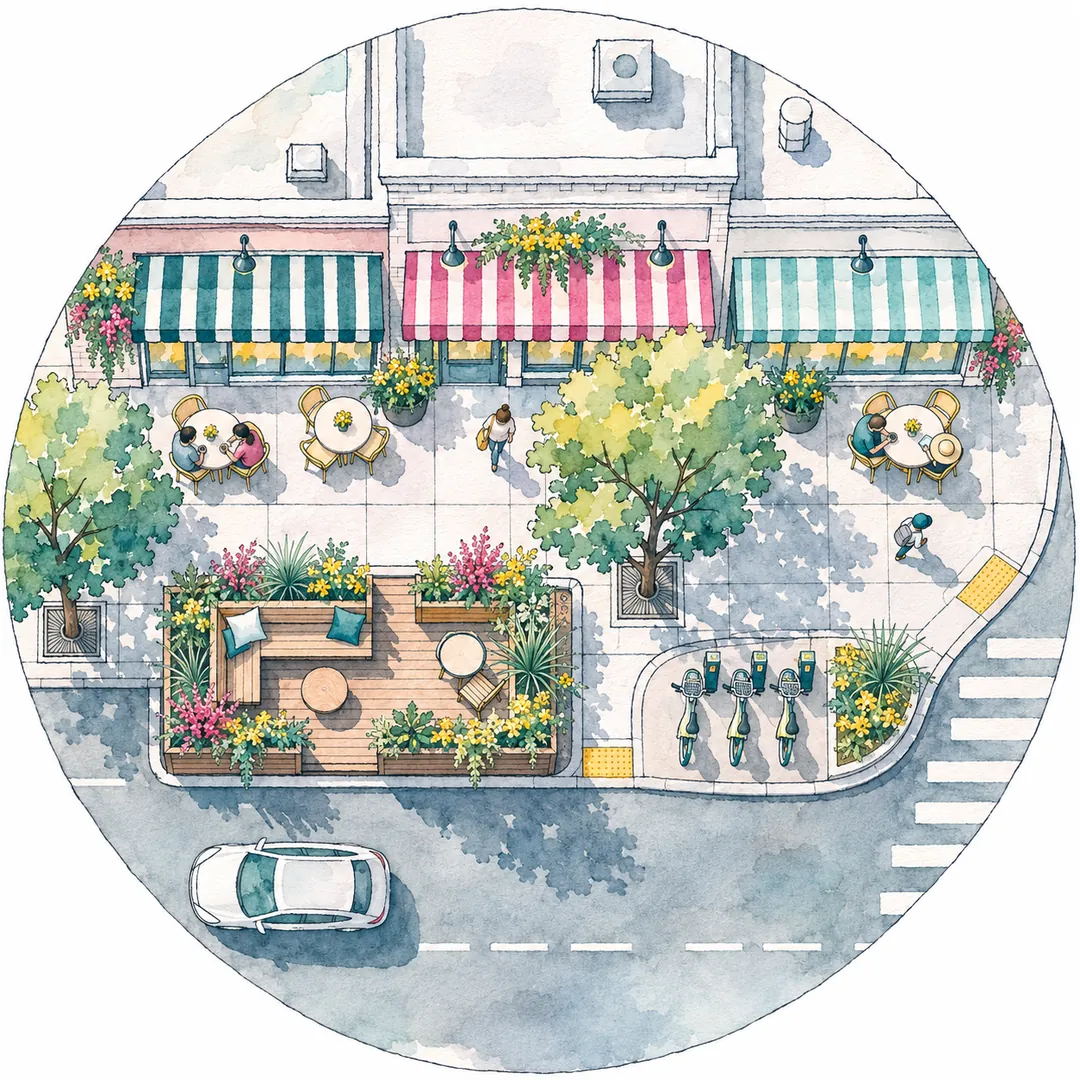
A main street is full of short trips: from the apartment above the bakery to the hardware store, from the bus stop to the office, from the houses a mile out to the Saturday market. The U.S. Department of Energy reports that in 2021, 52% of all trips were under three miles and 28% were under one mile. A neighborhood station puts a bike within reach for those trips.
A neighborhood is not a property with one owner, though. The sidewalks and curbs belong to the city, the storefronts belong to many owners, and the organization that wants the station often controls little land of its own. That shapes how Colibrino starts.
Public space needs a city agreement
A station on a public street, sidewalk or curb extension needs a city agreement before anything is installed. Colibrino starts neighborhood programs in one of two ways: on private land whose owner agrees to host a station (a business, a church lot, a downtown organization’s own property), or under an agreement with the city. Colibrino does not leave dockless bikes on public sidewalks, and it does not run e-scooters.
Cities write their own rules for shared vehicles. When shared e-scooters came to Cheyenne in 2021, the City Council passed three emergency ordinances covering licensing, insurance and enforcement; riders had to be 18 or older, and speed was capped at 15 mph. Denver now runs its shared bike and scooter program through a single operator. Expect a city to want a say in where stations go, how riders park, insurance and data. The network plan lists what the city must approve and who gives the approval; that decision is the city’s to make.
What a neighborhood organization weighs
Where stations go
The first station usually belongs where the organization or a willing owner controls the ground: a corner of a business’s parking lot, a church lot that sits empty on weekdays, the lot behind a downtown organization’s office. Good spots are near the places people already walk to, such as a bus stop, a grocery store or a row of shops, and have power within reach. A station must keep sidewalks, ramps and storefront entrances clear, including the accessible route. The station planning page explains what the site walk checks.
Merchants and parking
Business owners will ask whether a station takes customer parking or blocks a door. On private land, the owner decides. On a public curb, the city decides, and the network plan shows the exact footprint so everyone is discussing the same rectangle.
Who pays
The Neighborhood pay-per-ride program fits here: riders pay per ride or by pass, and a neighborhood, downtown or business organization provides the locations. A sponsor can help cover the program if the host wants that. Rider prices are set in the network plan and shown to riders before they ride. Rider access and payments explains passes and payment options. A Seasonal pilot runs one station for one riding season with a written review at the end, which suits an organization testing demand on its own lot.
Transit and the first mile
A station near a bus stop can cover the walk that is a little too long, at either end of a transit trip. The trip time calculator compares door-to-door time by bike, car and on foot for a trip you choose.
Data the board and the city will ask for
Every month the host receives a ride report with trips, active riders, bike availability, and issues and fixes, plus a CSV export at any time. Reports are aggregate. Individual rider details are used only to run accounts, payments and support, and Colibrino does not sell rider data. See ride data and reporting.
Public funding, honestly scoped
Federal programs such as the Transportation Alternatives Set-Aside and the Congestion Mitigation and Air Quality Improvement Program (CMAQ) fund public sponsors, not private operators. CMAQ applies only in areas in nonattainment or maintenance for ozone, carbon monoxide or particulate matter, and it lists shared micromobility projects among eligible types. In Wyoming, WYDOT’s Transportation Alternatives Program is competitive, with about $4.6 million a year; for the FY2028 cycle, the Statement of Intent window runs January 15 to February 28, applications are open April 16 to May 31, 2027, the local match is 9.51%, and the applicant must employ someone with LPA certification. Colibrino can help a city or other public sponsor prepare the transportation case and the data. It cannot promise eligibility or an award.
What the host provides, and what it receives
The host provides a spot on land it controls (or a city agreement for public space), access to power confirmed by a licensed electrician, one named contact, the owner’s and the city’s approvals, and help telling the neighborhood. It receives the bikes and station, installation, charging, inspections, repairs, rebalancing between stations, rider sign-up and support, launch materials with a safety session, the monthly ride report and a season review.
Rules to settle first
- Land: who owns each spot, and who signs for it.
- City agreement: needed for any station on a public street, sidewalk or curb extension.
- Prices: per-ride prices and passes, and whether a sponsor contributes.
- Ending a ride: trips end at a station bay, never on the sidewalk.
- Sidewalk riding: a city rule, which the rider rules follow.
- Hours, lighting and winter: when the station closes, how it is lit, and the written winter plan.
Example (fictional). A fictional downtown association in a mid-size High Plains town owns a small parking lot behind its office, a block from a bus stop, and a church two blocks away offers a corner of its lot. The network plan proposes a seasonal pilot with one station on the association’s lot, with riders paying per ride or by monthly pass. A spot on a curb extension in front of the cafes is listed as a later phase that needs a city agreement first, with a note of what the city would review. The church lot is held for a second station if the season’s reports show demand.
The neighborhood mobility section of our journal covers planning, funding and data in more depth. To talk through a location, plan a station and we will walk it with you.
Start with one station.
Tell us about the place: how many homes or beds, where people come and go, and where the nearest outlet is. We reply with questions or a time to walk the site with you.