
Station planning and site walks
Before any bike arrives, Colibrino walks the site with your contact and writes down where a station works, what powers it, how riders reach the street and what the first season should look like.
For: Property managers, HOA boards, campus offices and neighborhood groups
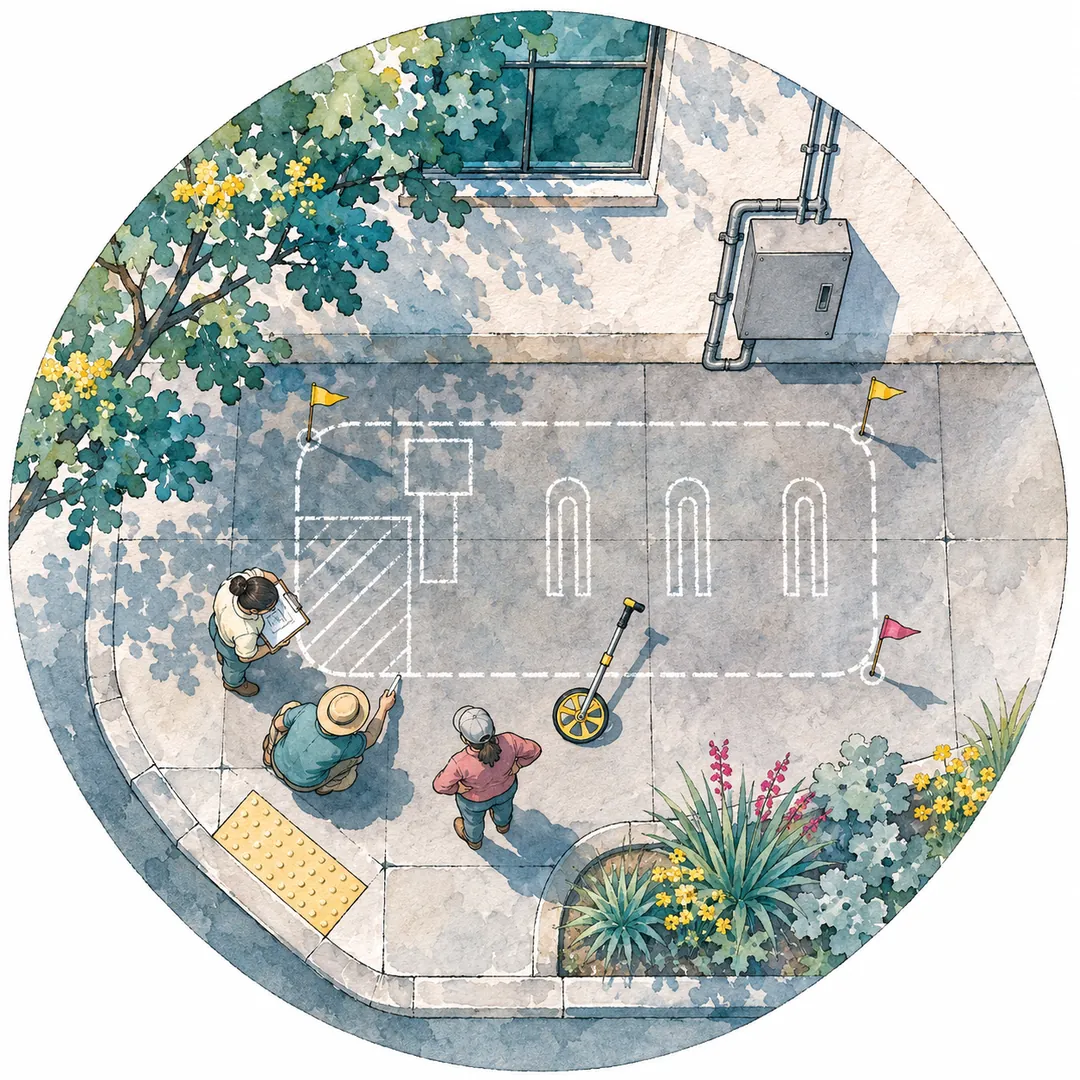
A bike station that sits in the wrong place stays quiet. If riders have to walk around a building to reach it, cross a parking aisle where cars back out, or dig the bikes out of a snow drift every morning, they stop using it, and the host pays for bikes that do not move. Station planning is the work that prevents that, and it happens before anything is ordered or installed.
Colibrino starts every program with a site walk and ends the planning stage with a written network plan. You decide whether to go ahead with the plan in your hands.
What happens on the site walk
The walk takes place with one person from your side: a community manager, a board member, a campus transportation coordinator or a neighborhood organizer. We look at the property the way a rider and a maintenance crew will use it.
Where people already go
We start at the doors people use most: lobby entrances, mail rooms, residence hall exits, the path to the bus stop. A station works best on that line, close enough to see on the way out. We note where residents already park their own bikes, because those spots show what people find convenient.
How riders reach the street
From each candidate spot we trace the route to the nearest street, path or bike lane. We look for curb ramps, gates, steps, parking aisles, and places where bikes and cars would share space badly. The station and its bikes must keep sidewalks, ramps and building entrances clear, including the accessible route people with disabilities use. The U.S. Access Board describes how accessible routes work: clear width, firm surfaces and no obstructions.
Power
Every bay charges, so the station needs electricity. We find the nearest outlet or panel, note what else shares the circuit, and estimate the charging load. A licensed electrician confirms the circuit and does any electrical work; Colibrino does not open panels. You can run the numbers for your own site with the station power calculator.
Ground, wind and snow
We check that the ground is level, paved and drains away from the bays, and whether it can take anchors. In Cheyenne and along the Front Range, wind and snow decide a lot: we note the prevailing wind, where drifts form against walls, and where plows pile snow. A spot in the lee of a building, out of the plow’s path, keeps bikes usable on cold mornings. The seasonal operations page explains how we plan for winter.
Light and visibility
A station should be lit at night and visible from windows, a front desk or a camera. Visibility helps riders feel safe and discourages tampering.
Rules and approvals
We ask about the rules that apply to the spot: lease terms, HOA covenants, campus policies, city permits for anything in a public right of way, and any requirements from your property insurer or the local fire marshal for charging equipment. We list what needs approval and who gives it. The site assessment checklist covers the same ground if you want to look before we visit.
What the network plan contains
After the walk, Colibrino writes a network plan. It is short, specific and yours to keep, whether or not you go ahead.
| Section | What it says |
|---|---|
| Station locations | One or more spots, marked on a site plan, with the reason for each |
| Size | Number of bikes and charging bays, with the assumptions behind them |
| Power | The circuit for each station, the estimated load and what the electrician must confirm |
| Riding area | Routes to the street, where riding is allowed on the property, and where it is not |
| Program | Resident amenity, campus program, neighborhood pay-per-ride or seasonal pilot |
| Rules | Draft rider rules for your community, based on your lease, covenants or policies |
| Season | Full year with a reduced winter fleet, or a riding season with winter storage |
| Launch | A proposed install date, launch week plan and the first report date |
| Price | Colibrino’s proposal for the program, with what is included |
The size estimate uses the same method as our fleet size calculator: the number of people who could ride, the share likely to sign up, rides per member and how many rides one bike can serve on a busy day. We start at the low end and grow the network once a season of rides shows where bikes are needed.
Example (fictional). At Larkspur Commons, a fictional 240-home apartment community with about 450 adult residents, the site walk found two lobby doors used by nearly everyone and a third, quieter door by the pool. The network plan put 2 stations of 8 bays each beside the two lobby doors, with 14 bikes: 54 expected members at a 12% sign-up assumption, 135 rides a week, and 27 rides on the busiest day at 2 rides per bike. Each station’s 8 bikes charge on one 20-amp, 120-volt circuit, an 800 W peak load, 41.7% of the circuit’s 1,920 W planning limit. The pool door was left for a later season. See the full example network.
What you provide, and what you receive
You provide a person to walk the site with us, access to the property and its electrical room, the rules that apply to the spot, and a decision once you have the plan.
You receive the site walk notes with photos, the network plan and Colibrino’s proposal. If you go ahead, the plan becomes the brief for installation, the fleet and launch week. The full sequence is on how we work.
When planning changes the answer
Sometimes the walk shows that a station is not a good fit yet: no reachable power without new wiring, no spot that keeps paths clear, or rules that need a board vote first. The plan says so plainly and lists what would have to change. A seasonal pilot with one station is often the right first step when the demand is uncertain; the programs page compares the options.
To book a site walk, tell us about your property on the contact page.
Start with one station.
Tell us about the place: how many homes or beds, where people come and go, and where the nearest outlet is. We reply with questions or a time to walk the site with you.