
A Class 1 pedal-assist e-bike fleet
Colibrino supplies the bikes and looks after them. Each one is chosen to a written specification, not a brand, and the specification is the same at every station.
For: Property managers, HOA boards, campus offices and neighborhood groups
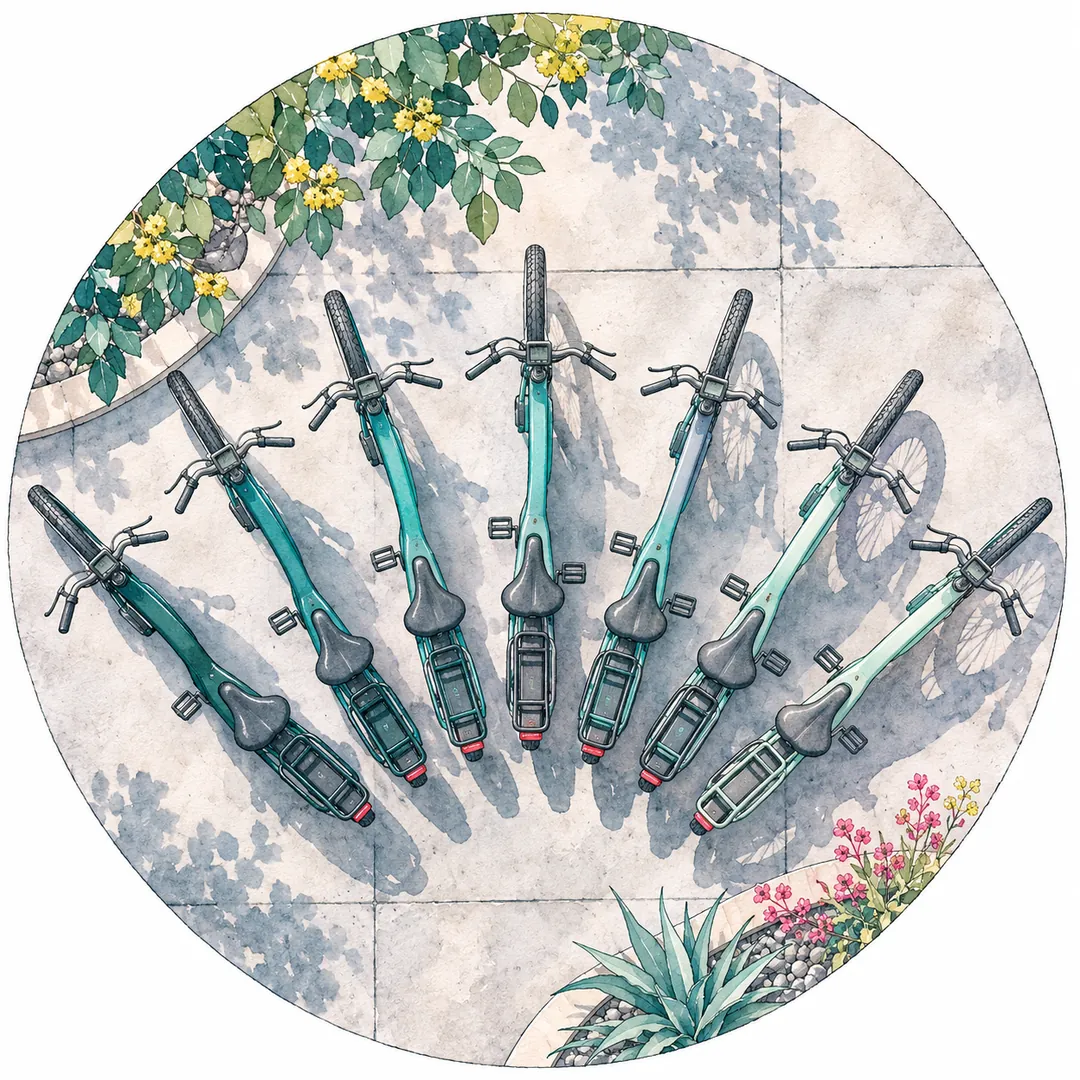
The bikes are what riders see, so they decide whether a station gets used. Colibrino supplies them as part of the service: you do not buy or store them, and you do not have to compare models. The program is not tied to one manufacturer. Instead, every bike in a Colibrino station must meet the written specification below, whatever the size of the station.
Lightweight step-through frames
A shared bike has many riders of different heights, in work clothes, skirts or winter coats. A step-through frame lets each of them get on without swinging a leg over a high bar. A lightweight bike is easier to walk in and out of a bay, lift over a curb or turn around on a narrow path. The seat adjusts without tools so each rider can set their own height. We do not publish a bike weight or battery size, because those depend on the model chosen for each fleet.
Class 1 pedal assist, and nothing faster
Wyoming law defines three classes of electric bicycle in W.S. 31-1-101(a)(xxxiv). A Class 1 bike’s motor helps only while the rider pedals and stops helping at 20 mph. A Class 2 bike’s motor can move it without pedaling, up to 20 mph. A Class 3 bike assists while pedaling up to 28 mph. Colorado uses the same three classes.
Colibrino specifies Class 1 only. W.S. 31-5-707 also requires the motor assist to stop when the rider stops pedaling, applies the brakes or disengages the motor, and every bike in the fleet must behave that way.
Why no throttles and no Class 3
A shared fleet carries confident cyclists and people who have not ridden in years. A Class 1 bike rides like a bicycle that helps: when you stop pedaling, it coasts. There is no throttle to twist by accident while walking the bike, and no extra speed on a path shared with children and dog walkers.
Class 1 also keeps the rules simple for hosts. The Colorado Department of Transportation says Class 1 and Class 2 bikes are generally allowed wherever traditional bicycles are permitted, while Class 3 bikes are restricted to streets or designated paths and carry a minimum rider age of 16 and a helmet requirement for riders under 18. Wyoming lets a local authority or state agency regulate e-bikes on trails it controls (W.S. 31-5-707(f)), so local rules can differ from the state’s, and campuses and HOAs set rules of their own. Check the rules where you are; our e-bike classes guide sets Wyoming and Colorado side by side.
Certified electrical systems and batteries
Every bike Colibrino specifies is certified to UL 2849, the standard for e-bike electrical systems, by a nationally recognized testing laboratory. Every battery is certified to UL 2271, the standard for light electric vehicle batteries, or tested as part of the bike’s UL 2849 system. These are requirements Colibrino places on its equipment; they are not certifications of the company.
Regulation is moving the same way. In June 2026 the U.S. Consumer Product Safety Commission proposed a mandatory safety rule for micromobility batteries built on UL 2849 and UL 2271, with added requirements. In Colorado, HB25-1197 requires e-bike lithium-ion batteries to be certified by an accredited testing laboratory. Each bike charges only on its manufacturer’s charger, in line with UL Standards and Engagement’s advice to use only the charger supplied or recommended by the maker. Batteries are charged only in the station bays or an operator facility.
Class labels on every frame
Wyoming has required, since January 1, 2020, that manufacturers and distributors permanently attach a label to each e-bike showing its class, top assisted speed and motor wattage, printed in at least 9-point type (W.S. 31-5-707(b)). In Colorado, HB25-1197 requires manufacturers and distributors, on or after January 1, 2027, to label each new e-bike with its class. Colibrino checks that every bike carries its label before it enters service. We do not modify motors or speed settings; Wyoming law forbids that unless the label is replaced to show the new class.
Lights, bells and baskets
These are specification choices that make a shared bike practical every day:
- front and rear lights that run from the bike’s battery, so a rider never has to bring their own
- a bell, for shared paths and parking lots
- a front basket or rack sized for a grocery bag or a backpack
- fenders, a chain guard and a kickstand
Wyoming law also requires e-bikes to meet the federal bicycle requirements in 16 C.F.R. 1512 (W.S. 31-5-707(d)).
Recall checks
Before a bike enters service, its model, battery and charger are checked against U.S. Consumer Product Safety Commission recall notices. We keep a record of each bike’s model and battery serial number, so a new recall can be matched to the bikes it affects. A recalled bike or battery comes out of service until the manufacturer’s remedy is done. The maintenance page covers what else takes a bike off the street.
Sizing the fleet
A station with too few bikes frustrates riders; one with too many costs the host money for bikes that sit. We size the fleet from five assumptions: how many people could ride, the share likely to sign up, rides per member per week, how much busier the busiest day is, and how many rides one bike can serve on that day. You can run the same method in the fleet size calculator.
Example (fictional). Larkspur Commons is a fictional 240-home apartment community with about 450 adult residents. At a 12% sign-up assumption there are 54 members. At 2.5 rides per member per week that is 135 rides a week: about 19 on an average day and 27 on the busiest day. At 2 rides per bike on the busiest day, the plan calls for 14 bikes and 16 bays, in 2 stations of 8 bays each. See the full example network.
We start at the low end and add bikes once a season of rides shows where they are needed. If your community needs an adaptive bike, such as a trike, tell us at the site walk and we will assess it and quote an option.
What you provide, and what you receive
You provide the space for the station and the program agreement. You receive the bikes, their batteries and chargers, all labeled, inspected and maintained by Colibrino, and their removal under the written end-of-program terms. To start, plan a station.
Start with one station.
Tell us about the place: how many homes or beds, where people come and go, and where the nearest outlet is. We reply with questions or a time to walk the site with you.