
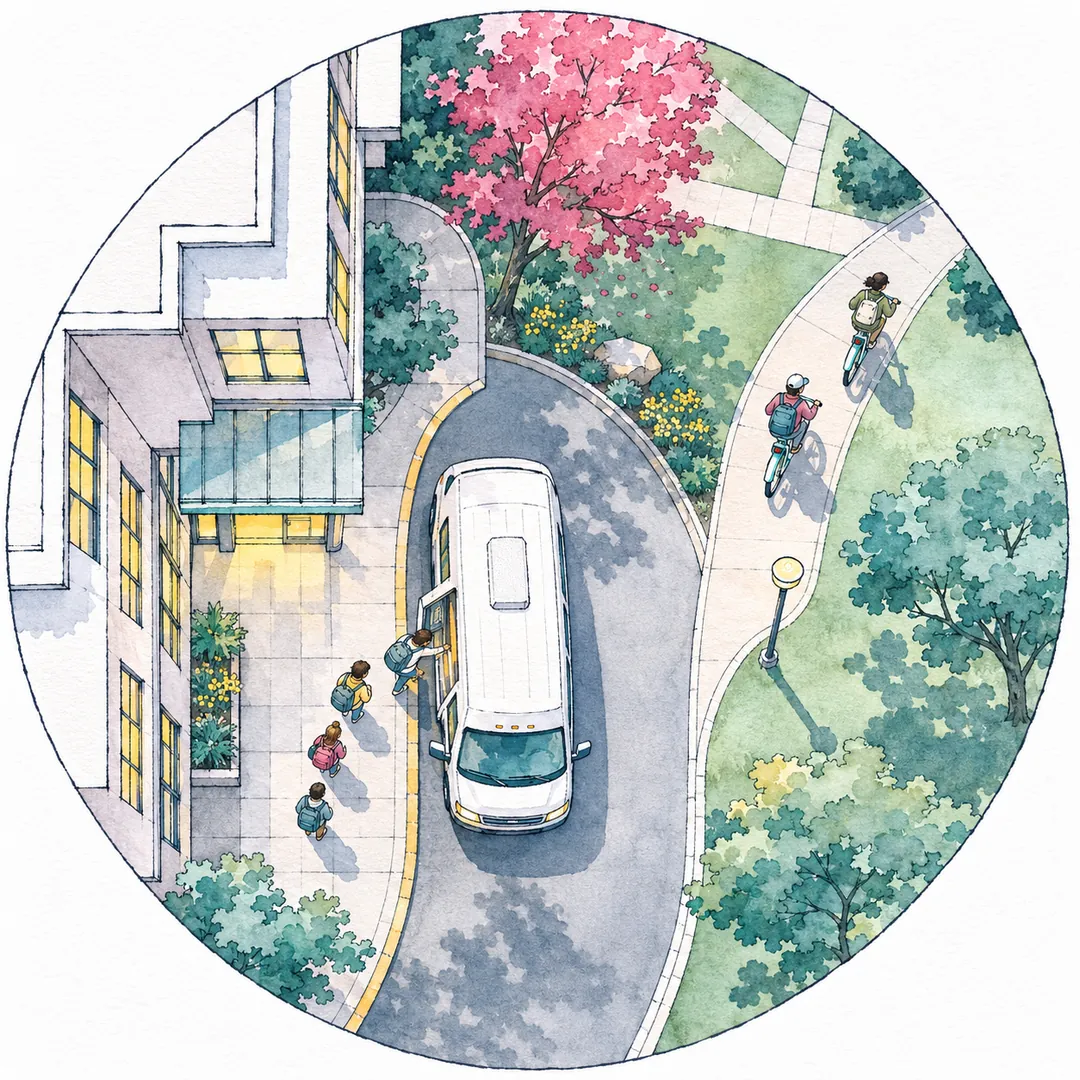
An off-campus student housing property has four ways to get residents to campus: a location close enough to walk, a property-run shuttle, transit (a city or campus bus the property promotes, buys into or pays passes for), and shared e-bikes. Shared e-bikes usually beat a shuttle for properties within about 3 miles of campus on a safe bike route, where residents travel at many different times of day and the property has a plan for winter. A shuttle or transit wins for longer distances, for the heaviest class-change peaks and for the worst weather, which is why many properties end up with a mix.
This guide is written for owners, operators and asset managers of purpose-built student housing, and for the university offices that work with them. It sets out the trip-time arithmetic, the service hours, the cost drivers and the weather rules, using university pages that show how real properties and campuses handle the trip today.
Four ways residents get to campus
Every property answers the campus trip with some combination of four options. Each one puts different work and cost on the property, and each one serves a different part of the day.
Walking is the cheapest option and depends entirely on the site. Within about a mile, with good sidewalks and safe crossings, the walk takes about 20 minutes at 3 mph and is a real option on most days.
A property shuttle is a van or small bus the property runs or contracts between the building and campus. It is a familiar amenity near some campuses. In a December 2021 RIT News article, the supervisor of the Town of Henrietta, home to RIT, said the off-campus apartment projects near the campus “almost all offer a shuttle service,” which reduces the number of cars heading to campus. The same article reported that more than 4,000 RIT students lived in large off-campus housing communities near the university.
Transit means a city or campus bus that stops near the property. The property can promote it, pay for passes, or buy into the service. The RIT article quotes RIT’s senior vice president for finance and administration saying that transportation is a key part of the discussion with these developments, with several of them participating in the university bus system and reimbursing their share of the cost.
Shared e-bikes are pedal-assist bikes at a station on the property, available to residents who sign up. In a resident amenity program the property pays a program fee, and residents ride free or at a member rate.
Many campuses offer students several of these at once. Champlain College’s off-campus page lists free parking for commuter students at specific campus locations, a free shuttle between its Lakeside campus, a main campus building and an apartment building, free access to the local bus system with a student ID card, and indoor and outdoor bike storage. It also tells students to consider how long it might take to walk, bike or bus to and from campus before choosing a place to live, which is the question your prospective residents are asking about your property.
| Option | What the property provides | What makes the cost grow | Strongest at | Weakest at |
|---|---|---|---|---|
| Walking | A location and safe routes | Nothing ongoing | Short distances | Distance, cold, dark |
| Shuttle | Vehicles, drivers, insurance, a schedule | Service hours | Distance, peaks, bad weather | Waiting, late nights, weekends |
| Transit | Promotion, passes or a cost share | Riders or a negotiated share | Frequent routes already at the door | Routes and hours set by others |
| Shared e-bikes | A station site, power, a contact | Fleet size and months of service | Trips at any hour, 1 to 3 miles | Wind, snow, big peaks |
Residents who cannot ride or walk far
Every plan needs an answer for residents with a disability, an injury or a heavy load. A bike-only answer leaves them out. The University of Wyoming, for example, lists a paratransit service for people who are unable to use its fixed-route buses because of a disability, which can be scheduled for any purpose within Laramie city limits on weekdays from 6:30 a.m. to 6:30 p.m., once eligibility is approved by its Transportation Services office. Ask whether the campus or city service your residents use offers something similar, and make sure any shuttle you run can carry a resident who uses a wheelchair or other mobility device. Adaptive e-bikes, such as trikes, are worth asking any e-bike provider about, but they do not replace an accessible vehicle.
Door-to-door time: how a shuttle, an e-bike and walking compare
Door-to-door time decides how residents rate a commute. A shuttle moves faster between stops, but every rider waits for it; an e-bike leaves when the rider does. On the planning assumptions below, an e-bike arrives first for most trips under about 3 miles, and walking beats an infrequent shuttle for trips under about a mile.
The arithmetic
Each option’s time is a few simple pieces added together. These are planning assumptions, so replace them with your own numbers.
- E-bike: distance at 12 mph average (including stops at lights), plus 2 minutes to unlock, walk to the bay and dock. These are the defaults in the trip time calculator.
- Walking: distance at 3 mph.
- Shuttle: an average wait of half the time between departures (a resident who arrives at the curb without checking the schedule waits, on average, half the gap), plus 2 minutes at the curbs, plus distance at the shuttle’s average speed. The chart uses 15 mph, which allows for stops, lights and loading.
For example, at 2 miles the e-bike takes 2 ÷ 12 × 60 + 2 = 12 minutes. A shuttle every 15 minutes takes 7.5 + 2 + 8 = 17.5 minutes. Walking takes 40 minutes.
Where the lines cross
On these assumptions, the e-bike is quicker than the stopping shuttle at every distance in the chart. A faster, more frequent shuttle changes that. The break-even distance, beyond which the shuttle arrives first, is half the gap between departures divided by the minutes the shuttle saves per mile over the e-bike (5 minutes per mile for the e-bike, 60 divided by the shuttle’s speed for the shuttle).
| Shuttle departs every | Break-even distance, shuttle at 25 mph (express) | Break-even distance, shuttle at 15 mph (with stops) |
|---|---|---|
| 10 minutes | 1.9 miles | 5.0 miles |
| 15 minutes | 2.9 miles | 7.5 miles |
| 20 minutes | 3.8 miles | 10.0 miles |
| 30 minutes | 5.8 miles | 15.0 miles |
Two more crossings matter for properties close to campus. Walking beats a shuttle every 15 minutes for trips under about 0.6 miles, and beats a shuttle every 30 minutes for trips under about 1.1 miles. A shuttle at a property half a mile from campus is mostly a convenience in bad weather, not a time saver.
What the arithmetic leaves out
- Planned departures. A resident who watches a live tracker waits less. Champlain’s page points students to a shuttle locator that shows the wait time. The resident still leaves on the shuttle’s schedule rather than their own, which is a cost in a student’s day even if it is not minutes at the curb.
- Finding a bike. The e-bike time assumes a bike is in the station. A fleet sized for the busiest day keeps that true most of the time; see the capacity section below.
- The last walk on campus. A shuttle drops everyone at one stop. A bike can be locked near a specific building if the campus allows it.
Short trips are common everywhere, not only near campus. The U.S. Department of Energy reports that in 2021, 52 percent of all trips by any mode were less than three miles, and 28 percent were less than one mile. Run your own property’s distances through the trip time calculator, adding the shuttle’s wait yourself.
Service hours: matching the schedule residents actually keep
A shuttle or bus serves residents only during its service hours, while shared e-bikes serve them whenever the station is open. Student trips run well beyond the class day: library nights, lab sessions, part-time jobs, weekends and early gym visits. Map those trips before deciding.
What campus transit hours look like
Campus and city transit is often most frequent at class times and thinner at other hours, as these two examples show. The University of Wyoming’s transportation page lists an Express Route every 10 minutes and a Link Route every 20 minutes, both Monday to Friday from 6:30 a.m. to 6:30 p.m. Late nights and weekends are covered by SafeRide, an on-call service that gives a free ride anywhere in Laramie city limits on a set schedule: until midnight Monday to Wednesday, until 2 a.m. Thursday and Friday, two windows on Saturday and an afternoon window on Sunday.
Clemson University shows the same pattern in a college town where apartments sit on bus routes. Its community routes page describes Clemson Area Transit (CATbus) as free, electric-powered buses that run year-round between main campus and surrounding areas, with a Red Route serving Clemson and Central apartments and a Gold Route serving GrandMarc, Publix and Crawford Falls. For fall 2026, Clemson News reported that from the first day of classes the red and gold routes run at 15-minute peak service from 7 to 11 a.m. and from 2 to 6:30 p.m., with 30-minute service from 11 a.m. to 2 p.m., and that Clemson Nightline runs seven days a week from 6 p.m. to 2 a.m.
City bike share can run around the clock. Boulder BCycle, an electric bike share with stations downtown, on University Hill and on the CU campuses, states that it is available for rides 24 hours a day, seven days a week.
Which option covers which hours
| Time band | Shuttle on a class-day schedule | Bus timed to classes | Shared e-bikes at the property |
|---|---|---|---|
| Weekday morning classes | Yes, at its best | Yes, often at peak frequency | Yes, limited by fleet size |
| Midday | Often reduced | Often reduced | Yes |
| Weekday evening | Often ends | Reduced or on-call service | Yes, if the station is open |
| Late night | Rarely | On-call service where it exists | Set by the property’s rules |
| Weekends | Rarely | Reduced | Yes |
| Breaks and summer | Usually stops | Reduced | Reduced fleet or storage |
The table assumes a shuttle run on a class-day schedule and a bus timed to classes, like the examples above; check your own shuttle contract and local transit schedules. The practical question is simple: which of your residents’ trips happen when your shuttle is parked? Those trips are where shared e-bikes add the most.
How to map your residents’ trips
You do not need a travel survey firm to see when residents travel. Three cheap sources usually give a clear picture within two weeks:
- Door or gate counts by hour, if your access system records them, for one normal week of classes.
- A two-question survey at the front desk or in the resident app: “When did you last leave for campus, and when did you come back?” and “How did you travel?”
- Shuttle boarding counts by run, which most drivers can record on a tally sheet.
Group the answers into the time bands in the table above. If a large share of trips falls in bands where your shuttle is parked or your bus runs every 30 minutes or worse, those are the hours to cover with something else.
Late-night riding raises its own rules. A property can set station hours and require lights after dark; the station’s location should be lit and visible from the front desk or a camera.
What each option costs, and what drives the cost
The three paid options grow with different things. A shuttle’s cost grows with the hours it runs, whether or not anyone rides. Transit costs grow with passes sold or with a negotiated share. A shared e-bike program’s cost grows with fleet size and the months it runs, and its cost per ride falls as residents use it more.
Shuttle
A shuttle budget is built from vehicles (purchase or lease), drivers’ wages and training, insurance, fuel or electricity, maintenance, cleaning and dispatch. Most of those are paid by the hour of service. Ask any contractor to quote a cost per service hour and multiply by the hours you plan.
Vehicle size also changes who can drive. Under federal rules, a vehicle used in commerce and designed to transport 16 or more passengers, including the driver, is a commercial motor vehicle (49 CFR 383.5), and no person may legally operate one without a commercial driver’s license that meets federal standards (49 CFR 383.23). A smaller vehicle avoids that requirement and carries fewer people per trip. Your insurer and your state licensing office will have their own requirements on top of the federal rule.
Transit
Transit costs the property least when a frequent route already passes the door. If not, the options are promotion only, passes paid by the property, or a cost-sharing agreement like the RIT arrangement described above. Some properties pass a transportation cost to residents through the lease; if you do, name it plainly in the lease and in your marketing.
Shared e-bikes
In a resident amenity program, the property pays a monthly program fee that depends on fleet size and months of service; electricity is a small part of the cost. The amenity budget worksheet converts a proposal into cost per bed, per member and per ride. Our article on whether residents want an e-bike share amenity covers the demand side.
Example (fictional). A fictional 600-bed student community sits 1.4 miles from campus. Its operator compares two proposals, both with fictional figures.
The shuttle contractor quotes a hypothetical $85 per service hour, all in. Running 12 hours a day, 5 days a week, for 32 weeks of classes is 1,920 service hours, or $163,200 a year: $22.67 per bed per month over 12 months. If the shuttle carried 250 rides on an average weekday (a hypothetical count), that would be 40,000 rides a year and $4.08 per ride.
The e-bike proposal is a fictional $2,400 a month for 9 months, which is not a Colibrino price. The amenity budget worksheet gives $21,600 a year, $3.00 per bed per month and, with 72 members riding 4 times a week, 1,248 rides a month and $1.92 per ride.
The e-bike program costs far less, but it serves 72 members, not every resident at 9 a.m. The operator’s real choice is how many shuttle hours the e-bikes can replace, not whether to replace the shuttle outright.
Questions to ask any provider
Whichever option you price, ask the same questions so the proposals can be compared:
- What exactly does the price include: vehicles or bikes, staff, insurance, fuel or electricity, repairs, replacements?
- Which months and hours does it cover, and what happens over winter break and summer?
- What do you report to us each month, and can we export the data?
- How fast are problems fixed, and who do residents call?
- What happens at the end: notice, removal of equipment, refunds of any prepaid passes?
A Colibrino network plan states what its price includes, and every agreement carries a written winter plan, a monthly ride report with a CSV export, and written end-of-program terms.
Capacity: the class-change peak
A shuttle moves many people at one moment; a shared fleet moves one rider per bike per trip. At class-change peaks, when hundreds of residents leave in the same half hour, capacity decides the answer more than speed does.
Shuttle capacity
A shuttle’s capacity per hour is its seats times its departures. As an illustration, a 14-passenger vehicle leaving every 15 minutes offers 56 seats an hour in each direction; two vehicles double it. If more residents than that leave for 9 a.m. classes, some wait for the next run, which adds a full gap to their trip.
E-bike capacity
A shared fleet is sized for its busiest day. The fleet size calculator works from the number of people who could ride, the share who sign up, rides per member per week, how much busier the peak day is and how many rides one bike can serve that day.
Example (fictional). For the fictional 600-bed community above, the operator assumes 12 percent of residents sign up (72 members), 4 rides per member per week (288 a week, about 41 on an average day), a busiest day 1.4 times the average (57.6 rides) and 3 rides per bike on that day. The fleet size calculator returns 20 bikes, 22 charging bays and 3 stations of 8 bays. Twenty bikes can carry 20 residents in the 8:30 a.m. wave; they cannot carry 150.
One station or two
Where the bikes come back to matters as much as how many there are. With one station at the property, every trip starts and ends at home, and a resident who rides to a 9 a.m. class leaves the bike locked on campus until the class ends. That bike serves one resident for the whole morning, so rides per bike on the busiest day stay low, which is why the example above assumes 3. A second station on campus land lets residents dock on arrival, so one bike can carry several residents in a morning, but it needs the campus’s approval and a site with power. Start with one station at the property, watch how long bikes stay away, and add a campus station only when the data and the campus both support it.
A split that uses both
The two options fit together. Run the shuttle at the peaks it serves well, and let shared e-bikes carry the midday, evening and weekend trips the shuttle serves poorly. Because a shuttle’s cost follows its service hours, cutting lightly used midday and evening runs can save more than trimming the morning service.
Weather, wind and winter
Weather cuts riding, and a property cannot control it. In cold, snowy or windy months, shared e-bikes should be a supplement to a shuttle or transit, not the only way to campus.
What campus surveys found
The 2012 University of Illinois bike sharing feasibility study reports that the majority of campus cyclists in Champaign-Urbana stop riding in winter, taking the bus or walking instead. It cites an earlier campus survey of more than 580 respondents in which 210 of those who chose not to cycle to class gave uncertain weather as the reason. The study describes four to six months of cold weather in the area each year.
High Plains wind and snow
On the High Plains, wind is as important as snow. The National Weather Service’s 2025 climate summary for the Cheyenne airport records an average wind speed of 11.3 mph and a highest gust of 75 mph. It records 35.1 inches of snowfall in 2025 against a 1991 to 2020 normal of 62.9 inches, and 14 days with an inch or more of snow against a normal of 19.5. The Wyoming State Climate Office notes that in winter there are frequent periods when the wind reaches 30 to 40 mph with gusts of 50 or 60 mph, and that Wyoming ranks first in the United States for annual average wind speed, at 12.9 mph.
A winter plan for each option
- Shuttle: keep the full schedule in the coldest months, when demand moves from bikes to the shuttle, and plan snow routes and a pickup point out of the wind.
- Transit: check whether winter and break schedules change, and tell residents.
- Shared e-bikes: choose between a full-year program with a reduced winter fleet and a riding season with winter storage and a spring relaunch. Colibrino’s practice is never to charge a frozen battery, and its winter options are on seasonal operations. Riders can read our guide to riding an e-bike in winter.
- Walking: clear sidewalks and crossings on your own property early, because the first block decides whether anyone walks.
Measure your own season
Regional climate tells you what to plan for; your own first season tells you what to keep. A monthly ride report shows which months shared bikes carry real trips and which months they sit. Compare those months with your shuttle’s boarding counts. If bike rides fall as boardings rise each November, the two options are doing their jobs, and the next winter plan can move bikes into storage earlier or later to match.
Resident experience: independence, waiting and batteries
Residents judge a commute on more than minutes. Waiting at a curb, a crowded van and a shuttle that stops at 6 p.m. shape how residents describe the property to the next year’s renters. Shared e-bikes offer independence; a shuttle offers certainty in bad weather.
What prospective residents compare
Student housing competes on amenities. The RIT article lists what off-campus communities near RIT offer that university housing could not: competitive rates, private bathrooms, in-unit laundry, pools, fitness centers and pet-friendly rules. Transportation belongs on that list, because residents use it on most class days. A leasing tour that can answer “how long to class at 9 p.m. in February?” is answering a real question.
Personal e-bikes and batteries
Some residents bring their own e-bikes or e-scooters, and with them batteries that charge in their rooms. A study by UL Standards & Engagement with the League of American Bicyclists’ Bicycle Friendly University program, published March 11, 2025, found that nearly two-thirds of respondents (63 percent) believe riders charge e-bikes in residential buildings, with more than 65 percent pointing to convenience and inadequate charging infrastructure. A shared fleet whose batteries charge only in the station gives some residents a reason not to bring a battery into the building at all. It does not remove personal devices, so the property still needs a written rule for them; our article on why colleges are banning e-bikes in dorms covers the policy options.
Storage for residents’ own bikes
Champlain’s page lists indoor and outdoor bike storage among its commuting options, and an off-campus property should plan for the same. Residents who ride their own bikes need covered, lockable racks close to the door, separate from any charging area.
Rider safety
A shared program should start with a short safety session in the first weeks of term, rider terms every resident accepts at sign-up and a clear way to report a problem. Class 1 bikes, which the Colorado Department of Transportation describes as pedal-assist only with a 20 mph maximum, are a reasonable fit for residents who may be new to e-bikes. State and local rules on helmets, age and where e-bikes may ride differ; the e-bike classes guide summarizes Wyoming and Colorado, and a city or campus can set stricter rules.
Lease and move-out details
Write the rules into the lease or house rules: who may ride, minimum age, where shared bikes may be left during a class, what happens to a resident’s membership at move-out, and how a lost or damaged bike is handled. Settle them before launch, not after the first complaint.
Working with the campus and the city
The best transportation answer for a property often already exists and belongs to someone else. Before buying a shuttle or a fleet, ask the university and the city what they run, what they plan and what they will allow on their land.
Questions for the university
- Does a campus or city bus stop near the property, and could the property buy into it as several RIT-area properties do?
- Do students already have free access to a bike share or a bus with their ID card?
- Where may a property shuttle stop on campus, and where may residents leave a shared bike?
- Would the campus approve a return station on campus land for the property’s bikes?
The second question matters more than it seems. CU Boulder’s Parking and Transportation office announced that from August 1, 2025, all CU students and employees are eligible for a free Boulder BCycle membership, through a partnership between CU Boulder’s Environmental Center and BCycle, with unlimited trips under 60 minutes for 12 months and fees for trips over an hour. A property near those stations would do better to promote that membership than to duplicate it. Our guide to campus bike share models compares this kind of membership with campus-run and contracted fleets.
What a property can offer the campus
The conversation goes better when it runs both ways. A property can share aggregate trip counts from its shuttle or bike program, carry campus safety messages to its residents, and take pressure off campus parking. Those are outcomes a campus transportation office cares about, and they are a better opening than a request for a stop or a station site.
Questions for the city
- Is the route between the property and campus safe for riders: bike lanes, paths, crossings and lighting?
- Would a shuttle stop or a station on a public street or sidewalk need a permit or agreement? A shared bike station on public land needs the city’s agreement first.
- Are there plans for transit changes, bike lanes or a bike share that would change the answer in two years?
In Laramie, for example, the University of Wyoming counted 10,630 students on the 15th day of fall 2026 classes, and its transit page lists Park ’N Ride lots and paratransit alongside its bus routes. A property there would start by asking how close its residents are to the Express or Link routes, and when SafeRide covers the trips those routes do not.
When shared e-bikes beat a shuttle: a decision rule
Shared e-bikes beat a shuttle when four conditions hold together: the property is within about 3 miles of campus, the route is safe to ride, residents travel at many different times and the property has a plan for winter. When any of those fails, keep a shuttle or transit as the main answer and use e-bikes to fill the hours it does not cover.
| Situation at the property | Lead with | Add |
|---|---|---|
| Within about 1 mile on safe sidewalks and crossings | Walking, with secure storage for residents' own bikes | Shared e-bikes for errands and late trips |
| 1 to 3 miles, bike lanes or paths most of the way, trips spread through the day | Shared e-bikes | Transit passes or a peak-hour shuttle for winter and bad weather |
| 1 to 3 miles with a campus or city bus at the door every 10 to 15 minutes | Transit: promote it, buy in or pay passes | Shared e-bikes for evenings, weekends and trips the bus does not reach |
| More than about 3 miles, or no safe bike route | Shuttle or transit | Bike storage; shared e-bikes only if a safe route exists |
| Hundreds of residents leaving in the same half hour | Shuttle at the peaks | Shared e-bikes for midday, evening and weekend trips |
| Long, windy or snowy winters | A shuttle or transit option that runs all year | A seasonal e-bike program with a reduced winter fleet or storage |
Applying the rule
Work through the rule in this order:
- Measure the trip. Distance from the front door to the main class buildings, and the route a rider would take.
- Map the hours. When residents leave and return, using class schedules, a short survey or door data.
- List what already exists. Campus buses, city routes, bike share and student passes, with their hours.
- Compare times. Use the trip time arithmetic for each option at your distance and at your shuttle’s frequency.
- Check capacity. Count residents in the largest class-change wave and compare with shuttle seats and fleet size.
- Plan the winter. Decide what runs in the coldest and windiest months.
Example (fictional). A fictional 640-bed community sits 2.2 miles from campus on the High Plains. It runs a leased shuttle every 20 minutes from 7:30 a.m. to 5:30 p.m. on weekdays; a city bus stops at the corner every 30 minutes; a bike lane covers most of the route except one arterial crossing with a signal. On the planning assumptions above, an e-bike takes about 13 minutes door to door, the shuttle about 20.8 minutes and the bus about 25.8 minutes, while walking takes 44. Residents’ late trips to the library and to jobs fall after the shuttle stops. The operator keeps the shuttle at the morning and afternoon peaks, drops the midday runs, adds a shared e-bike station by the leasing office for the rest of the day and weekends, and keeps full shuttle hours from December through February, when the e-bike fleet is reduced. The leasing team gets one honest answer for every hour of the week.
Where Colibrino fits
Colibrino is a Cheyenne, Wyoming company that plans, installs and runs small e-bike stations, with Class 1 pedal-assist bikes and compact charging stations, for apartment communities, universities, student housing and neighborhoods. Most student communities fit its Resident amenity program, in which the property pays a monthly program fee and residents ride at no charge or at a member rate the property chooses; batteries charge only in the station bays. The student housing page explains what the property provides and receives, and programs compares the resident amenity with a one-season pilot.
What to do next
Start with the trip, not the vehicle. The checklist below takes an operator from a question to a decision in the order the evidence arrives.
- Measure distance and route from your main door to the two or three buildings most residents use, and note crossings, lighting and bike lanes.
- Collect the hours residents travel, from class schedules, a two-question survey or front desk observation, including evenings and weekends.
- Call the university’s transportation office and ask about bus routes, buy-in arrangements, student ID passes, bike share memberships and campus stops.
- Run the numbers with the trip time calculator, adding half your shuttle’s gap as waiting time, and with the amenity budget worksheet once you have a proposal.
- Size a fleet for your busiest day with the fleet size calculator, then start below that number.
- Write a winter plan for every option you keep.
- Pilot before committing. A one-season pilot of shared e-bikes, alongside a trimmed shuttle schedule, will show which hours each option really serves.
More articles for campus offices and housing operators are collected under campus mobility. When you want a written plan for a station at your property, ask for a site walk and we will start at the door your residents use most.