
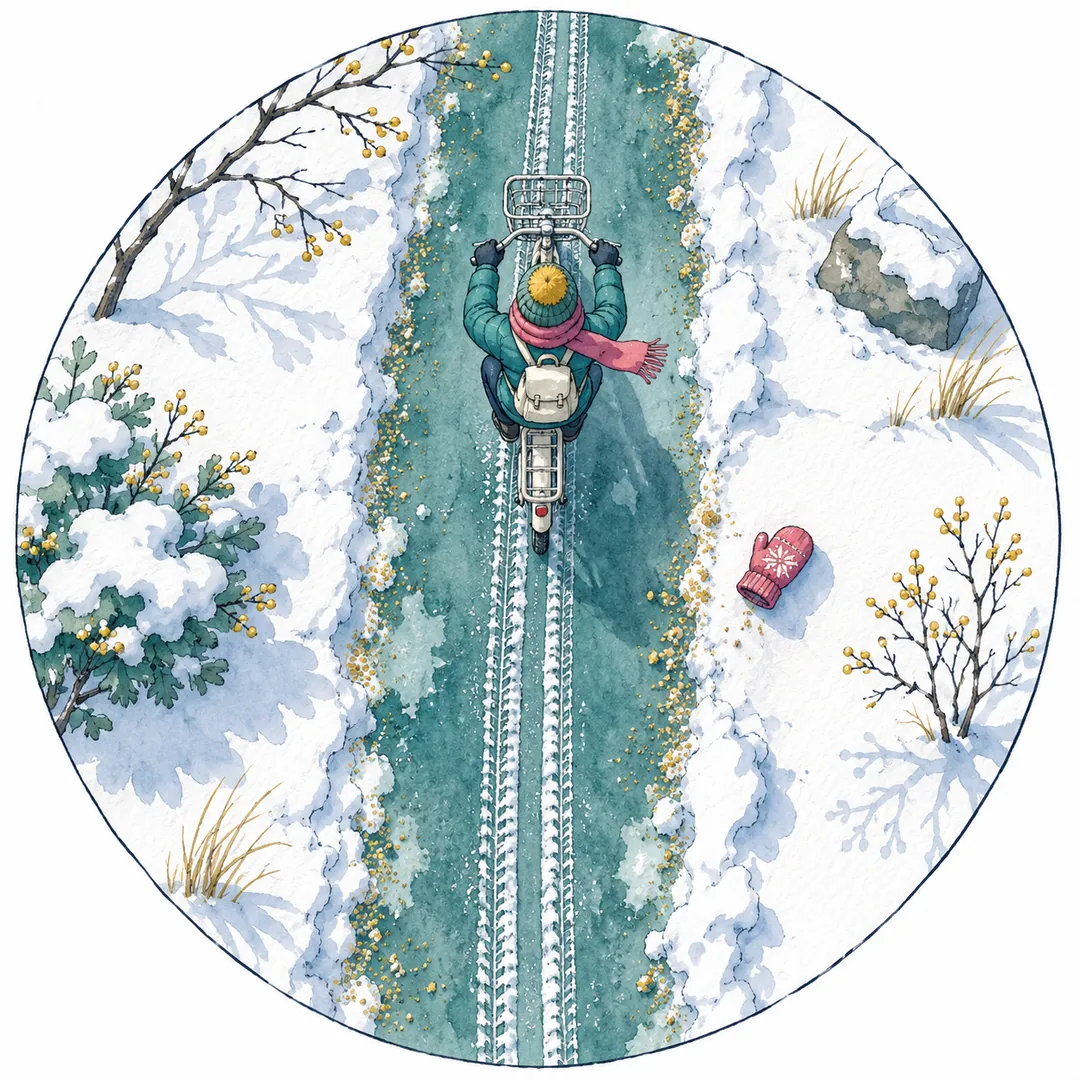
Yes. On most winter days in Cheyenne, Laramie and the Front Range you can ride an e-bike, as long as you plan for a shorter range, longer braking and short daylight. Cold can cut a battery’s power by as much as a third below freezing, a cold battery must warm to room temperature before it is charged, and the days to leave the bike at home are black ice, drifting snow, extreme wind chill and high wind.
This guide covers what changes between October and April: what cold does to the battery and how far the bike goes, how each winter surface rides, tires and lights, dressing for wind chill, salt and sand, which days to skip, and how shared e-bike programs keep running through winter. Charging temperatures and long-term battery storage have their own article, storing an e-bike battery for winter, so this one sticks to riding.
Can you ride an e-bike in winter on the High Plains?
You can ride on most winter days here, because a High Plains winter is mostly cold and dry rather than snowy. The National Weather Service’s 2025 climate summary for the Cheyenne airport lists the 1991 to 2020 normals alongside what happened in 2025:
| Cheyenne airport | Normal year (1991 to 2020) | 2025 |
|---|---|---|
| Days with a low of 32°F or colder | 170.4 | 150 |
| Days with a high of 32°F or colder | 32.8 | 32 |
| Days with a low of 0°F or colder | 7.8 | 11 |
| Snowfall | 62.9 inches | 35.1 inches |
| Days with 1 inch of snow or more | 19.5 | 14 |
Read the first two rows together. In a normal year about 170 mornings start at or below freezing, but only about 33 days stay at or below freezing all day. Most cold mornings warm above freezing by afternoon. And with about 20 days a year bringing an inch of snow or more, most winter days have no new snow at all. The lowest temperature in 2025 was -12°F, on January 20.
So the real question is not whether an e-bike works in winter. It is which days to ride, what to change on those days, and which days to skip. The rest of this guide answers those three in turn.
Freeze and thaw is the hazard to plan for
The same numbers explain where most winter trouble comes from. When most nights freeze and most afternoons thaw, snow that melts on a sunny afternoon runs across paths and freezes again after sunset. The icy hours are therefore early mornings and evenings, and the icy places are wherever meltwater collects or shade lingers: the low point of a path, the foot of a driveway, a curb ramp, the shaded side of an underpass. A route that was only wet at 3 p.m. can be glazed by 6 p.m. without a flake of new snow. A ride out at midday and home after dark can be two different rides on the same route.
Who should wait for better days
Winter adds risk on top of whatever a rider already finds hard. Someone in their first weeks on an e-bike is still learning how the assist and the brakes respond, and should learn on dry pavement, not packed snow. Children and lighter riders lose heat faster and have less weight over the tires. If you are new, take your first cold-weather rides on a dry, quiet street or an empty lot in daylight, try a few starts and stops in the lowest assist, and add snowy routes only once those feel routine. Colibrino plans its stations for this climate, and a Colibrino bike is a Class 1 pedal-assist e-bike: the motor helps only while you pedal and stops helping at 20 mph.
What cold does to an e-bike battery and its range
Cold makes a lithium-ion battery deliver less energy, so the bike goes less far on the same charge. Bosch eBike Systems calls the battery “the most sensitive component of the eBike” and says it “can lose capacity at low temperatures, which in turn can limit the bike’s range.”
Cycling UK, the British cycling charity, gives more detail. At 5°C (41°F) and below, it says, a battery loses efficiency and capacity, does not hold its charge as well and will not charge back up completely. “Below freezing, battery power can drop by as much as one-third.” It adds that these changes are temporary and the battery recovers when temperatures rise.
The London Fire Brigade explains why: chemical reactions inside the battery slow down at lower temperatures. It says cold “usually” affects performance rather than safety, but that repeatedly exposing batteries to very low temperatures can cause damage over time.
Turning that into a plan
The chart uses the range estimator’s method. Its default winter case, 80 percent of the battery available and 25 percent extra energy for wind or snow, gives 15.4 miles against 24.0 miles on a mild, calm, flat day. At a one-third loss the same battery reaches 12.8 miles. The estimator asks for your own cold-weather number rather than guessing one, so the best input is your own observation: ride the same route on a mild day and a cold day, and compare how much of the gauge each trip uses.
Riding habits that help the battery
Cycling UK offers several habits that help in the cold:
- Start with low assist. Start slowly with lower assistance to give the battery time to warm up, then after about 20 minutes raise the assist if you want. The battery warms as it works.
- Combine short trips. Many short journeys drain the battery faster than one longer one, as with a car.
- Avoid stop-and-go where you can. Lots of stopping and starting puts extra load on the battery, so a route with fewer lights and crossings helps.
- Consider a neoprene cover. Both Bosch and Cycling UK mention a neoprene sleeve for the battery in very cold weather.
If your own bike waits outside all day
An owned bike parked outside at work or class spends hours at the day’s temperature, and so does its battery. Cycling UK says you should never store the battery outside or in an unheated space in winter, and suggests bringing it into your workspace and keeping it somewhere safe. Bosch gives the same advice for a bike kept in a carport or unheated shed: detach the battery and keep it at room temperature. A battery that went out warm in the morning and comes back to the bike warm in the afternoon will give you noticeably more of its charge on the ride home than one that sat on the rack all day. Lock the bike as usual; a removable battery is also one less thing to steal.
On a shared bike you do not manage any of this: the bike charges in its bay after each ride. What you can do is check the gauge before you ride, choose the fullest bike for a long trip and dock with a margin.
Charging and keeping the battery warm between rides
A cold battery should warm up before it is charged, and it should spend cold nights indoors. Each source puts it a little differently, and they agree on the essentials:
- Bosch: when temperatures are below zero (the article works in Celsius, so below freezing), remove the battery, store it at room temperature and put it back on the bike shortly before the next ride. Store it indoors, ideally between 10 and 20°C (50 and 68°F), and charge the cells at room temperature.
- Cycling UK: never charge the battery while it is still cold. After a chilly ride, bring it inside and leave it for a couple of hours to warm up, and do not speed this up by putting it next to a heater, because sudden temperature changes can damage it.
- London Fire Brigade: allow cold batteries to warm to room temperature before charging, because charging a battery when it is extremely cold can damage it. Avoid leaving a battery outside overnight in winter, and if you keep it indoors, make sure it will not block your escape route if it starts a fire.
Each battery maker sets its own charging and storage temperatures, and the maker’s manual is the final word for your battery. For the storage side of winter, including charge levels for a battery that will sit for months, see storing an e-bike battery for winter. For where to charge safely in a home, see charging an e-bike indoors.
Shared bikes are different
Riders never take a Colibrino battery home and never charge one indoors; the station bays or Colibrino’s own charging area do it. A frozen battery is never charged. When batteries are outside the maker’s charging range, they come into the operator’s charging area to warm up first. Seasonal operations describes how that works at each site.
How snow, slush and ice ride
Each winter surface asks for something different, and two of them are reasons to stay home. Bosch’s advice is plain: “In extreme weather conditions, such as black ice or drifting snow, both the eBike and the conventional bike should be given a rest,” and in winter it is advisable to ride only “if you are completely confident that you can ride safely under difficult conditions.”
| Surface | How it rides | What to do |
|---|---|---|
| Dry pavement, cold air | Normal grip; shorter range; shaded patches may still be icy | Ride. Watch shade on the north side of buildings and trees. |
| Wet pavement or thin slush above freezing | Longer braking, spray, grit thrown onto the bike | Ride with care. Brake early, clean the bike afterward. |
| Fresh snow on a plowed lane or path | Soft, slower, rear wheel can spin under strong assist | Adapt. Lowest assist to start, steady pedaling, plowed routes only. |
| Packed snow | Fair grip at steady speed, little grip for sudden moves | Adapt. No sudden steering or braking; slow for corners. |
| Refrozen ruts and ridges | Ruts steer the front wheel for you | Walk that stretch, or skip the ride. |
| Deep unplowed snow | Bike bogs down, balance is hard | Skip or walk. |
| Black ice or glaze | Almost no grip, often invisible | Skip. Bosch says give the bike a rest. |
| Drifting snow | Drifts form across paths without warning, often with strong wind | Skip. Bosch says give the bike a rest. |
| Sand or grit on dry pavement after a storm | Loose layer that slides in corners | Ride with care. Straighten up before braking. |
Starting, braking and turning
- Start gently. Bosch advises that when starting off on snow, riders should do without motor support such as a high turbo level, “otherwise the tires will simply spin and slide instead of gripping.” Start in the lowest assist or none, in an easy gear, and let the bike roll before adding power.
- Brake early and in a straight line. Wyoming’s equipment rule asks that a bicycle’s brake stop it within 25 feet from 10 mph on “dry, level, clean pavement” (W.S. 31-5-706). Snow, slush and ice are none of those, so expect far longer stops and start braking sooner. Squeeze both brakes gently rather than grabbing either one.
- Turn upright. Slow down before a corner, then turn with the bike as upright as you can. Leaning hard on a slick surface is how the front wheel slides out.
- Look for shade. Ice lingers where the sun does not reach: the north side of buildings, under trees, and on paths beside walls. A route that is clear at noon can be glazed in a shaded stretch.
Plowed routes first
Where a city publishes a snow plan, it tells you which routes are cleared first. Boulder’s snow and ice response is a Front Range example. It says there are over 80 miles of multi-use paths in the city, 73 of which are cleared edge to edge once per day during and immediately after snowfall, and that protected bike lanes are among the criteria for first-priority streets, which get service every two to four hours during snowfall. Check your own city’s snow map, and plan winter rides on the routes it clears first.
The day after a storm
The first day after a snowfall has its own hazards. Boulder’s page notes that plows may push snow onto curbs and sidewalks to keep the streets clear, and the city gives property owners, managers and tenants 24 hours after snow stops falling to clear sidewalks and curb ramps next to their property, at least 5 feet wide (Boulder Revised Code, Section 8-2-13). Other cities set their own rules and deadlines. Until that work is done, expect:
- curb ramps and crossings blocked by plow berms, so the route you normally use to leave a path may not be open
- ridges of hard snow along the edge of a plowed bike lane, which can catch a front wheel that drifts toward them
- sand and grit piled at intersections and on corners
- parked cars sitting farther from the curb, which narrows the space for bikes
Ride the day after a storm more slowly than the plowed surface suggests, and be ready to stop and walk the bike across a berm rather than ride over it.
Tires and traction for a winter e-bike
Grip comes from the tires, so they matter more in winter than any other part. If you own the bike, you can set it up for the season; on a shared bike you ride what the fleet provides and choose your days and routes to match.
- Tread and width. A wider tire with a deeper tread holds packed snow better than a narrow, smooth one.
- Pressure. Lower pressure puts more rubber on the ground. Stay within the pressure range printed on the tire’s sidewall, and check it more often in winter, because pressure drops as the air in the tire cools.
- Studs. Bosch notes that riders who regularly ride on snow-covered paths or roads can use tires with spikes. Studded tires grip ice that a normal tire cannot, although they are slower and noisier on dry pavement. They are an owner’s choice for a rider who commutes through icy months.
- Fenders. Full fenders keep slush and road salt off you and off the drivetrain.
On a shared bike, the pre-ride checklist asks you to confirm that both tires look full and the tread is not worn through. In winter that check matters twice as much. If a tire looks soft, dock the bike, choose another and report it.
Getting off and walking on a slick surface
Knowing when to walk is part of riding in winter, and an e-bike is heavier to walk than an ordinary bike. Stop completely before you dismount, with the bike upright, rather than stepping off while it still rolls. Turn the assist off or to its lowest level so a stray push on a pedal does not start the motor. Walk on the side of the bike away from traffic, with both hands on the bars and a finger near the brake levers, so the bike stays under control if your own feet slip. Short, flat-footed steps work better on ice than long strides. When the slick stretch ends, check that the bars and brakes still line up before you ride on.
Seeing and being seen on short winter days
Winter riding is often dark riding. The U.S. Naval Observatory’s data for Cheyenne show how short the days get:
| Cheyenne, 2026 | Sunrise | Sunset | End of civil twilight |
|---|---|---|---|
| June 21 | 5:27 a.m. MDT | 8:35 p.m. MDT | 9:09 p.m. MDT |
| November 22 | 6:55 a.m. MST | 4:35 p.m. MST | 5:05 p.m. MST |
| December 21 | 7:21 a.m. MST | 4:34 p.m. MST | 5:05 p.m. MST |
That is about 9 hours and 13 minutes of daylight on the shortest day, against about 15 hours and 8 minutes in June. A ride home after a 5 p.m. class or shift is a ride in the dark for most of the winter.
Lights and reflectors
Wyoming law requires every bicycle in use at nighttime to have a front lamp emitting white light visible from at least 500 feet and a rear red reflector visible from 600 feet; a red rear lamp visible from 500 feet may be used in addition (W.S. 31-5-706). Colorado and many cities and campuses have their own lighting rules, so check where you ride.
- Turn the lights on for every winter ride, day or night. Snow, low cloud and blowing snow all reduce visibility in daylight.
- Wear bright clothing with reflective panels. Bosch advises winter riders to wear bright colors with reflectors.
- Watch the low sun. In winter the sun sits low at morning and evening rush hours, and a driver facing it may not see you. Take extra care on east-west streets near sunrise and sunset.
Being seen against snow
White, gray and pale clothing disappears against snowbanks and an overcast sky. Bright colors and reflective panels show up much better. Lights need attention too: slush thrown up by the front wheel and spray from passing cars coat the lenses, and a light caked in grime gives off a fraction of its beam. Wipe both lights before you leave and again after a slushy stretch. If your own bike has separate battery-powered lights, check their charge more often in winter; if they run on lithium-ion cells, the cold that shortens the e-bike’s range shortens theirs too.
Dressing for cold and wind chill on an e-bike
Dress for the wind chill, not the thermometer, and remember that riding makes its own wind. The National Weather Service defines wind chill as how cold people and animals feel when outside, based on the rate of heat loss from exposed skin caused by wind and cold. Its formula is:
Wind chill (°F) = 35.74 + 0.6215T - 35.75(V^0.16) + 0.4275T(V^0.16), where T is the air temperature in °F and V is the wind speed in mph.
Here is what the formula gives for some typical High Plains winter mornings:
| Air temperature | 5 mph wind | 15 mph wind | 25 mph wind |
|---|---|---|---|
| 30°F | 25°F | 19°F | 16°F |
| 20°F | 13°F | 6°F | 3°F |
| 10°F | 1°F | -7°F | -11°F |
| 0°F | -11°F | -19°F | -24°F |
The Weather Service says that at a wind chill of -19°F, from 0°F air and a 15 mph wind, exposed skin can freeze in 30 minutes. Its glossary puts the threshold for potentially dangerous wind chill at about -20°F and lower. It also notes that bright sunshine can raise the wind chill temperature by 10 to 18°F, and that frostbite needs an actual air temperature below freezing.
The chart assumes a person standing still. On a bike, your own speed adds moving air on your face and hands, so even a calm morning feels like a breezy one, and a headwind adds to it. That is the reason to cover skin completely on the coldest days.
What to wear
E-bike riders have one advantage. Bosch notes that with motor assistance, riders tend to perspire a lot less when temperatures drop, and Cycling UK says the assist still leaves you putting in enough effort to warm up. You can dress warmer than a cyclist on an unassisted bike without arriving soaked.
- Hands. Bosch calls gloves “indispensable,” because cyclists’ fingers get cold very quickly. Choose gloves or mittens that still let you work the brakes.
- Head and ears. A thin headband or hat that fits under the helmet. Bosch calls the helmet “an absolute must in winter.”
- Face. A neck gaiter or face cover for days near the -20°F wind chill line, and glasses or goggles against wind and grit.
- Body. Layers: a base layer that moves sweat away, an insulating layer and a shell that blocks the wind. Bosch recommends breathable jackets, which insulate by trapping body heat but let air pass through the membrane.
- Feet. Warm socks and shoes with soles that grip a snowy pedal and an icy curb.
Example (fictional). A student lives 2.2 miles from campus in fictional off-campus housing on the High Plains. At 7:45 a.m. the air is 10°F with a 15 mph northwest wind, so the wind chill table gives -7°F. The path is plowed and dry except for a shaded stretch under a row of trees. The student wears mittens over thin gloves, a headband under the helmet and a gaiter over the nose, starts in the lowest assist, and walks the bike through the shaded stretch, where the morning sun has not reached a glazed patch. At 4:50 p.m., after sunset, the ride home is in the dark, so both lights are on and the student checks the battery gauge before leaving, because the cold has used more of it than in October.
Salt, sand and slush: caring for the bike in winter
Winter roads throw salt, sand and grit at a bike, and an e-bike has electrical contacts to protect as well. The Colorado Department of Transportation says all of its snow removal products contain salt with added corrosion inhibitors. It uses a solid “ice slicer” made of granular salt and magnesium chloride, liquid magnesium chloride when pavement is above 16°F and a cold-temperature version below 16°F, and sand or a sand and salt mixture mainly in high elevations and on the eastern plains, where more traction is needed. CDOT plows about 23,000 lane miles of state highways; cities plow their own local roads with their own mix.
Whatever the mix, some of it ends up in bike lanes and on your bike. A short routine after slushy rides keeps it from doing damage:
- Rinse gently. The London Fire Brigade says not to wash an e-bike with high-pressure water, because lithium-ion batteries are not waterproof. Use a low-pressure rinse or a damp cloth.
- Dry and lubricate the chain. Salt and water on a bare chain turn to rust quickly.
- Clean the battery contacts. Cycling UK warns that grit and water can work their way into the electrical contacts and affect the connection. Clean them regularly with a soft, dry cloth.
- Check the brake pads more often. Cycling UK notes that an e-bike’s extra weight makes it heavier on the brakes, and pads can wear more quickly; grit speeds that up.
- Dry the battery before charging. If the battery got wet, the London Fire Brigade advises removing and drying it before charging, if possible.
Rain and splashes are not the problem. Bosch says water “will not have any adverse effect on an eBike, since the components are protected against rain, spray and splashes.” The trouble is grit, salt and high-pressure water, not ordinary wet riding.
On a shared bike, the operator does this work. Every Colibrino station visit includes a check of brakes, tires, lights, locks and battery condition, and a bike that fails is taken out of service. If you notice grinding brakes or a sticky chain, dock the bike and report it.
Which winter days to skip
Skip a ride when the surface, the air or the wind is beyond what any technique can fix. On the High Plains that usually means one of these:
- Black ice or glaze, including freezing drizzle. Bosch puts it first on its list of days to rest the bike.
- Drifting snow. Bosch’s second example. Wind moves snow across paths and into drifts quickly, and it often comes with poor visibility.
- Refrozen ruts on the only route you have, when you cannot walk around them.
- Deep fresh snow before the plows have reached your route.
- High wind. A High Wind Warning, or gusts of 40 mph and up. Our guide to riding an e-bike in strong wind gives the full ride-or-wait rule.
- Dangerous cold. A wind chill near the Weather Service’s -20°F danger line, or a local Cold Weather Advisory or Extreme Cold Warning, which the Weather Service sets locally for each area.
- Darkness plus ice. A route you would ride in daylight can be the wrong choice after dark, when glaze is invisible.
Skipping a day is easier when you know your other options in advance: a bus, a ride, a walk, or leaving earlier to walk part of the way. Plan them in November rather than on an icy morning in January.
How shared e-bike programs handle winter
Shared programs answer the winter question in different ways, and some Mountain West and Midwest systems now run all year. The Better Bike Share Partnership, in a December 11, 2025 look at winter operations, notes that many systems close in the coldest months because of low ridership, finances, and wear and tear, while some keep a year-round service for people who rely on it.
- Salt Lake City. GREENbike, a nonprofit bike share, has run year-round since 2013. It reduces its bike fleet in winter, but all stations remain operational. Its ridership in January 2024 was 35 percent higher than the January before, and it uses the slower season to rotate every bike through its shop for a full inspection.
- Des Moines. The nonprofit system has run year-round since the 2015 to 2016 winter. Stations farther from downtown close and the fleet is cut by 40 to 50 percent; ridership is sparse from mid-December to early March, mostly dedicated riders taking short trips.
- Minneapolis. A city pilot let shared scooters run until December 31. The city expected 0.5 to 0.75 trips per vehicle per day and saw about 1.2 to 1.3. The operator planned to keep about 1,000 bikes and 1,000 to 1,500 scooters running through the following winter. The city’s project manager reported feedback that bike lanes are plowed better than the streets.
What a Colibrino winter looks like
Every Colibrino network plan includes a written winter plan, agreed with the host before launch. It chooses one of two options: a full year with a reduced winter fleet, where fewer bikes stay out and the station is checked after storms, or a riding season with winter storage, where bikes and batteries are stored indoors and a spring date is announced. The plan also says how batteries are charged in the cold, who clears snow where, and how riders hear about closures. Seasonal operations has the details, and the rider guide explains what riders see at the station.
For riders, the practical upshot is simple. Read the notices your program sends, expect fewer bikes on winter days if your station runs all year, and never take a shared bike indoors or charge it at home to keep it warm.
Example (fictional). Larkspur Commons, the fictional 240-home apartment community used across this site, has 14 bikes at two lobby stations. Its manager chose a full-year program with a reduced winter fleet: from December through February one lobby station stays open with fewer bikes, the other station’s bikes go into storage, and the stored bikes return after a spring inspection. Residents get a notice in late November that names the open station and explains what happens on storm days, and a second notice when the stored bikes come back. The example network walks through the rest of that plan.
Questions to ask your program before winter
If you ride a shared e-bike, a few questions in November save surprises in January:
- Will my station stay open all winter, close for the season, or run with fewer bikes?
- How will I hear about a closure for a storm or high wind: app, email, text or a sign?
- If the station closes for the season, what happens to my pass or membership for those months?
- Which station is the nearest one that stays open?
- Who do I call if a bike has a problem in the cold, such as a lock iced shut or a soft tire?
For hosts deciding on winter service
The programs above show the trade-off a host faces. Winter riders tend to be fewer but more dependent: Des Moines describes its winter riders as mostly dedicated riders taking short trips, and Salt Lake City’s director argues that a service people rely on should not vanish for months. Against that sit snow clearing, a station exposed to wind and drifts, and the cost of keeping bikes out in conditions that wear them faster. A full year with a reduced fleet suits sites with steady winter trips; a riding season with storage suits seasonal pilots and exposed sites. Both are written down before launch, and either can change at the season review.
Your winter riding checklist
Use this list on any winter morning. It takes two or three minutes.
- Check the forecast for temperature, wind and any advisory or warning for your area.
- Find the wind chill for your ride time in the table above, and dress for it, with skin covered at -20°F and below.
- Choose plowed routes and note any shaded stretches you may need to walk.
- Check the battery and expect less range. Run your trip through the range estimator if it is long.
- Do the bike check from the pre-ride checklist: tires, brakes and both lights.
- Start in the lowest assist and an easy gear, and raise the assist after the battery and you have warmed up.
- Brake early, turn upright, and leave twice your usual stopping room.
- Skip black ice, drifting snow, deep unplowed snow and high wind.
- After a slushy ride, wipe the bike, dry the chain and clean the contacts; never use a pressure washer.
- Bring your own battery inside to warm before charging, or dock a shared bike in its bay and let the station handle it.
For the rest of the season’s riding questions, browse Riding e-bikes, including our guide to riding in strong wind. If you run a property or campus and want a station that works through a High Plains winter, the contact page starts with a site walk.