
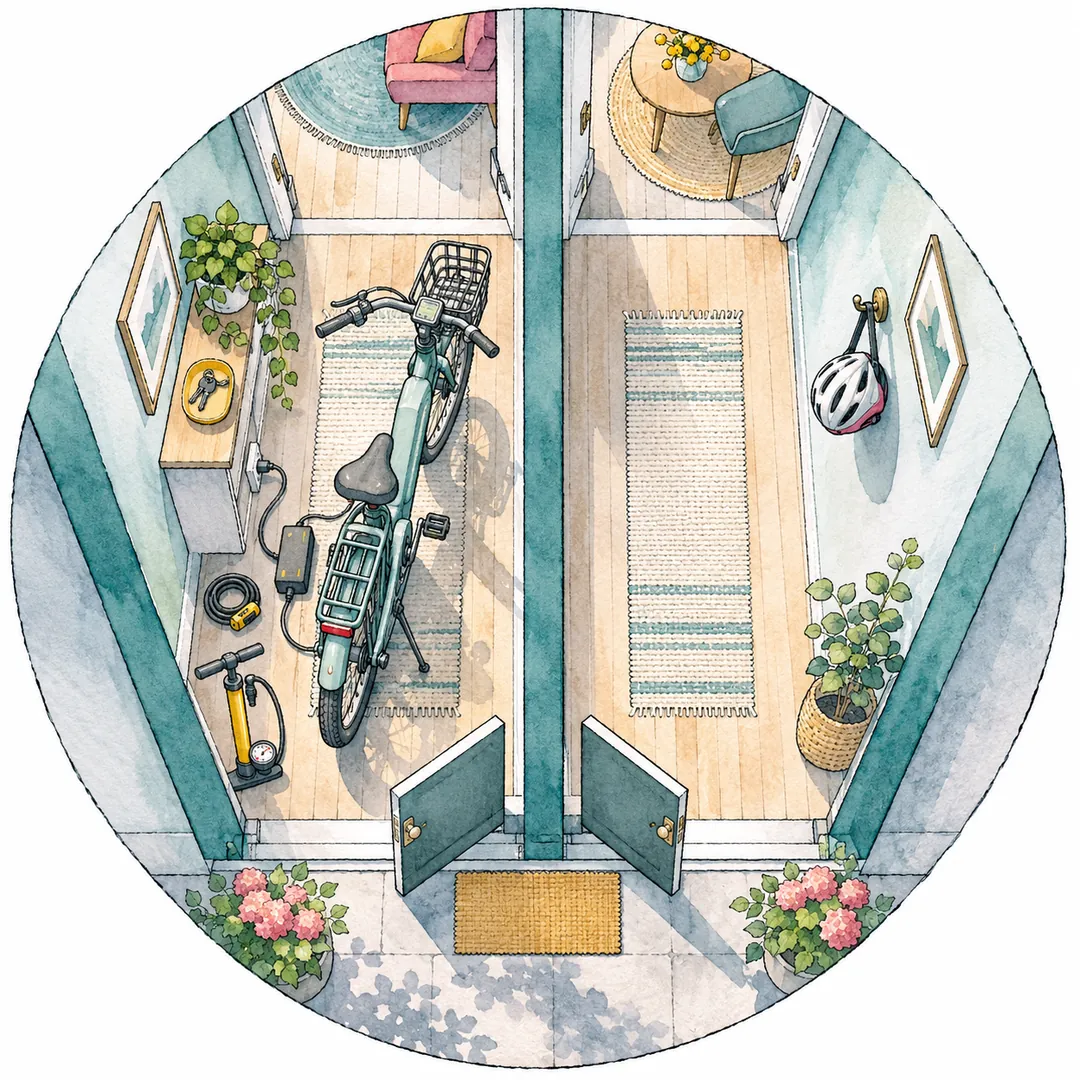
If most of your trips are short, start and end near bike share stations, and you ride a few times a week, a shared e-bike usually costs less and asks almost nothing of you: no charging at home, no storage, little theft risk and no winter battery care. If you ride every day, ride long or in places no system covers, or need to carry children or cargo, owning usually wins on freedom, and for heavy riders it can win on cost per ride too, but you take on charging, storage, security, repairs and the season.
A disclosure before the numbers: Colibrino plans, installs and runs shared e-bike stations for apartment communities, campuses, HOAs and neighborhoods, so we have an interest in this question. Colibrino has no stations running yet and publishes no prices. Every price in this article is a public figure from another program, a public agency or an industry report, or a clearly labeled assumption. Where owning wins, we say so.
Shared or owned: the short answer
The right choice depends less on the price of a bike than on three facts about your trips: where they go, how often you make them and how long they last. Shared bikes are cheapest and easiest when a station sits near both ends of a trip and the ride is short. Owning makes sense when trips go beyond any station network, when you ride often enough to spread the cost of a bike across hundreds of rides, or when you need a bike that fits you, your children or your groceries.
| If this describes you | Shared usually fits | Owning usually fits |
|---|---|---|
| Trips start and end near stations | Yes | Either |
| A few short rides a week | Yes | Costly per ride |
| Daily rides, or rides over an hour | Watch time limits and fees | Yes |
| No stations where you go | Not an option | Yes |
| You live in an apartment with no secure storage or safe charging spot | Yes | Hard |
| You carry children or heavy loads | Rarely | Yes, with the right bike |
| You want nothing to do with winter battery care | Yes | You must plan for it |
The rest of this article puts numbers and duties behind each row: what shared rides cost, what owning costs once the price tag is spread over years, what an owner has to do about charging, storage, theft and winter, and where each option falls short. It ends with a checklist.
What a shared e-bike ride costs
Shared e-bike prices vary widely by city and by pass, from well under a dollar a ride on a busy annual membership to more than $7 for a single long ride. The best national picture comes from NACTO’s 2023 snapshot of shared micromobility in the U.S. and Canada, published in July 2024 by the association of city transportation officials. It reports:
- Pay as you go, station-based. On average a trip costs around $3.00 for the first 30 minutes, then $0.10 to $0.20 for each additional minute. E-bike fees add an average of $0.22 per minute. For a typical 30- to 35-minute trip, that comes to an average of $3.85 for a one-way pedal bike trip and “$7.00 or more” for a one-way e-bike trip, which can add up to $14 a day for commuting.
- With a pass. In most cities an annual pass now costs more than $100 before tax, and over $200 in the New York City area. Pedal-bike trips of a set length are usually included, but e-bike fees “tack on an additional $0.10 to $0.20 per minute,” so passholders still pay “often $3.00 to $5.00 or more per 30- to 35-minute e-bike ride.”
- Dockless e-bikes and scooters. The average one-way trip cost around $6.00 in 2023, even though typical trips last only 11 to 12 minutes.
- Reduced fares. Most dockless operators offer reduced-fare pricing for qualifying riders, usually half the cost of a single trip, which NACTO notes serves only people with the very lowest incomes.
Two Front Range price lists
Local price lists can look very different from the national averages. Boulder BCycle, an electric bike share system with stations linking downtown Boulder, CU and the Boulder Creek Path, listed these prices when we checked in November 2026:
| Boulder BCycle pass | Price | What it includes |
|---|---|---|
| Single ride | $5 per 15 minutes | One trip up to 15 minutes; $5.00 for each additional 15 minutes |
| Guest pass | $18.60 | Unlimited 30-minute trips for 24 hours |
| Monthly membership | $32.71 a month | Unlimited 1-hour trips for 30 days |
| Annual membership | $163.57 a year | Unlimited 1-hour trips for 365 days |
Trips longer than the included time cost $7.63 for each additional 30 minutes on the guest, monthly and annual passes. The system also lists a library pass, a low-income access pass and discounted annual memberships for the University of Colorado. Denver’s Shared Bike and Scooter Program, operated by one contracted company since May 2026, lists a Denver Resident Pass at $0.25 a minute and free riding of up to 60 minutes a day for income-qualified residents.
The spread matters. A rider making short trips on an annual membership in a system like Boulder’s pays well under a dollar a ride; the same rider paying single-ride prices pays $5 a trip. The pass you choose changes the answer more than the bike does.
Costs that do not show on the price list
A few costs of sharing are easy to miss when you compare a pass with a purchase:
- Overtime. Passes include a set ride time per trip. A long errand, a slow ride into the wind or a forgotten dock can turn a covered ride into an extra charge.
- Sales tax. NACTO notes that riders pay sales tax on each bike share trip, even on publicly owned systems, while buses and trains are not taxed the same way.
- Walking to and from stations. A station two blocks from your door and one block from your destination adds a few minutes to every trip. The trip time calculator includes time to walk to the bay and dock, so you can compare door to door.
- Availability. If the station is empty at 7:45 a.m., the cheapest ride is the one you cannot take. Ask how the program rebalances bikes between stations.
What Colibrino charges
Colibrino does not publish prices. In its programs, a property, HOA or campus may pay for the program so residents or students ride at no charge or at a member rate the host chooses, or riders may pay per ride or by pass in a neighborhood program; rates are set in each network plan. The programs page compares the four program types, and rider access and payments explains how passes and payments work.
What owning an e-bike costs beyond the price tag
The price tag is the biggest number, but an owner also pays for wear, the battery, security and time. A fair yearly cost spreads the purchase over the years you expect to keep the bike, subtracts what you could sell it for, and adds what keeping it on the road costs.
| Cost of owning | How to count it per year |
|---|---|
| Purchase | (Price paid after discounts minus expected resale value) ÷ years you expect to keep the bike |
| Battery | Price of a replacement battery ÷ years you expect the battery to last |
| Tune-ups and parts | Brake pads, tires, chain and a yearly service |
| Lock and security | A good lock spread over its life, plus any insurance or registration fee |
| Electricity | Small: a few cents per charge (see below) |
| Storage and charging space | Free in a garage, but in an apartment it may be the reason you cannot own one |
| Your time | Charging, carrying the battery, maintenance, and dealing with a flat tire on the way to work |
Electricity is the one cost people overestimate. Colibrino’s charging cost calculator, with its default assumptions of 15 Wh per mile, 85 percent charger efficiency and $0.13 per kWh, puts the electricity for a 1.8-mile ride at about $0.0041, less than half a cent. Repairs, parts and the battery cost far more.
The battery ages
Every lithium-ion battery loses capacity as it ages, so an owned bike goes a little less far each year. Bosch, a maker of e-bike drive systems, notes on its range assistant that its range figures apply to a new battery, “whose performance is subject to aging as with every lithium-ion battery.” At some point an owner either accepts the shorter range or buys a replacement battery, which is why the table above counts it as a yearly cost. Ask the seller what a replacement battery costs and whether it will still be available in five years, because a bike whose battery can no longer be bought is worth much less.
Buying a bike that is certified
Price is not the only thing to compare when shopping. Colorado’s incentives only apply to e-bikes certified to UL 2849 or EN 15194, and the Energy Office warns on its tax credit page that “low-cost bikes may not meet safety standards.” Whether or not you claim an incentive, looking for a certification mark on the bike and its battery is a sensible filter, and a building’s rules may ask for one before an e-bike can be stored on the property. Colibrino’s community e-bike rules builder includes a rule of that kind in its starting draft.
Colorado’s purchase incentives
If you live in Colorado, two state programs can lower the purchase price, and they can be combined at retailers that take part in both.
- E-bike tax credit discount. The Colorado Energy Office says Coloradans can get $225 off a qualified e-bike at a participating retailer, limited to one discount per calendar year. The bike must be certified to UL 2849 or EN 15194, have a motor of 750 watts or less, and have two or three wheels and fully operable pedals. The buyer pays sales tax on the full price.
- Income-qualified rebate. The Colorado E-Bike Rebate is $1,000 off a new e-bike, with $300 more for an e-cargo bike and $300 more for an adaptive e-bike. You must live in Colorado, be at least 18, and have a household income below 80 percent of your county’s area median income or be enrolled in a listed assistance program. A standard e-bike must cost no more than $5,000. Registration opens in one-week windows; the next two are January 11 to 18, 2027 and March 15 to 22, 2027. Registrants are selected at random, selected registrants upload proof of income and address within a week, and the rebate must be used at a participating retailer within 60 days. Only one rebate is allowed per person, ever.
Selection is a lottery, so plan for the chance of not being picked. The Energy Office’s August 6, 2026 announcement says the program has $3 million for the current fiscal year, enough for more than 2,800 rebates, and that more than 34,000 Coloradans applied during the first run of the program. It also reports that 89 percent of recipients in that first run said they would not have bought an e-bike without the rebate, and that recipients replaced an average of 2.85 car trips a week with e-bike rides. The state rebate cannot be combined with a local rebate, such as Denver’s, on the same bike.
Denver’s own program shows how quickly local money goes: the city’s e-bike rebate page says its 2026 standard rebate was $675, income-capped, and that all 2026 rebates have been claimed, with a waiting list for unredeemed vouchers.
In Wyoming we did not find a statewide e-bike purchase incentive when we checked in November 2026. Ask your city and your electric utility before you buy, in case a local program exists.
A side-by-side example
Numbers make the comparison concrete, as long as every assumption is visible. The example below uses Boulder BCycle’s published prices for the shared side and a fictional set of ownership costs for the owned side.
Example (fictional). Riley is a fictional graduate student who rides six one-way trips a week, each under 15 minutes, for 36 weeks of the year: 216 rides.
Shared, at Boulder BCycle’s November 2026 prices: single rides at $5 come to 216 × $5 = $1,080 a year. A monthly membership bought for 9 months costs 9 × $32.71 = $294.39. An annual membership costs $163.57. Per ride, that is $5.00, $1.36 or $0.76.
Owned, with assumed costs: Riley buys an e-bike for an assumed $1,800 in Colorado, takes the $225 tax credit discount and expects to sell it for $300 after five years, so the bike costs ($1,800 - $225 - $300) ÷ 5 = $255 a year. Riley budgets an assumed $150 a year for tune-ups and parts, $120 a year toward a replacement battery (an assumed $600 battery once in five years), $18 a year for a $90 lock kept five years, and about $1 a year of electricity. The total is about $544 a year, or $2.52 a ride.
The result: with stations near both ends of every trip, the annual membership costs about a third as much as owning. Without stations, sharing is not an option at all. These ownership figures are assumptions for illustration, not typical prices; use your own.
The answer changes with the pricing model. Suppose instead a system charged a hypothetical $150 annual pass plus $0.15 a minute on e-bikes, inside the $0.10 to $0.20 range NACTO reports. Riley’s 216 twelve-minute rides would cost $150 + 216 × 12 × $0.15 = $538.80 a year, about the same as the fictional owned bike. The chart shows how cost per ride changes as rides per year rise under each approach.
Reading the chart
Owning gets cheaper per ride the more you ride, because most of its cost is fixed. Pay-per-ride never does. Passes sit in between, and a cheap annual pass with long included ride times is hard to beat on cost alone. To see what a pass would have to cost to beat your current short car trips, run your own trips through the commute cost calculator; with its default inputs, a pass costing less than $38 a month saves money against driving those trips.
Charging and storage: the duties that come with owning
The biggest difference between sharing and owning is not money. It is that an owner becomes responsible for charging and storing a lithium-ion battery, usually at home. With a shared station bike, the bay charges the bike after every ride and you never handle the battery.
How often that charging happens at home is easy to underestimate. In New York City’s e-bike battery charging pilot, which ran from March 7 to September 7, 2024 with 118 test users, the city’s Department of Transportation found that before the pilot most participants (81 percent) charged their e-bike batteries at home, and 41 percent went home between shifts to recharge. The participants were app-based delivery workers, who ride far more than most residents, so their habits are not typical. But the pattern holds for any owner: without somewhere else to charge, the battery comes home. During the pilot, with free outdoor battery swapping and charging docks, the share of participants charging at home fell by 35 percent, and there were no fire incidents.
What safe home charging asks of you
AAA lists the habits it recommends for e-bike owners. Among them:
- Do not leave a battery charging unattended, and do not charge overnight; a full charge usually takes 2 to 6 hours.
- Charge in an open-air location if possible, not in a garage or an apartment entryway.
- Use only the cord and charger made for your bike, and plug directly into a wall socket, never an extension cord or power strip.
- Set a timer, and if you leave home, unplug and finish charging when you return.
- Store the bike and battery in a cool, dry place away from anything flammable, not in direct sunlight or near a doorway that could block an escape route.
- Remove the battery if you will not use the bike for 12 hours or more.
The London Fire Brigade adds that a battery kept indoors must not block your escape route if it starts a fire. In a studio or a one-bedroom apartment, finding a spot that is open, attended, away from the door and away from anything flammable is genuinely hard, and your building’s rules may limit where you can do it.
What your building may say
Leases, house rules and HOA covenants can set conditions on e-bikes and their batteries: where they may be stored, whether they may be charged in units or common areas, and which certification marks they need. Read yours before you buy. Our articles on e-bike battery rules in apartments and charging an e-bike indoors go through the rules and the safer options in detail.
Storage is the other half. An e-bike is heavier than a regular bike, often heavy enough that carrying it up several flights of stairs every day is impractical. If your building has no secure bike room, the bike lives in your unit, which is exactly where the charging questions above become hardest.
How a shared station handles it
At a Colibrino station the rule is simple: riders never charge Colibrino batteries at home or indoors. Bikes charge only in the station bays or in an operator charging area, plugged in without extension cords or power strips, with the manufacturer’s charger. Colibrino specifies bikes certified to UL 2849 and batteries certified to UL 2271 (or tested as part of the UL 2849 system), and checks them against recall notices. The rider guide explains what a rider does at the end of a trip: lock the bike into a bay and walk away.
Theft, repairs and recalls
An owner carries every risk that a shared program spreads across its fleet. That is the honest cost of the freedom to ride anywhere.
Theft
An e-bike is a valuable thing to leave outside, and its battery is a valuable part on its own. Owners need a good lock and a habit of using it every time, ideally locking the frame to something solid in a visible, well-lit place. Taking a removable battery with you when you park has two benefits: it is not stolen, and in winter it stays warm. Write down the frame’s serial number and keep the receipt. Ask your renters or homeowners insurer whether an e-bike is covered and up to what value; policies differ.
With a shared bike, theft is mostly the operator’s problem. Station bikes are locked in their bays when no one is riding them. While a bike is checked out to you, the program’s rider terms say what you owe if it is lost or damaged, so read them; Colibrino’s rider terms are written with each host and cover what happens after damage.
Repairs
Tires go flat, brake pads wear, chains stretch, and electrical parts sometimes fail. An owner finds a shop, waits for the repair and rides something else meanwhile. Owners should budget for a yearly service. A shared program does this work on its own schedule: every Colibrino station visit includes a check of brakes, tires, lights, locks and battery condition, and a bike that fails is taken out of service until it is repaired. A rider with a problem docks the bike, takes another and reports it.
Recalls and replacements
E-bikes, batteries and chargers are recalled from time to time. The London Fire Brigade recommends registering your e-bike with the manufacturer so it can contact you quickly about a safety alert or recall. AAA adds that a damaged battery should be replaced, and that like a helmet, a battery should be replaced after a crash even if there is no visible damage. Old batteries must never go in the trash or the recycling bin; take them to a battery recycler. A shared program handles recall checks, damaged batteries and recycling for its whole fleet.
Winter and wind: who carries the season
On the High Plains and the Front Range, winter is a real cost of owning. The battery needs care in the cold, and someone has to decide whether the bike rides at all on an icy morning.
Bosch eBike Systems advises that when temperatures are below freezing, owners remove the battery, store it at room temperature and put it back on the bike shortly before the next ride, and charge it at room temperature. For an owner who parks outside, that means carrying the battery inside at home, at work and at class through most of the winter. A battery that will sit unused all winter needs its own storage routine; storing an e-bike battery for winter covers it.
A shared program carries the season for its riders, in a way the program states in advance. Every Colibrino network plan includes a written winter plan: either a full year with a reduced winter fleet, or a riding season with winter storage and a spring relaunch. Frozen batteries are never charged. The trade-off is that a shared rider may find fewer bikes, or none, in midwinter, depending on the option the host chose. An owner can ride on any day they judge safe.
Wind affects both equally. Whatever bike you ride, our guides to riding in strong wind and riding in winter cover when to ride and when to wait.
Where each option falls short
Neither option is right for everyone, and each fails in predictable ways. This table puts the weaknesses side by side.
| Situation | Where sharing falls short | Where owning falls short |
|---|---|---|
| Coverage | Only useful where stations or service areas reach both ends of the trip | Works anywhere you can ride and lock up |
| Availability | A station can be empty when you need a bike, or full when you want to return one | The bike is there, unless it was stolen or has a flat |
| Trip length | Passes include set ride times; longer rides cost extra | No clock |
| Fit and cargo | One frame size for everyone; little room for cargo or children | You choose the bike, the seat, the rack and the child seat |
| Up-front cost | Small: a pass or a ride | Large, even with a rebate |
| Charging and storage | None for the rider | Daily, at home, under building rules |
| Theft and repairs | The operator’s problem | Yours |
| Winter | Depends on the program’s winter plan | Yours to manage, every day |
| Program changes | A program can change its prices or end | You keep the bike |
The last row is easy to forget. Shared programs change. Prices go up, operators change, and some programs end. Before you sell a car or plan a daily commute around a shared system, read its terms, look at what happens if it closes, and keep a backup.
Time: the cost nobody prices
Both options take time, in different places. A shared rider spends it walking to a station, checking the app for a bike and docking at the end. An owner spends it carrying a battery inside, waiting for a charge that AAA says usually takes 2 to 6 hours, locking and unlocking, and taking the bike in for repairs. Neither is large on any one day, but over a year they shape which option feels easier. If you already walk past a station on your way out, sharing costs you almost no time. If the nearest station is a ten-minute walk, an owned bike in a secure garage may save you an hour a week.
Example (fictional). A nurse lives in a Front Range city and works 7 miles away, outside the bike share service area, on shifts that end after the last bus. Shared bikes cannot make this trip, so the comparison is between an owned e-bike and driving. The nurse rents a townhouse with a garage, which solves storage and gives a place to charge while someone is home, and plans a backup ride for the icy and high-wind days the bike stays in. For this trip pattern, owning is the only bike option, and the duties are manageable because the building allows them.
Middle options: subscriptions, semester rentals and resident programs
Between a single shared ride and a bike you own there are options that mix the two.
E-bike subscriptions
Some companies rent an e-bike to one person for a monthly fee. The bike is yours to use exclusively, so you get the freedom of owning without the purchase price, and some plans include repairs. But the charging, storage, theft and winter duties are the same as owning, because the bike lives with you. Read what a subscription includes before comparing its monthly price with a bike share pass: who pays for a stolen bike, a worn battery or a flat tire, and how much notice ends the contract.
Semester rentals and bike libraries
Some campuses lend or rent ordinary bicycles by the semester. At the University of Wyoming, the Pokes’ Spokes Bike Library rents in-town bikes for the semester at $25 for students and $50 for staff and faculty, with helmets and locks included. These are not e-bikes, but for flat, short trips across a campus they are a low-cost way to find out how often you actually ride before buying anything.
Mixing the two
You may not have to choose one. A regular, unpowered bike kept for short flat trips costs far less to own and has no battery to charge or store, while a shared e-bike covers the hills, the headwinds and the days you arrive somewhere in work clothes. Others own an e-bike for the daily commute and use shared bikes for one-way trips, such as riding to dinner and getting a ride home. The question to ask is which trips each option serves best, not which option wins every trip.
Resident and campus programs
The third middle option is a shared station where you live. In a resident amenity program, a property or HOA pays for a station so residents can ride at no charge or at a member rate; in a campus program, a campus office funds the program or riders buy passes. For a resident, this combines the convenience of a bike outside your door with none of the owner’s duties. If your building does not have one, ask the manager or board; the programs page explains how such programs work and who pays.
Example (fictional). A resident of Larkspur Commons, the fictional 240-home apartment community used across this site, makes a typical 1.8-mile trip to a grocery store and back three times a week. The community’s two lobby stations hold 14 shared bikes. Before the stations, the resident had priced an e-bike and found nowhere to charge it under the lease: the unit has no balcony and the house rules bar charging in hallways. Using the shared bikes, the resident rides from the lobby and docks there on return, and the charging, storage, repairs and winter care stay with the operator.
How to decide: a checklist
Work through these questions in order. Most people have an answer by question five.
- Is there a shared system or a resident station where you go? If stations do not reach both ends of your common trips, sharing is not an option for those trips. Start your thinking with owning, or with a mix.
- How many rides a year will you make? Count one-way trips. Under a hundred a year usually favors sharing; several hundred makes owning cheaper per ride, unless a local annual pass is very cheap.
- How long are your rides? Check the included ride time on the pass you would buy, and the fee for going over.
- Where would an owned bike live and charge? If the honest answer is “in my unit, near the door,” read your lease and the safe-charging habits above before buying.
- Can you lock it safely at both ends? If not, theft risk may decide it for you.
- Do you qualify for an incentive? In Colorado, check the $225 tax credit discount, and if your income qualifies, register for a rebate window. The next windows open January 11 and March 15, 2027.
- What will you do in winter? Owners need a plan for battery care and icy days; shared riders should ask their program what it does in winter.
- What do your car trips cost now? The commute cost calculator shows what a monthly pass or an owned bike has to beat.
If you choose a shared bike, the rider guide explains how a station-based ride works, from sign-up to docking. If you own, follow your battery maker’s charging and storage instructions every time. And if you manage a property or campus where residents keep asking where they can charge an e-bike, a shared station may answer that question for the building; it starts with a site walk through the contact page. For more on riding either way, browse Riding e-bikes.