
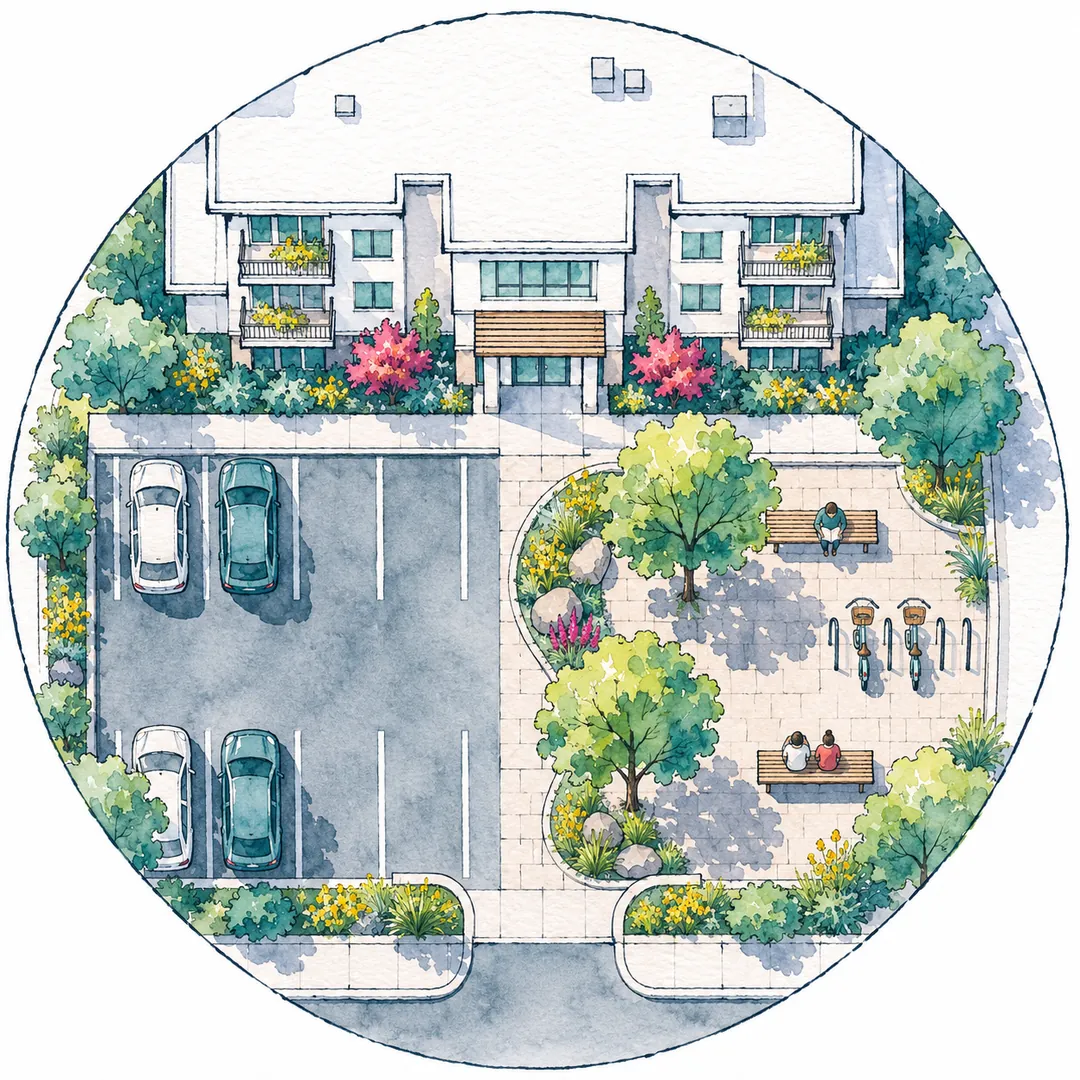
Since June 30, 2025, Colorado’s HB24-1304 has barred cities and counties in the state’s metropolitan planning areas from requiring minimum parking for new multifamily housing, and for qualifying adaptive reuse, inside the transit service areas mapped by the Department of Local Affairs. Developers can still build as much parking as they want; the city simply cannot require it, except for a one-space-per-unit minimum in narrow cases backed by published findings. With fewer required spaces, a transportation demand management (TDM) plan carries more of a building’s access story. In Denver’s TDM menu, a resident e-bike share counts as one programmatic strategy: useful to residents, small on its own, and strongest next to transit passes and priced parking.
This article explains what the law changed for Colorado parking minimums, how two Front Range cities are applying it, how Denver’s TDM rules work in practice, and what a developer should ask before putting a shared e-bike program into a TDM plan. It describes statutes, rules and agency guidance as of November 2026. It is not legal advice, and local codes and the planning office have the final word on any project.
What HB24-1304 changed for multifamily parking
HB24-1304 took away a local government’s ability to require parking for multifamily and qualifying adaptive reuse projects that sit at least partly inside an Applicable Transit Service Area. It did not ban parking, and it did not touch most other local parking powers.
The Colorado General Assembly’s bill page shows the governor signed HB24-1304, “Minimum Parking Requirements,” on May 10, 2024, and the act took effect August 7, 2024. The prohibition itself started later. The Department of Local Affairs (DOLA) guidance page says that on or after June 30, 2025, subject jurisdictions must not enact or enforce local laws requiring minimum parking in areas wholly or partially within an Applicable Transit Service Area. The ban covers multifamily residential development, adaptive reuse for residential use, and adaptive reuse for mixed use that is at least 50% residential.
Who it applies to
The law covers parts of municipalities and counties inside a metropolitan planning organization (MPO) that fall in a mapped transit service area. DOLA lists 49 subject jurisdictions. Along the northern Front Range that list includes Fort Collins, Loveland, Greeley, Longmont, Boulder and unincorporated Larimer and Weld counties, and to the south it includes Denver, Aurora, Lakewood, Colorado Springs and Pueblo, among others.
DOLA notes that the statute does not define “multifamily,” so local governments may use their own definitions. Its page points to the definition in C.R.S. 38-45-101 (any property with more than one dwelling unit, including condominiums and cooperatives) and to the building-code habit of treating three or more units as multifamily. If your project sits near that line, ask the planning office which definition it uses before you assume the law applies.
What a city can still require
The law is narrower than it may sound. According to DOLA’s summary of C.R.S. 29-35-303(3), a local government in a transit service area can still do several things when a developer chooses to build parking.
| Local parking power | Status inside an Applicable Transit Service Area |
|---|---|
| Require a minimum number of car spaces for covered multifamily projects | Not allowed from June 30, 2025, except the narrow exception below |
| Require accessible spaces under the Americans with Disabilities Act in parking the developer provides | Allowed |
| Require electric vehicle charging spaces under the Colorado Model Electric Ready and Solar Ready Code in parking the developer provides | Allowed |
| Set a maximum number of parking spaces | Allowed |
| Require that provided spaces be priced, not given away free | Allowed |
| Require a contribution to a parking enterprise, permit system or shared parking plan | Allowed |
| Adopt or enforce minimum bicycle parking requirements | Allowed |
| Enforce parking conditions tied to affordable housing funding, or agreements signed before July 1, 2025 | Allowed |
Two rows matter most for an e-bike program. Cities can still set bicycle parking minimums, so a shared e-bike station does not automatically replace required bike racks or a secure bike room. And cities can require that voluntary parking be priced, which changes how residents weigh a car against other options.
The one-space-per-unit exception
A subject jurisdiction can still impose a minimum of up to one space per dwelling unit on a specific project, but only for projects with 20 or more units or for regulated affordable housing. DOLA describes the conditions. Within 90 days after receiving a completed application, the local government must publish findings supported by substantial evidence of a substantial negative impact on safe pedestrian, bicycle or emergency access, or on existing parking within one-eighth mile.
The findings must include parking utilization data from within one-eighth mile, be reviewed and approved by a professional engineer, and show that managing on-street parking demand in that area would not fix the problem. A jurisdiction that uses the exception must report it to DOLA by December 31 of the year it was used, with the first reports due December 31, 2026. In practice, a developer in a covered area should expect the default answer to be “no minimum,” and should treat an exception as something the city has to earn on the record within 90 days.
How to tell whether a site is in a transit service area
The legal test is DOLA’s official Applicable Transit Service Areas map, not a rule of thumb. Check the map, then check how your city has written the map into its code.
The City of Colorado Springs, on its page about the code change, describes the map as based on a one-quarter mile radius of transit stops with service every 30 minutes or better. That is a useful mental picture, but service changes, and the map reflects the transit plans and stops DOLA used. DOLA publishes the map, its methodology and a data spreadsheet, and it also offers a multi-law applicability map that shows which state land use and housing laws apply where.
Use these steps for a candidate site:
- Find the parcel on DOLA’s Applicable Transit Service Areas map. Note whether any part of the parcel falls inside the mapped area, because “partially within” is enough.
- Confirm that the city or county is on DOLA’s list of 49 subject jurisdictions.
- Confirm that the project type is covered: multifamily residential, residential adaptive reuse, or mixed-use adaptive reuse that is at least 50% residential.
- Read the local code’s parking section. DOLA’s guidance suggests writing the exemption into an applicability statement or a parking table, so look there first.
- Ask the planning office whether it has used, or plans to use, the one-space-per-unit exception in your area.
- Note what the city still requires: bicycle parking, accessible spaces, electric vehicle readiness and any parking maximum.
Write the answers down with the date you checked. Maps and codes change, and a site plan review can take long enough for both to move.
How Front Range cities are putting it into practice
Cities have taken two broad paths: carve out exactly the area the law requires, or go further and drop parking minimums everywhere. Colorado Springs is an example of the first path and Denver of the second.
Colorado Springs: a new exempt area that matches the map
Colorado Springs explains on its page that its Unified Development Code required minimum parking for multifamily development everywhere except three exempt areas. The city proposed a fourth parking exempt area, defined as the Transit Service Area as mapped by DOLA, so that certain multifamily projects at least partly inside it are not required to provide parking. If a developer provides parking voluntarily, those spaces must still meet the code’s design standards.
The page is candid about the limits of local choice. The city notes that although it is a home rule city, the General Assembly declared minimum parking a matter of mixed statewide and local concern, and that no public meetings were held because the law leaves little room to change the requirement. When we checked in November 2026, the page still listed the City Council hearing date as to be determined, so confirm the code’s current status with the city.
Denver: minimums removed citywide, TDM kept
Denver went beyond the state law. The city’s Modernizing Parking Requirements page says that starting August 11, 2025, new buildings and changes to existing buildings no longer have to include a minimum number of car parking spaces, anywhere in the city. Before the change, the page notes, market-rate apartments required one space per dwelling unit.
Some rules remain. Denver keeps limits on how much parking can be built within one-quarter mile of rail stations, design rules for parking areas, and accessible spaces whenever parking is provided. The same page says “Transportation Demand Management (TDM) rules still apply” and that the city is updating those requirements alongside the parking change. Denver’s page also lists Longmont among nearly 90 U.S. cities that removed minimum parking ratios.
Why fewer required spaces shift weight to TDM
When the code stops setting a parking number, the developer, the lender and the market set it instead, and the building needs another way to show how residents will get around. That is the job of transportation demand management.
The Colorado Department of Transportation defines TDM as the discipline of encouraging and facilitating traveler behavior that makes more efficient use of the transportation network. In plain terms, it means giving residents real choices about how, when and whether they travel: transit passes, bike parking, shared bikes and cars, information, and parking that costs what it costs.
The state’s case for the law rests on unused parking. DOLA cites a study of multifamily housing near Regional Transportation District (RTD) stations, Residential Parking in Station Areas: A Study of Metro Denver. It found that about 40% of parking spaces for market-rate housing and about 50% for income-restricted housing were unused by residents at peak times. Spaces that sit empty still cost money to build, light, plow and insure.
Parking is still a business decision
Denver’s own page makes the point that removing a minimum does not remove parking. It says lenders typically decide how many spaces a project needs to be financially viable, and that a space in a structured garage can add as much as $50,000 to the cost of a dwelling unit. So the real question for a developer is not “how few spaces can we build” but “what mix of parking and other access will lease, finance and satisfy the city.”
You can put numbers on that trade with the parking cost calculator. With its example defaults ($25,000 to build a space, $600 a year to run it, 6% financing over 30 years), one space costs about $2,416 a year, or $201 a month. For example, if you enter Denver’s $50,000 structured-space figure instead, keeping the other defaults, the cost rises to about $4,232 a year, or $353 a month per space. Those are planning figures from the tool’s formula, not market prices.
TDM does not require a train station
The state’s December 2024 report on parking management, prepared by the Colorado Energy Office with DOLA and CDOT under HB24-1304 and linked from DOLA’s page, notes that although the law applies to transit-served areas, TDM does not require transit service. Bike libraries, ride sharing, wayfinding and similar measures can support travel without a private car anywhere. The same report pairs unbundled parking, which prices a space separately from rent, with complementary investments such as bike share and car share.
That matters for properties outside a mapped area. A building in a suburban part of the Front Range may still have parking minimums, but its city may accept TDM measures in a parking reduction request, or the owner may simply want fewer cars and lower costs. Either way, the same menu of measures applies.
How Denver’s TDM rules work
Denver requires most new development to file a TDM plan, sorted into tiers by size, and then to keep the chosen strategies running and report on them every year. Its rules are a useful model even if your project is elsewhere.
Denver’s TDM program page says the TDM regulation has been in effect since June 1, 2021, and that applicants submit a TDM Plan Compliance Spreadsheet before their site development plan. The state’s December 2024 report describes Denver as the first Colorado city to require most new development to comply with and routinely report on TDM measures.
Tiers by number of homes
The Rules and Regulations Governing Transportation Demand Management set residential tiers by dwelling units.
| Tier | Residential size | What the rules require |
|---|---|---|
| Tier 0 | Fewer than 25 dwelling units | Exempt, with limited exceptions such as projects in Large Development Review |
| Tier 1 | 25 to 49 dwelling units | A TDM plan using supportive infrastructure (physical measures) to reach the maximum drive-alone rate; a designated TDM contact |
| Tier 2 | 50 or more dwelling units | A TDM plan using both infrastructure and programmatic strategies; must keep to the maximum drive-alone rate; a designated TDM contact; a biennial tenant survey |
Base and maximum drive-alone rates
The rules work in single-occupant vehicle (SOV) rates: the share of commute trips made by someone driving alone. Each project starts from a base rate set by its Blueprint Denver neighborhood context and by whether it is in a high-frequency transit area, then must reach a lower maximum rate. For example, the rules list a residential base rate of 70% in the Urban context outside a high-frequency transit area, with a Tier 2 maximum of 64%. The strategies a developer picks must add up to that gap.
The rules define a high-frequency transit area as within a one-quarter mile walkshed of a bus stop or a one-half mile walkshed of a rail platform, with service every 15 minutes or better in both weekday peaks and service seven days a week. Note the difference from the state law’s mapped areas: Denver’s TDM rules use their own transit test.
Obligations that last after opening
Several provisions in the rules shape what kind of program a developer can commit to:
- Infrastructure measures must be built before occupancy, and the city will not issue a certificate of occupancy until they are.
- Programmatic strategies must be available within six months of the certificate of occupancy, with evidence such as contracts, invoices or memoranda of understanding.
- Strategies must be “permanently maintained once implemented, unless a replacement strategy has been approved” by the city’s transportation department.
- Strategies in an approved plan may not be excluded from any tenants.
- Approved plans bind successors and assigns, so a sale does not end the obligation.
- Tier 1 and 2 properties file an annual report that includes the tenant participation rate where applicable, and must post the approved strategies in a public area in English and Spanish.
Tier 2 properties that miss their maximum rate in the biennial survey move through a stepped enforcement process: a review meeting, then added programmatic strategies, then another review, and only after a fourth failure are trips over the maximum treated as violations. The rules also say enforcement of the survey results does not start until four properties in the same context are reporting.
Where a shared e-bike program sits on Denver’s TDM menu
Denver’s menu lists “Provide bicycle, e-bike, or micromobility share” as a programmatic strategy worth a 1.0 reduction, the same value as a shared mobility subsidy, car share access or an information screen. Transit pass subsidies and parking pricing carry far more weight.
The TDM Strategy Menu, marked last updated June 1, 2021, assigns each strategy a reduction value, and the rules say the sum of the chosen reductions must bring the base rate down to the maximum rate. The chart below shows the values for strategies the menu marks as applicable to residential projects.
What the two shared mobility strategies ask for
Denver’s detailed strategy guidance describes the e-bike share strategy in one line. It is a “bike, e-bike, scooter or similar share/loaner program (separate from the publicly accessible options in the City) to provide employees and residents with short-term access for trips.” It can run on a low-tech check-out system or a technology-enabled system with automated check-outs. In other words, a station on the property, used by residents, fits the description; the city’s public scooter program does not count as your strategy.
The second strategy, “Subsidize shared mobility (e-bikes, e-scooters),” asks the property to provide at least $30 a month for tenants to use on publicly accessible shared mobility options. A building near a public bike or scooter network could choose this one instead, or both. The flexible sustainable transportation incentive fund, worth 5.0, can also pay for e-bike purchase or maintenance and incentives to use shared bikes, among other uses.
Reading the math honestly
The chart makes one point plainly: an on-site e-bike share will rarely carry a TDM plan by itself. A 100% transit pass subsidy is worth ten times as much on the menu, and unbundled parking four times as much. A shared e-bike program earns its place in a plan because residents use it for the trips between transit, errands and work, and because it supports the higher-value strategies, not because of its points.
How it works with the larger strategies
Think of the e-bike share as the piece that makes the bigger strategies easier to live with. Each pairing below is a design idea, not a menu rule, so check how your city scores combinations.
- With transit passes. A pass is only useful if the stop is reachable. A shared bike turns a long walk to a frequent route into a short ride, which matters most where stops are far apart.
- With unbundled parking or parking fees. When residents pay for a space separately, some households will try living with one car or none. They then need something for the trips transit does not serve well: a late shift, a hardware store run, a child’s practice across town.
- With new resident kits. Denver’s guidance for the kits strategy suggests including micromobility credits where the service area has them. A kit that includes sign-up instructions for the building’s own e-bike station gives residents a reason to try it in their first week, when habits are still forming.
- With information screens. A lobby screen that shows bus arrivals can also show how many bikes are docked at the station, so residents choose between the two before they walk out the door.
Example (fictional). Juniper Yards is a fictional 120-home building planned in Denver’s Urban context, outside a high-frequency transit area. With 120 units it falls in Tier 2, so it starts from a 70% residential base rate and must reach 64%, a gap of 6 points, and its plan must include at least one infrastructure measure. For this example, assume the city treats its planned parking as not overparked, so no extra reduction applies. One combination that reaches 6: unbundled parking (4.0), an on-site e-bike share (1.0) and an information screen in the lobby (1.0). Another: transit passes subsidized at least 50% (5.0) plus the information screen (1.0), with the e-bike share added as a seventh point of margin. The developer picks the second, because the transit pass strategy does most of the work and the e-bike share gives residents a way to reach the bus stop and the grocery store.
What a shared e-bike program has to prove in a TDM plan
A TDM plan turns an amenity into an obligation. Before you list a shared e-bike program, make sure you can show the city that it exists, that tenants can use it, and that it will keep running or be replaced with an approved strategy.
Denver’s rules spell out the evidence. Within six months of the certificate of occupancy, the owner submits documentation that “clearly shows the property is contractually and/or monetarily obligated to offer a particular strategy” to all tenants, such as contracts or invoices that state the service and its timeframe. The annual report then asks for verification that programmatic strategies continue, plus the tenant participation rate where applicable.
Obligations mapped to program terms
The table pairs each TDM obligation with what to ask any operator, including Colibrino, to put in writing before you list the program in a plan.
| TDM obligation (Denver rules) | What to get in writing from the program operator |
|---|---|
| Programmatic strategy available within six months of occupancy | A launch date tied to the certificate of occupancy, and a pilot or phased start if lease-up is slow |
| Proof of a contractual or monetary obligation | A signed agreement naming the service, the number of bikes and bays, and the term |
| Strategy not excluded from any tenant | Who may ride (all residents, minimum age) and whether a member rate is allowed under your plan |
| Annual verification and tenant participation rate | A monthly report with trips, active riders and bike availability, and a data export you can keep |
| Permanent maintenance unless a replacement is approved | Written end-of-program terms, with enough notice to get a replacement strategy approved |
| Plans bind successors and assigns | Assignment terms if the building is sold |
Ask the city one question early: does a resident e-bike share that charges a member rate still count, or must the program be free to tenants? The strategy text does not say, and the answer changes your operating budget.
Seasons and wind count too
On the Front Range, a TDM program also has to survive winter. Whether a seasonal program counts is the city’s call, and the annual report and any tenant survey will reflect the months it actually ran. Ask for a written winter plan: either a full-year program with a reduced winter fleet, or a riding season with winter storage and a spring relaunch. Colibrino writes one into every network plan, and station planning covers how a site’s wind and snow shape where a station goes.
Funding the program beyond lease-up
Programmatic strategies cost money every year, and the state’s December 2024 report notes that Colorado jurisdictions handle that differently. Denver monitors compliance; the report says Boulder requires developers to set aside funding in a short-term escrow account, and that the Colorado Housing and Finance Authority expects tax credit applicants to show two years of TDM programming in operating expenses. Budget the program in the operating pro forma, not just the amenity package at opening.
The same report describes The Quayle, a 102-unit affordable housing property in Denver’s Baker neighborhood, with secure parking for about 100 bicycles, a bike repair room and only 30 car spaces, unbundled at $150 a month. The report says the developer later added shared e-scooters, e-bikes, a tricycle and a vehicle for residents. It is one published example of a building where shared vehicles sit inside a broader access plan rather than standing alone.
Sizing a resident e-bike program for a building with less parking
Size the program from the people who live there, not from the parking you did not build. A rough count of adult residents, a sign-up assumption and a rides-per-member figure give you a starting fleet you can test for a season.
The fleet size calculator does this with a simple chain: members times rides per member gives weekly rides; the busiest day is 1.4 times an average day; each bike serves two rides on that day; and you add 10% spare bays. Its defaults describe the fictional Larkspur Commons, a 240-home community with about 450 adult residents: a 12% sign-up assumption gives 54 members, 135 rides a week, 14 bikes and 2 stations of 8 bays.
Example (fictional). Juniper Yards, the fictional 120-home building from the TDM example, expects about 180 adult residents. The calculator’s other defaults stay the same: 12% sign-up, 2.5 rides per member per week, a busiest day 1.4 times average, 2 rides per bike on that day and 10% extra bays. That gives 22 members, 55 rides a week, about 8 rides on an average day and 11 on the busiest day. The calculator returns 6 bikes, 7 charging bays and 1 station of 8 bays. On the drawings, that is one paved pad by the lobby door, a dedicated circuit and a light, and the developer keeps any required bike parking separate, because a city can still set bicycle parking minimums.
Space, power and the station’s footprint
A compact station for six to eight bikes fits along a wall or path, but it needs things a parking stall does not. It needs a level pad that drains, a circuit an electrician has confirmed, lighting and a clear accessible route past it. The property developers page covers what to put on the drawings, and the station power calculator checks a circuit’s planning limit.
Keep batteries out of the building
A shared fleet that charges in its own outdoor bays keeps those batteries out of units, corridors and bike rooms. Residents’ own e-bikes are a separate question for the building’s rules and the fire marshal. The apartment communities page and our article on what residents expect from an e-bike share amenity cover the amenity side; this article stays with parking and TDM.
Questions to settle with the planning office first
Most surprises in a TDM plan come from assumptions nobody checked. A short meeting or email with the planning office and the city’s TDM staff before you finalize the site plan avoids most of them.
- Is the site covered by HB24-1304? Confirm the parcel on DOLA’s map, the project type and the local code’s applicability statement.
- Will the city seek the one-space-per-unit exception? Ask early, because the 90-day findings clock starts with a completed application.
- What does the city still require? Bicycle parking minimums, accessible spaces, electric vehicle readiness, and any parking maximum near rail.
- Which TDM rules apply, and in which version? Denver said it is updating its TDM requirements with the parking change; get the current spreadsheet and menu.
- How is “overparked” measured now? Denver’s 2021 rules lower the maximum drive-alone rate when a project provides parking above the code minimum, and let the city choose an analogous minimum where none applies. With minimums gone, ask how this works for your project.
- Does a resident e-bike share count, and in what form? Ask whether a member rate is acceptable, whether a seasonal program qualifies, and what evidence the city wants at six months.
- What happens if a strategy ends? Ask how long a replacement approval takes, and build that notice period into any program agreement.
- Who is the TDM contact after opening? Name the role, not just the person, because property managers change.
If your project is outside Denver, the same questions still apply. The state report notes that Denver is the only Colorado community it found monitoring TDM compliance, but other cities may accept TDM measures in a parking reduction, a planned unit development or a development agreement.
Common mistakes when shared e-bikes go into a parking plan
The most common mistakes come from treating an e-bike program as a parking credit instead of a service residents have to want and the owner has to keep funding.
- Counting the station as bike parking. Shared bays are not a substitute for required bicycle parking unless the city says so in writing.
- Promising a parking reduction the code does not offer. Inside a covered transit service area there is no minimum to reduce; outside one, any reduction is the city’s decision.
- Choosing strategies for points alone. A 1.0 strategy residents ignore still has to be maintained, reported and replaced if it stops.
- Forgetting winter. A Front Range program needs a written plan for cold, snow and wind, or the annual numbers will tell the story for you.
- Leaving the end of the program unwritten. Denver’s rules require approved replacements; a contract without exit terms makes that hard.
- Ignoring first and last mile. A shared bike is most useful between the building and transit, shops and work. Our article on bike share for the first and last mile to transit covers that connection.
What to do next
Start with the site, then the code, then the program. A developer who knows whether a parcel is covered, what the city still requires and which TDM strategies will carry the plan can decide where a shared e-bike program helps and where it is only decoration.
A practical order of work:
- Check the parcel on DOLA’s Applicable Transit Service Areas map and record the date.
- Price the parking you are considering with the parking cost calculator, using your own build cost.
- Draft a TDM strategy mix that reaches the required rate without relying on any single 1.0 strategy.
- Size a resident e-bike program with the fleet size calculator and mark the station pad, circuit and light on the drawings.
- Get the program’s launch date, reporting, winter plan and end-of-program terms in writing before the TDM plan is filed.
Colibrino plans, installs and runs small e-bike stations for apartment communities and new developments, from a site walk to a written network plan with station locations, power, rider rules and a winter plan. If you are weighing a station as part of a Front Range project, the residential mobility section has related articles, and you can plan a station with us during design.