
E-bike stations for HOAs and planned communities
An HOA board answers to every member, so a station has to fit the covenants, the paths and the people who use them, from retirees to teenagers. Colibrino plans it with the board and runs it for the association.
For: HOA boards, community managers and planned community developers
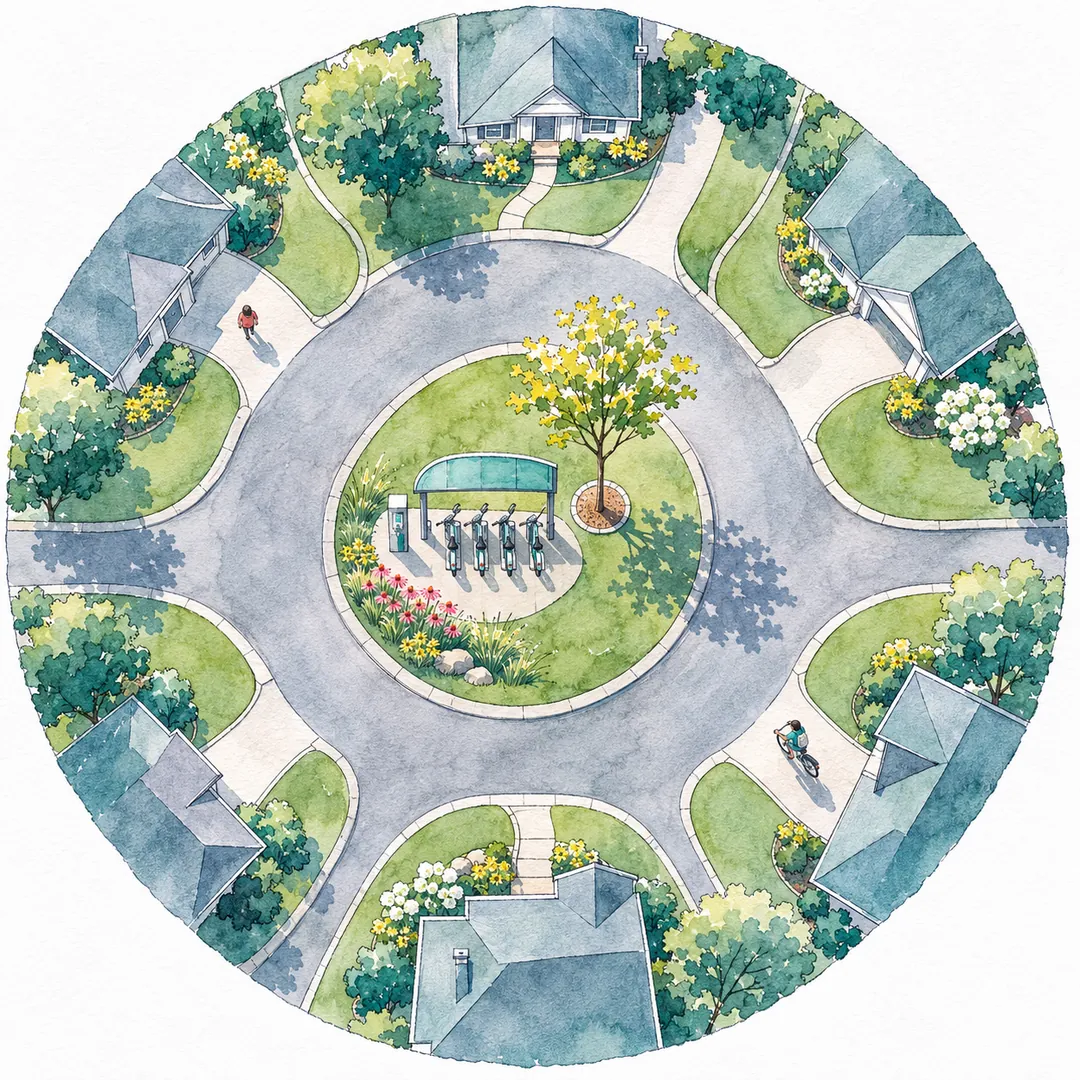
In a planned community, the common ground belongs to everyone, and so does the decision to put something on it. A board weighs what members will actually use, what it costs the association, who is responsible when something goes wrong, and whether it fits the covenants. Colibrino plans a station with the board, places it on common ground members already pass (a clubhouse, a pool, a mail kiosk, a trailhead) and runs it as an amenity for members.
Colibrino supplies the bikes and the station, keeps every bike charged, inspected and repaired, signs riders up and answers them, and sends the board a monthly ride report it can share with members.
What a board weighs
Covenants and architectural review
A station is a structure on common area, and your covenants may require the architectural review committee to see it first. The network plan includes a marked site plan and a description of the station (its footprint, locking bays, weather hood, lighting and signage) that a committee can review. Power can come from a clubhouse panel or a common-area meter. A licensed electrician confirms the circuit and does any electrical work.
Paths, speed and who rides
Community paths are shared with walkers, strollers, children on scooters and dogs on leashes. That is one reason Colibrino runs Class 1 pedal-assist bikes only: the motor helps only while the rider pedals and stops helping at 20 mph, and there is no throttle. The board sets the rest: a speed limit on shared paths, places where riding is not allowed, and a minimum rider age.
The law sets the outer limits. Wyoming defines three classes of e-bike in W.S. 31-1-101, lets local authorities regulate the operation of bicycles and e-bikes and require their registration and licensing (W.S. 31-5-109), and lets a local authority or state agency regulate e-bikes on trails it controls (W.S. 31-5-707). In Colorado, CDOT says Class 1 and Class 2 e-bikes are generally allowed wherever traditional bicycles are permitted, while Class 3 carries a minimum rider age of 16 and a helmet requirement for riders under 18. Local rules are moving: Cowboy State Daily reported in November 2026, citing WYDOT, 22 e-bike crashes in Wyoming through October 29, 2026, against 10 in all of 2025, and that Rock Springs approved an ordinance requiring helmets for minors on Class 3 e-bikes. A board’s rules add to state and local law; they do not replace it. The network plan checks current local rules for your area, but it is not legal advice. The e-bike classes guide sets out the definitions side by side.
Responsibility and insurance
Boards ask who is responsible if a rider is hurt or a bike is damaged. Riders accept Colibrino’s rider terms at sign-up. The program agreement sets out what each side is responsible for and the insurance each carries. Ask the association’s insurer to review the agreement before the board votes.
Cost and member support
Members pay for common amenities through their assessments, so a board needs a number it can defend. The amenity budget worksheet turns a proposal into a cost per home per month that can sit next to the pool, the clubhouse and the landscaping contract. The monthly ride report then shows members what they are getting: trips, active riders, bike availability, and issues and fixes.
Winter
The network plan places the station out of the snow plow’s path and away from where plowed snow is piled, and every site gets a written winter plan: a full-year program with a reduced winter fleet, or a riding season with winter storage and a spring relaunch. See seasonal operations.
Which program fits
The Resident amenity program fits most associations: the association pays a monthly program fee, and members ride at no charge or at a member rate the board chooses. For a board that would rather try before it commits, a Seasonal pilot runs one station for a fixed term, normally one riding season, and ends with a written review and a recommendation to keep, resize, move or end it, so the board can bring members a record instead of a forecast. Prices are quoted after the site walk and set in the network plan. The programs page compares the options.
What the association provides, and what it receives
| The association provides | The association receives |
|---|---|
| A spot on common ground the association controls | Class 1 pedal-assist bikes and a compact charging station, installed |
| Access to power, confirmed by a licensed electrician | Charging in the station bays, inspections, repairs and rebalancing |
| One named contact, a board member or the community manager | Rider sign-up, access, payments and support |
| Board approval, and architectural review if the covenants require it | Launch materials and a safety session for members |
| Help telling members: the newsletter, the community website, a meeting | A monthly ride report, a CSV export and a season review |
Rules to settle first
- Approval: whether the station needs architectural review or a member vote under your covenants.
- Who may ride: members, tenants of members, guests, and the minimum rider age.
- Paths: the speed limit on shared paths and where riding is not allowed, such as the pool deck or playground.
- Who pays: the association, members at a member rate, or both.
- Station hours and lighting: when the station closes and how it is lit.
- Insurance: the insurer’s review of the program agreement.
The community e-bike rules builder drafts a rule set from your answers, for the board to adapt and check against the covenants, local ordinances and its insurer’s requirements.
Example (fictional). The board of a fictional planned community of single-family homes wants to try shared e-bikes before asking members to fund them for good. The site walk finds a spot beside the clubhouse, lit and visible from the office, with power from the clubhouse panel. A second spot at the trailhead has no power nearby and is set aside. The network plan proposes a seasonal pilot: one station at the clubhouse for one riding season, a minimum rider age of 16 and a 10 mph limit on shared paths set by the board, and winter storage with a spring relaunch. At the end of the season, the written review recommends whether to keep, resize, move or end the station, and the board decides with the monthly ride reports in hand.
The residential mobility section of our journal covers planned communities, amenities and rules in more depth. To begin, plan a station and we will walk the common ground with your board.
Start with one station.
Tell us about the place: how many homes or beds, where people come and go, and where the nearest outlet is. We reply with questions or a time to walk the site with you.